Last updated: September 2026
This guide is part of our full map of wedge pillows for acid reflux, GERD, and better sleep.
Most people get used to a wedge pillow in stages, so it depends which stage you mean: about two nights for the strangeness to fade, one to two weeks to fix the setup, and roughly six weeks before judging the elevation itself.
Key takeaways
- Three clocks run at once, and they are easy to confuse. Novelty fades in days, setup problems take a week or two, and any change in symptoms was measured at six weeks.
- The first night is reliably the worst. A meta-analysis of 53 sleep studies found sleep onset latency, wake after sleep onset and light N1 sleep all longer on night one than night two (SLEEP, 2024).
- Early discomfort is common, not a sign you chose wrong. In the largest trial — which raised the bed rather than using a wedge — 39 of 63 people reported mostly minor problems against none in the control group, and 24 of those were the bed slipping rather than the body complaining (BMC Primary Care, 2021).
- Six weeks is where the evidence runs out, not where the discomfort lasts. In the one high-quality crossover trial, the elevation arm was about twice as likely to reach a clinically important improvement by six weeks (risk ratio 2.1, 95% CI 1.2 to 3.6). No trial looked further.
- Stacking pillows to feel comfier works against you — the NHS advises against them as a substitute for raising the head of the bed, because of the abdominal pressure (NHS).
- Memory foam feels firmer cold and softer warm, so the same wedge pillow can feel like a different product in week three (Polyurethane Foam Association).
- If it never takes, that is a tolerance result, not a failure. Of 15 patients who tried both, 5 preferred the wedge, 9 preferred blocks under the bed legs and 1 neither.
How long does it take to get used to a wedge pillow?
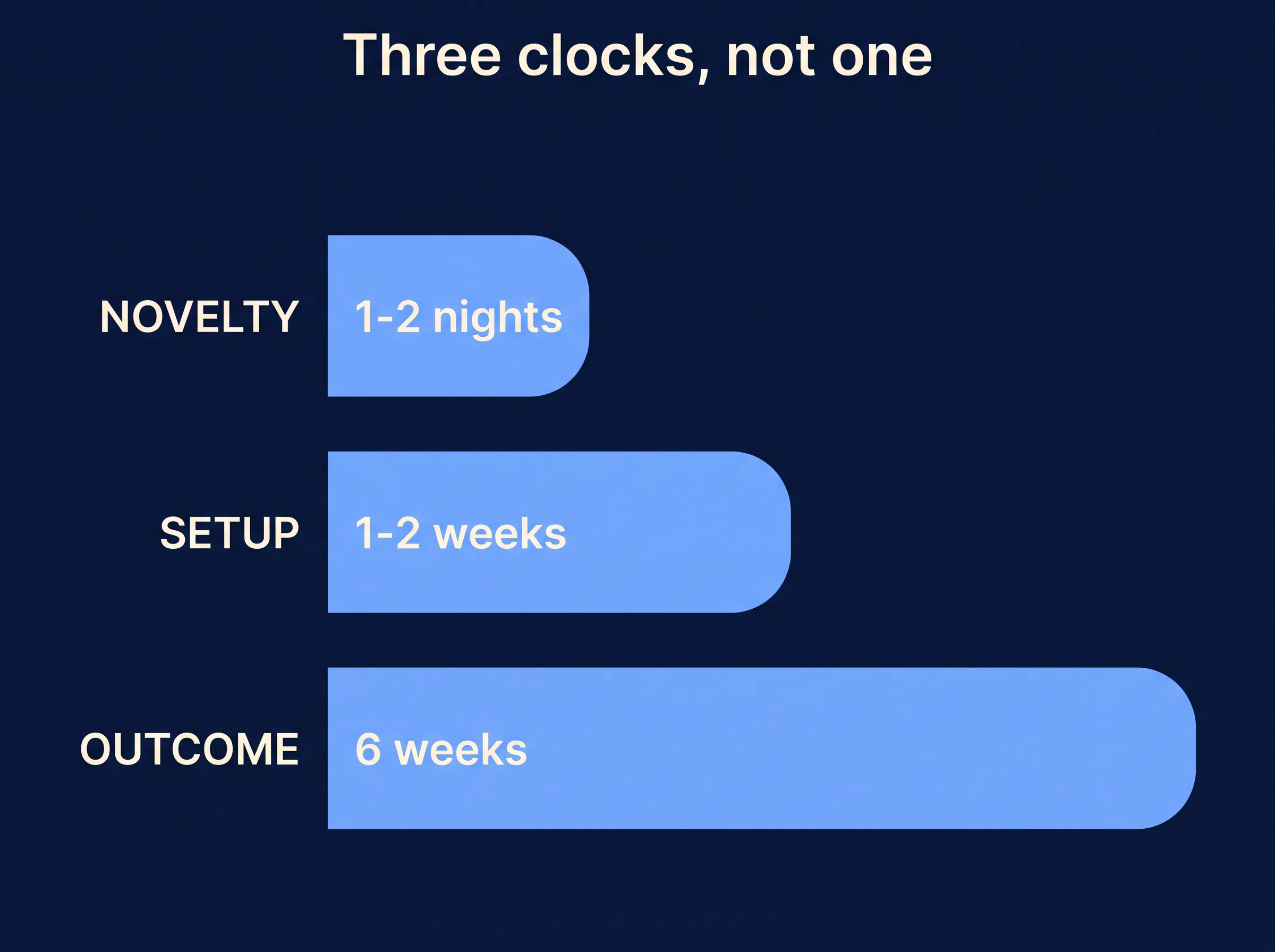
Split the question into three clocks, because they run at different speeds and only the first is measured in nights. Almost every guide online answers with a single figure — “a night or two”, “three to five nights”, “one to two weeks” — and none cites anything. Those numbers answer only the easiest part of the question.
| Clock | How long | What is happening |
|---|---|---|
| Novelty | 1-2 nights | You are reacting to an unfamiliar sleeping position, not to the wedge pillow itself |
| Setup | 1-2 weeks | You find out whether you slide, where your shoulders sit, what goes under your head |
| Outcome | ~6 weeks | The interval at which the research measured a change in reflux symptoms |
So the two-week mark is a decision about your setup, the six-week mark one about elevation. People who quit on night four are reacting to the first clock and reading it as a verdict on the third.
Why is the first night the worst?
Sleep researchers have a name for it, and they budget for it. The first-night effect describes the consistent drop in sleep quality on a first night in unfamiliar conditions. It was first described in 1966, and a meta-analysis of 53 studies by Ding and colleagues in 2022 — summarised in the 2024 paper below — found that against night two, night one had longer sleep onset latency, more wake after sleep onset, more light N1 sleep and longer time to REM, with lower total sleep time and efficiency.
Two details matter here. Sleep labs treat adaptation nights as standard procedure rather than a courtesy: that 2024 paper concludes scheduling them before the real experiment controls first-night impairment effectively. And the effect showed up even in a familiar environment — people recording at home in their own beds — where what was novel was the equipment, not the room. Something new in an otherwise ordinary bed is enough.
This remains an adjacent finding: it was measured for new surroundings and recording gear, not a change in sleeping angle. It supports treating a bad first night as weak evidence about the wedge — not as no evidence at all.
What is normal in the first two weeks, and what isn’t?
Mild aches and fiddling with the setup are expected; sliding flat and sharp pain are problems to solve, not to endure. As the takeaways note, 39 of 63 people in the largest trial’s elevation arm reported something — mostly the bed slipping rather than the body complaining. A majority reporting something is why the honest answer to “is it supposed to feel like this?” is usually yes, for a while.
| What you notice | Reading | What to do |
|---|---|---|
| Strange, hard to drop off | Normal, nights 1-3 | Change nothing yet |
| Mild neck or shoulder stiffness | Common, weeks 1-2 | Adjust what is under your head, not the wedge |
| You wake up flat at 3 a.m. | A design problem | Sliding is about slope and foam, not discipline |
| Lower back ache after a few nights | Fixable setup issue | Check the apex against your shoulders |
| Hip pain as a side sleeper | Often mis-blamed | Can come from the mattress or topper under you |
| Sharp pain, numbness, breathlessness | Not an adjustment symptom | Stop and speak to a doctor |
On that last row: a wedge pillow is positioning hardware, not a treatment. If something feels acutely wrong the answer is not more perseverance — our page on who should be careful with a wedge pillow covers where propped sleeping is the wrong tool.
5 things to change before you give up on a wedge pillow
Work through these in order. Each changes a different variable, so changing them all at once tells you nothing.
- Check where the apex sits. The high point belongs under your shoulders, not your neck. If your chin tucks toward your chest you are folded rather than inclined — position before product. Our height guide maps apex height to what your torso is doing.
- Take the extra pillows off the top. Counter-intuitive, because adding a pillow is what makes night one feel better. The NHS advises against additional pillows instead of raising the head of the bed: a stack bends you at the waist and raises abdominal pressure — the same pressure that pushes stomach contents upward. One thin pillow on a wedge already holding the elevation is a different arrangement, covered on what to put on top of a wedge pillow. Start with nothing, adding a flatter pillow only if your chin lifts away.
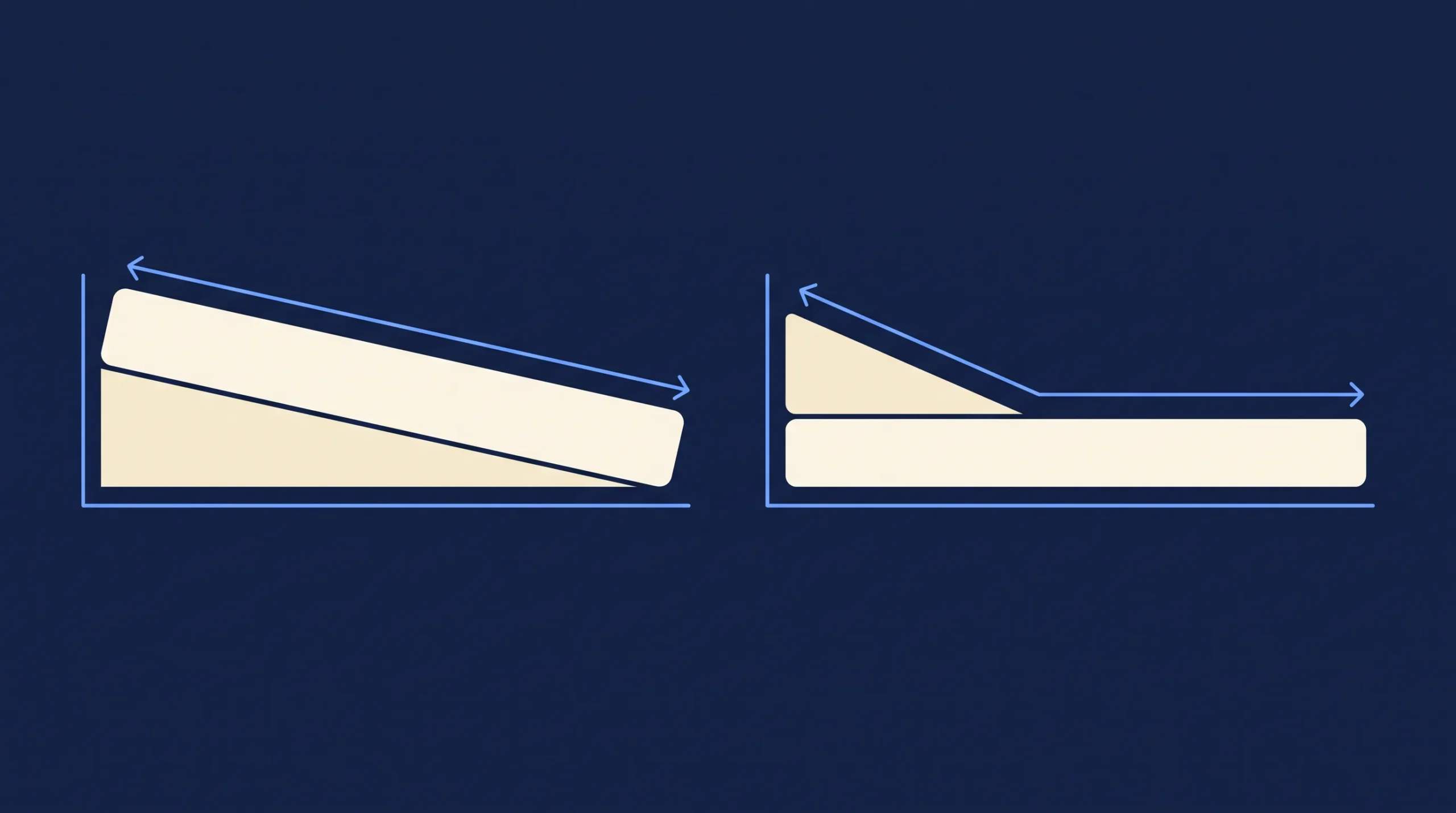
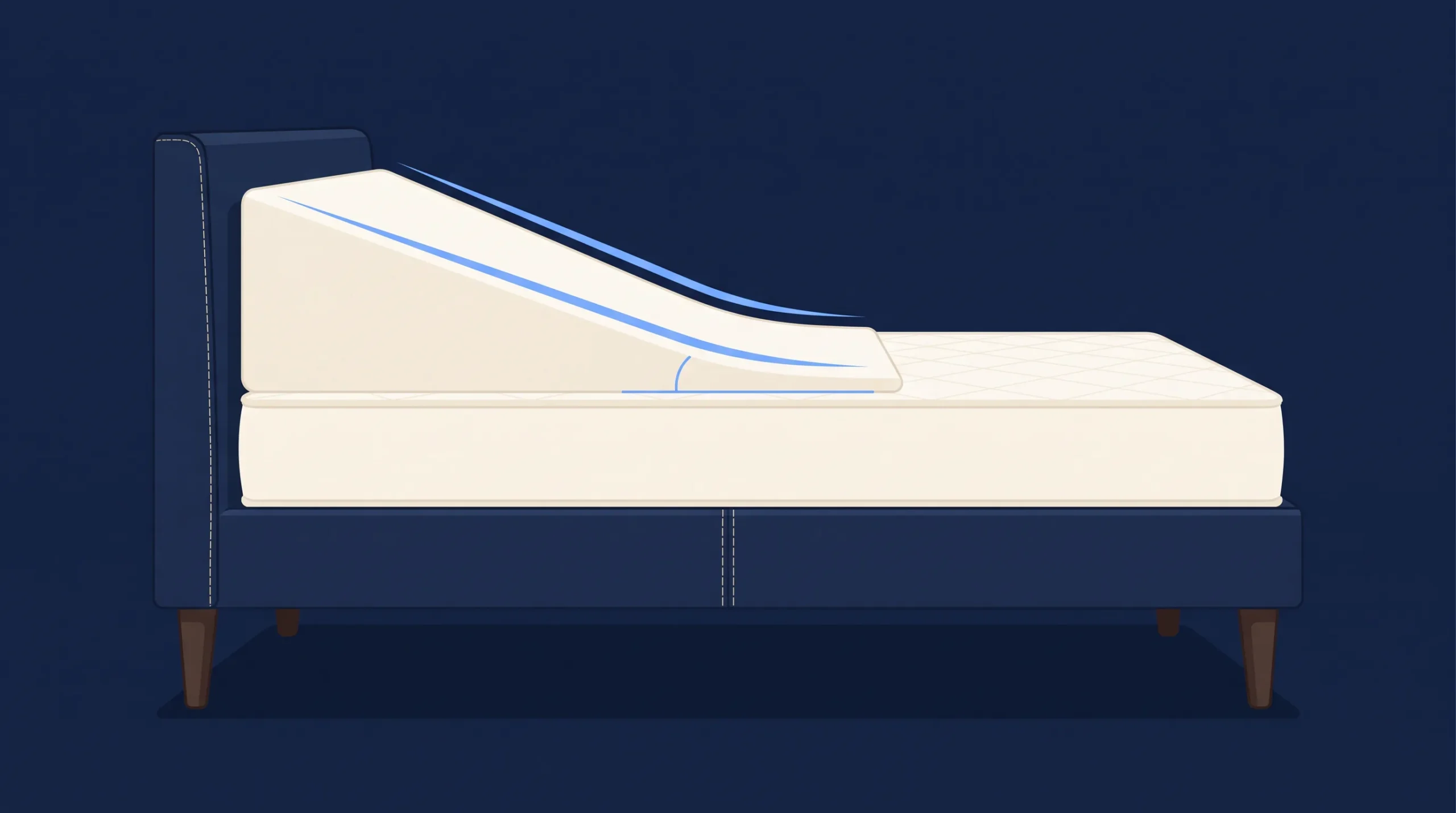
- Treat sliding as a hardware question. If you wake flat you lost the elevation you were testing, and nothing else you observe that fortnight means anything. A steep single ramp has nothing to hold your hips; a transition slope and firmer foam do, as our reflux and GERD guide sets out.
- Look underneath before blaming the wedge. A soft mattress or tired topper lets the base sink unevenly, which surfaces as hip or back ache and gets attributed to the incline. Press the mattress beside the wedge — if it gives, that is a variable in your experiment.
- If you sleep on your side, change the method, not the angle. It works, but it is a different setup, needing attention at the shoulder and knees rather than the head. Our side sleeping guide covers it.
If two weeks of this yields no workable configuration, the problem is the equipment or the approach — a useful result, not a failure.
Why does the wedge pillow feel different in week three?
Because memory foam is temperature-sensitive, so the room and your body heat change how firm it feels. Viscoelastic foam softens with heat and stiffens when cool, and the Polyurethane Foam Association — an industry body — notes the effect is large enough that the standard firmness test may not capture it. How much difference you notice will vary, but it is an argument against judging firmness from one cold night. A wedge that feels steadily less supportive over months is a different matter, covered in how often to replace a wedge pillow.
How long before you can tell whether it actually worked?
Six weeks is the honest answer, because that is where the research ends. The 2021 systematic review in BMC Primary Care covered five controlled trials and 228 patients. All four that reported patient symptoms found improvement in the elevation groups, and in the highest-quality crossover trial people in the elevation arm were about twice as likely to reach a clinically important improvement in reflux symptom scores by six weeks (risk ratio 2.1, 95% CI 1.2 to 3.6).
The review is candid about the limits: five trials, small samples, all at high risk of performance bias, none running past six weeks, and too much variation between them to pool at all. So six weeks is not a claim that adaptation takes that long — it is the outer edge of what anyone has measured. Elevation is a positioning aid to use alongside whatever else you are doing, not a treatment, and the evidence behind it is thin rather than settled.
That thinness cuts both ways. The six weeks is still usually worth running: the intervention is cheap, entirely reversible, carries no drug interactions, and nothing else in the positioning category is better evidenced.
For your own six weeks, change one thing at a time. Alter the angle, the pillow on top and your evening meal in the same fortnight and you will finish without knowing which one mattered.
What if you never get used to it?
Then you are in company, and there is a tested alternative. In the trial that put the same 15 patients on both a wedge and blocks under the bed legs, 9 preferred the blocks, 5 the wedge and 1 neither. The 2021 review also notes that across its trials the bed-blocks arms showed statistically significant reductions in acid exposure and reflux episodes against control, while the wedge arm did not reach significance. Read that carefully: in trials this small, failing to reach significance is what an underpowered study looks like, not a demonstration that wedges do nothing. What it does mean is that raising the bed is a real option rather than a consolation prize.
So “I could not get used to a wedge” is a tolerance result, not a verdict on sleeping at an incline. The routes onward: raising the bed with risers, a wedge under the mattress instead of on top, or an adjustable bed. Rule out one first — improvising with a pile of pillows tends to come apart overnight, for reasons in stacked pillows versus a wedge pillow.
Methodology: this guide draws on published research into head-of-the-bed elevation and sleep adaptation, NHS self-help guidance, and the production specs supplied by the makers of the wedge pillows named.
Frequently asked questions
Is it normal to sleep badly the first night on a wedge pillow?
Yes. A meta-analysis of 53 sleep studies found night one consistently worse than night two on sleep onset latency, wake after sleep onset and sleep efficiency, even in a familiar bedroom. A poor first night tells you little about whether the wedge pillow suits you.
How many nights should I give a wedge pillow before deciding?
Two or three nights before changing anything, then two weeks to work through the setup: apex position, what goes on top, sliding, and the mattress underneath. Judgements about whether the elevation changed anything belong at around six weeks, the interval the research used.
Should I start at a lower angle and build up?
Reasonable for comfort, but a lower incline may sit below the elevation the research tested. The NHS describes 10 to 20 cm at the head of the bed and the trials used 20 to 28 cm, so a very shallow start is a comfort step rather than a test of elevation.
Why does my lower back hurt after a few nights on a wedge pillow?
Usually the apex is in the wrong place, so you bend at the waist instead of resting on a slope — or you slide down and finish the night folded. The mattress underneath can also be the cause. Our page on lower back pain and wedge pillows works through it.
Can I keep my normal pillow on top while I get used to it?
You can, though a flatter one is often better and stacking several is counterproductive — the NHS advises against pillows as a substitute for raising the head of the bed, because of the abdominal pressure. Start thin, add only if your chin lifts away.
How long do I wait before trying bed blocks instead?
If two weeks of setup changes have not produced a configuration you can sleep in, that is a reasonable point to raise the bed itself. In the trial that tested both on the same 15 patients, 9 preferred the blocks against 5 for the wedge, so switching method is well-trodden rather than giving up.
Choosing a wedge pillow you are more likely to stick with
Most of the five steps above are things you adjust. Two are not: sliding down and aching at the waist track the slope and the foam, so what you buy sets how much of the rest you have to work through.
For reference against the research, the trials used wedges and blocks of roughly 20 to 28 cm: the Aeris Wedge Pillow measures 65 × 65 cm with a 22 cm apex, the Flexicomfort Wedge Pillow 60 × 56 cm with a 28 cm apex. If you are choosing rather than troubleshooting, our five-step guide takes the decisions in order.
Advertisement

Aeris Wedge Pillow
65 × 65 cm base, 22 cm apex, 3.1 kg.
See the Aeris Wedge product details on AmazonProducts mentioned in this guide
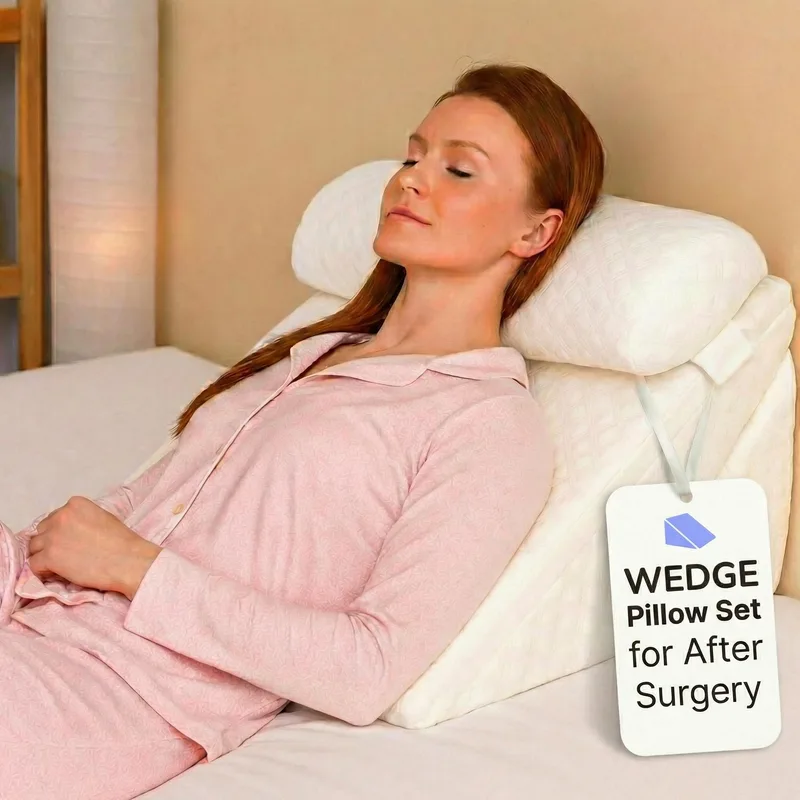 Flexicomfort Wedge Pillow — 60 × 56 cm, 28 cm apex, memory foam, 3.5 kg