Last updated: October 2026
This guide is part of our full map of wedge pillows for acid reflux, GERD, and better sleep.
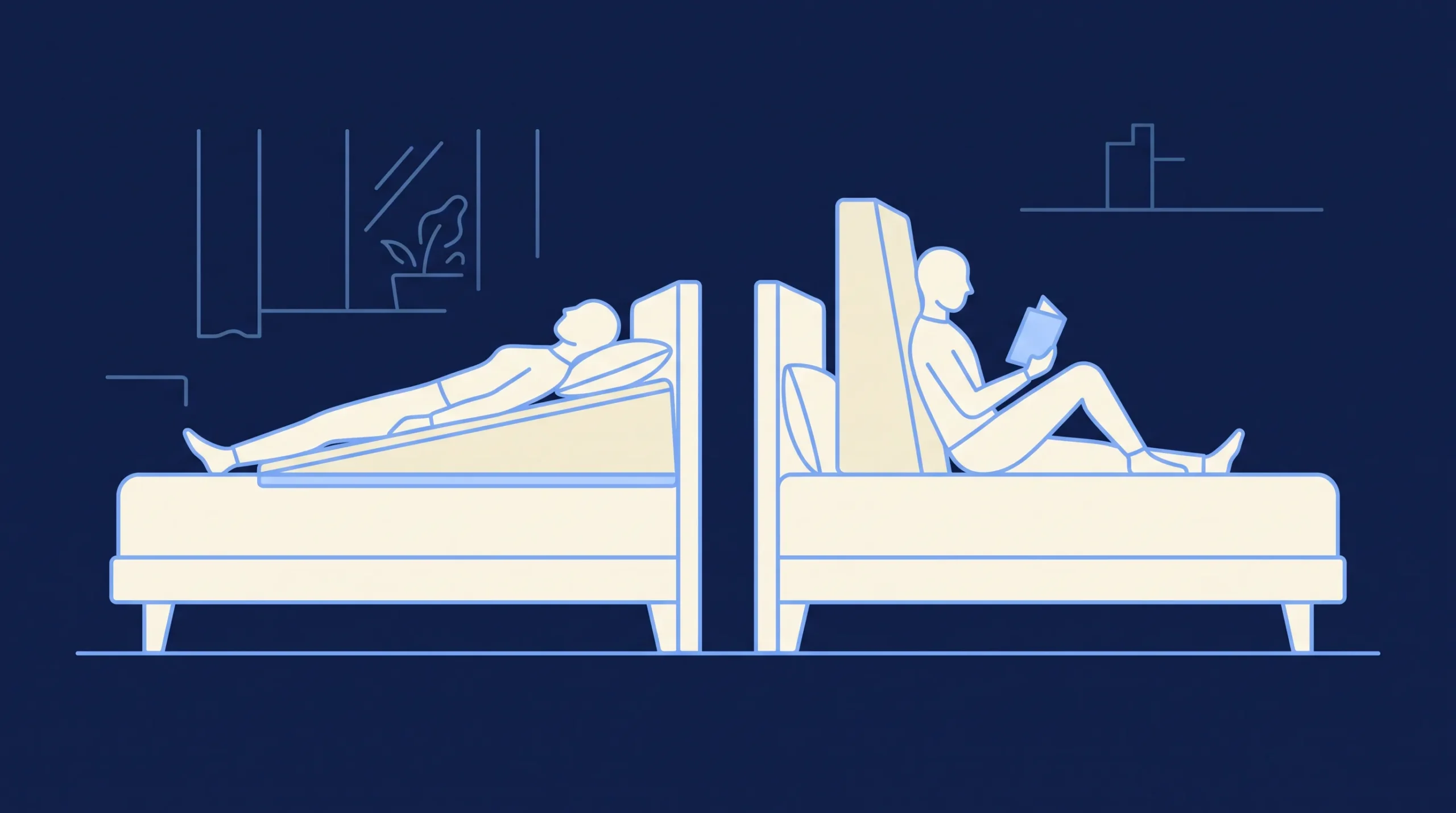
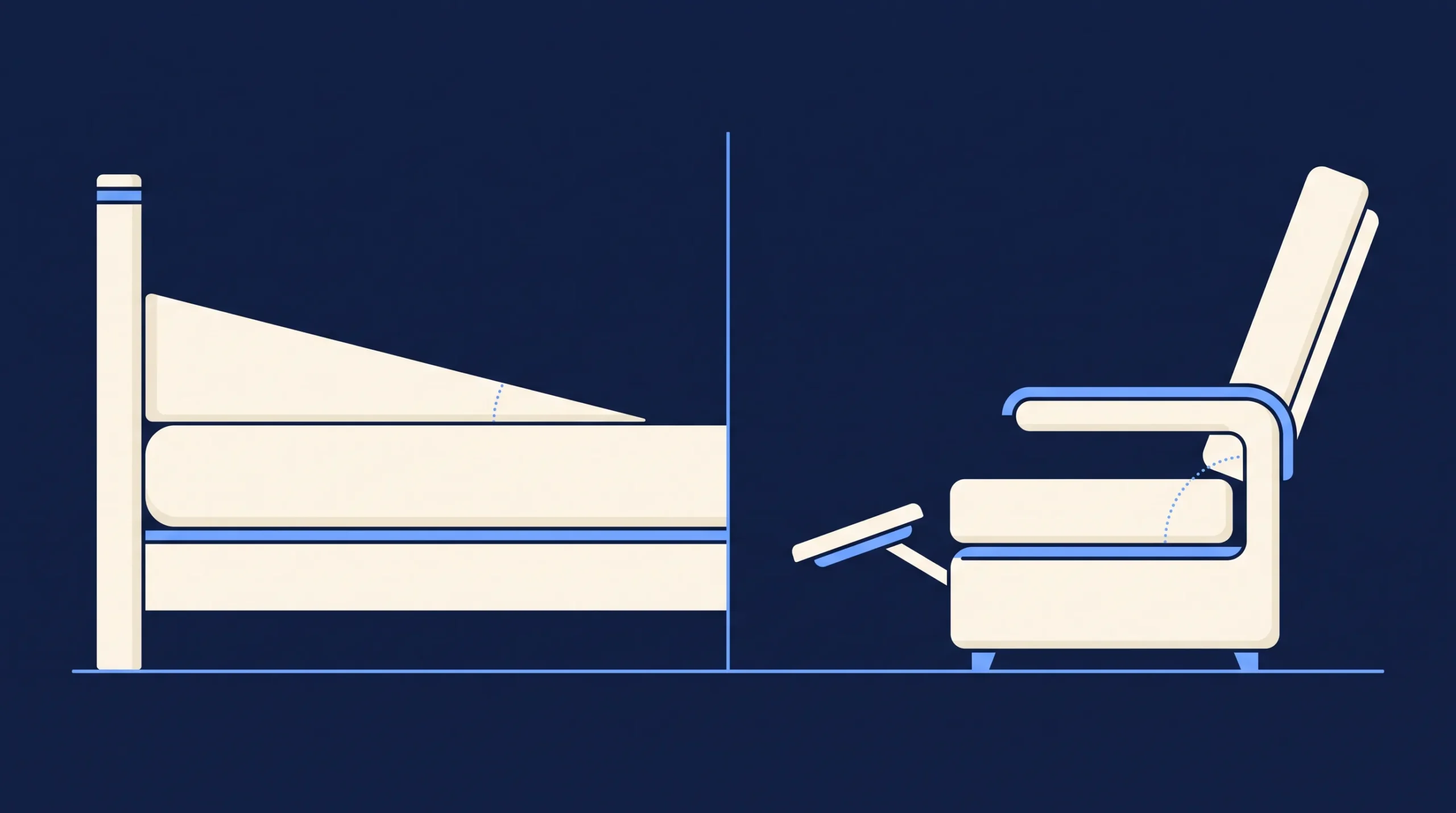
Wedge pillow vs recliner is a choice about anchoring: a recliner holds a steeper angle for you, while a wedge pillow keeps your bed, your side-sleeping position and your half of the mattress. Both raise the torso; only one is furniture.
This guide compares the two on angle, sliding, side sleeping and what the research measured.
Key takeaways
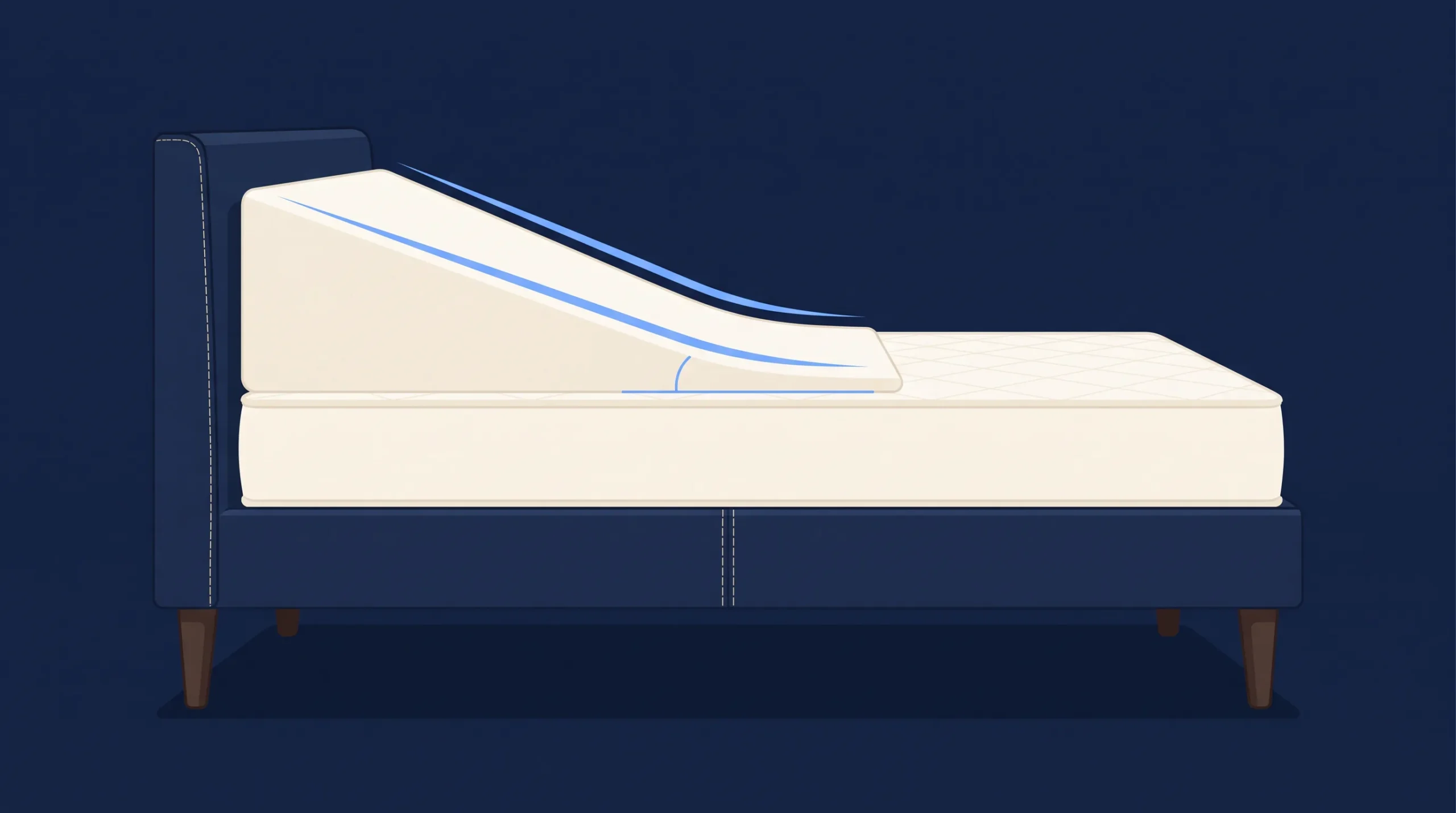
- A recliner’s angle is set by its mechanism and held by the seat, so it rarely collapses; a wedge pillow’s angle is set by its height over its length — 22 cm of lift across a 65 cm ramp is about 19 degrees.
- The elevation research used gentle angles, not chair angles: a 2017 study of 52 sleep-apnea patients used a 7.5 degree tilt and saw the apnea-hypopnea index fall from 15.7 to 10.7 events per hour.
- A recliner’s advantage is partly that its seat holds your hips in place. In the IBELGA randomized crossover trial, where the whole bed was raised 20 cm, 16 of 63 people reported sliding down the bed as a mild adverse event and 4 reported it as a serious one.
- The recliner’s cost is position. In the American College of Gastroenterology’s 2022 guideline, sleeping on the left side is rated “unequivocal” evidence while sleeping with the head elevated is rated “equivocal” — and a chair mostly holds you on your back.
- Seated posture concentrates load. The EPUAP/NPIAP/PPPIA International Guideline asks clinicians to assess “time spent sleeping in a recliner”, because body weight on buttocks and thighs produces high interface pressures at the ischial tuberosities and sacrum.
- In 23 healthy volunteers measured in hospital reclining chairs, neither the upright nor the legs-elevated position brought interface pressures down to what the authors called generally safe levels.
- A wedge pillow is a pillow-sized purchase that stays on your half of a shared bed; a recliner is a furniture purchase that needs floor space of its own.
Does a recliner work better than a wedge pillow for reflux?
Many people report stronger immediate relief from a recliner, and the likeliest reason is angle rather than mechanism. Both approaches rely on the same idea — keeping the torso above the stomach — but a chair reaches a steeper, better-anchored slope than most foam wedges, and holds it because your hips sit in the seat.
The evidence base underneath both is modest. The ACG’s 2022 guideline lists “sleep with head elevated” as equivocal in strength of evidence and equivocal in mechanism, yet still recommends it. The best single trial of raising the bed, IBELGA, randomized patients already on acid-suppressing medication to 20 cm of elevation for six weeks against six weeks flat: 27 of the 39 patients analysed, or 69.2%, reached the primary outcome of at least a 10% drop in their reflux symptom score, and the mean score change was −1.24 with elevation against 0.09 without it.
What no trial has done is compare a chair against a wedge pillow directly. So the honest answer is that a recliner usually gives more angle with less slipping, and that this is a difference in how reliably the position is held, not evidence that chairs treat reflux and wedge pillows do not.
How much angle does each one actually give?
A wedge pillow’s angle is fixed geometry you can calculate; a recliner’s is adjustable but bends you at a set point. Divide a wedge’s apex height by its ramp length and you have its slope: the Aeris wedge pillow lifts 22 cm across a 65 cm base, about 19 degrees, and a taller 28 cm wedge over a 60 cm ramp works out at about 25 degrees.
A recliner has two surfaces hinged together, so its back can sit far steeper than any sleeping wedge while the hip crease stays wherever the seat pan puts it. That fixed crease is why some people find a chair comfortable immediately and others wake with a numb seat: you cannot move the bend to suit your back the way you can slide down a ramp. Our wedge pillow height guide works through the height-and-length arithmetic in inches.
| Wedge pillow | Recliner | |
|---|---|---|
| Typical angle | About 17–25 degrees on a sleeping wedge | Adjustable, usually steeper than a sleeping wedge |
| Where the body bends | Wherever you position yourself on the ramp | At the fixed seat-to-back hinge |
| Holds its angle overnight | Yes, if the foam is firm enough | Yes, held by the mechanism and your own weight |
| Sliding down | The main complaint; reduced by knee support | Largely prevented by the seat |
| Side sleeping | Possible, with the ramp starting below the waist | Limited; most chairs hold you on your back |
| Sharing a bed | Keeps you in the bed | Takes you out of it |
| Pressure distribution | Spread along the back and hips | Concentrated under the buttocks and sacrum |
| Footprint | Stores in a cupboard | Needs floor space of its own |
What does the research say about sleeping sitting up?
The clearest published example is a single case, and it is instructive in both directions. In a 2022 report in Sleep Medicine Research, a 40-year-old man with severe obstructive sleep apnea had a total apnea-hypopnea index of 68.6 events per hour — 84.5 supine, 44.7 in non-supine positions. During the hour he slept in his habitual sitting posture, obstructive events disappeared, and deep and REM sleep occurred only in that hour.
The proposed mechanism is anatomical: moving from supine to sitting gives a greater pharyngeal cross-sectional area and a lower passive closing pressure, because gravity pulls less on the airway and lung volume rises. That mechanism applies to a recliner as much as to a man propped against his headboard.
The same case contains the limit. He slept sitting “two or three times nightly” and lay back down when his buttocks went numb. One hour of better breathing was bought with a posture he could not hold.
Is a wedge pillow enough, or do you need the steeper angle?
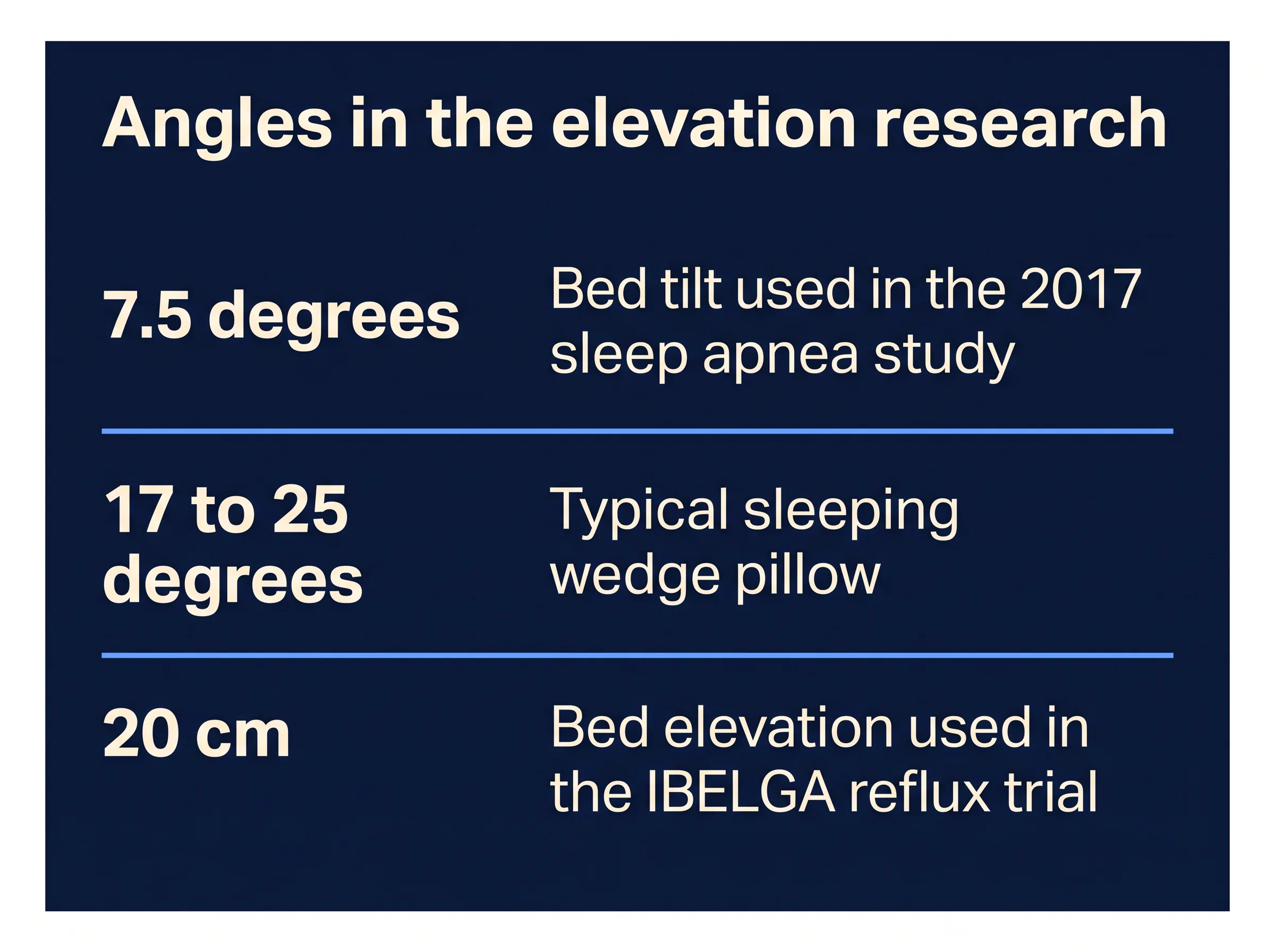
For many people a gentle angle is enough, which is the most useful finding in this comparison. The 2017 Sleep Breath study tilted the whole bed only 7.5 degrees in 52 patients with obstructive sleep apnea; the apnea-hypopnea index fell from 15.7 to 10.7 events per hour, minimum oxygen saturation rose from 83.5% to 87%, and sleep architecture was unchanged. When seven of those patients were measured again without the tilt, their index returned to baseline.
That matters because a sleeping wedge pillow of 17 to 25 degrees already clears that threshold by a wide margin. The argument for a chair is not usually “I need 45 degrees” — it is “my wedge pillow does not stay under me”. That is a different problem with cheaper remedies, covered in our guide to wedge pillows for acid reflux and GERD and in the comparison of stacked pillows against a wedge pillow.
4 things a recliner costs you that a wedge pillow does not
- Side sleeping. Most chairs hold you supine, and the ACG guideline rates left-side sleeping as the one positional measure with unequivocal evidence behind it. Giving that up to gain angle is a real trade. Our guide to side sleeping on a wedge pillow sets out how the ramp has to be arranged.
- Pressure distribution. The International Guideline’s seating chapter describes how seated weight rests on a small surface — buttocks, thighs, feet — producing high interface pressures at the ischial tuberosities and sacrum, with added shear when the pelvis tilts backwards. It explicitly asks clinicians to ask patients about time spent sleeping in a recliner. In the 2014 measurements of 23 healthy volunteers in hospital reclining chairs, average pressure moved only from 42.9 to 40.0 mm Hg when the legs were elevated, and the authors concluded that neither position reached generally safe levels.
- The shared bed. A wedge pillow sits on your half of the mattress. A chair relocates one person to another piece of furniture, often in another room.
- Adjustability over time. A wedge pillow can be swapped for a lower or higher one, or softened with a knee pillow, for the price of a pillow. A chair’s hip crease is where the frame puts it.
Which should you choose for snoring, reflux or recovery?
Match the tool to why you are sitting up, and for how long. For night-time reflux or snoring that you expect to manage for months or years, a wedge pillow keeps you in bed, keeps side sleeping available and is the cheaper experiment. For a few weeks after an operation, when getting in and out of bed is the hard part, a chair earns its place — our post-surgery recovery guide covers that window.
If the real problem is that you cannot tolerate lying down at all, neither piece of furniture is the answer to reach for first. Breathlessness that only eases when you sit up is something to raise with a doctor rather than solve with a purchase, and the same applies to choking at night or a steadily rising number of pillows.
Where a wedge pillow keeps slipping out from under you, the remedy is usually mechanical: a longer ramp that starts below the waist, firmer foam, a thinner head pillow, or support under the knees. Where the whole bed feels wrong instead, the comparison to run is against raising the mattress — see wedge pillow against an adjustable bed and wedge pillow against bed risers.
What about a recliner and a wedge pillow together?
They solve overlapping problems, so most people need one or the other. A chair already supplies angle and anchoring, which is what a wedge pillow is for, and stacking a foam ramp onto a reclined seat tends to push the head forward and steepen the bend at the waist.
The combination that does make sense is sequential: a chair in the evening or the first weeks after surgery, then a wedge pillow in bed for the night. For head support on top of the ramp, our guide to what pillow to put on top of a wedge pillow covers the thickness question.
Angles in this guide are calculated from each maker’s production spec sheet; the research summaries link to the published papers.
Frequently asked questions
Is a wedge pillow or a recliner better for acid reflux?
No trial has compared them directly. A recliner usually gives a steeper angle and holds your hips in the seat, which is why relief can feel more immediate. A wedge pillow gives a gentler angle but keeps you in bed with left-side sleeping available, which the ACG’s 2022 guideline rates as the positional measure with the strongest evidence behind it.
How many degrees does a wedge pillow give compared with a recliner?
Sleeping wedge pillows generally sit between 17 and 25 degrees: 22 cm of apex height over a 65 cm ramp is about 19 degrees. A recliner’s back can be set much steeper, but the bend in your body happens at the fixed seat hinge rather than anywhere you choose. The published elevation studies used 7.5 to about 30 degrees, so a wedge pillow is already inside the researched range.
Is sleeping in a recliner every night bad for you?
It is not a position the pressure-injury guidance treats as neutral. The International Guideline’s seating chapter asks clinicians to assess time spent sleeping in a recliner, because seated weight rests on a small area and raises interface pressures at the sacrum and ischial tuberosities. In 23 healthy volunteers measured in reclining chairs, neither position brought those pressures to levels the authors considered safe. If you sleep in a chair nightly, raise it with a doctor.
Why does a recliner feel better than my wedge pillow?
Usually because of anchoring rather than angle. The seat holds your hips still, so the slope you fall asleep on is the slope you wake on. Sliding down was the most common adverse event in the IBELGA elevation trial, reported by 16 of 63 people as mild and 4 as serious. A longer wedge pillow that starts below the waist, plus support under the knees, targets the same problem.
Can you sleep on your side in a recliner?
Most chairs hold you close to supine, because the back and armrests leave little room to roll. A wedge pillow on a mattress leaves side sleeping open, provided the ramp starts low enough that your shoulder and hip are both supported.
Do I need a wedge pillow if I already have a recliner?
Probably not at the same time, since both do the elevation job and layering them steepens the bend at your waist. The usual sequence is a chair for the evening or the early weeks of a recovery, then a wedge pillow for the night in bed.
Is a recliner better than raising the head of the bed on blocks?
They fail differently. Raising the whole bed keeps you flat on a mattress and preserves side sleeping, but IBELGA found over half its participants had some adverse reaction at 20 cm of tilt, with sliding, leg-vein symptoms and bed instability among them. A chair removes the sliding and introduces seated pressure instead.
Will a wedge pillow help my snoring as much as sleeping propped in a chair?
Possibly, because the useful angles are smaller than people assume. In the 2017 study a 7.5 degree tilt lowered the apnea-hypopnea index from 15.7 to 10.7 events per hour in 52 patients, and a sleeping wedge pillow at 17 to 25 degrees is well above that. Snoring with witnessed pauses in breathing should be assessed by a doctor rather than managed with furniture.
Choosing between the two
If you are managing night-time reflux or snoring for the long run, start with the wedge pillow: it is the reversible, low-cost test, it keeps side sleeping on the table, and the researched angles sit inside what a foam ramp already provides. Keep the chair in mind for recovery weeks, or for the evening, rather than as the permanent bed.
As the maker of the Aeris wedge pillow we can say it rises 22 cm over a 65 cm base, about 19 degrees, with a ramp long enough to start below the shoulder blades. If your problem is specifically that you slide off whatever you try, the longer answer is a steeper set with a headrest or knee support rather than a different chair.
Advertisement
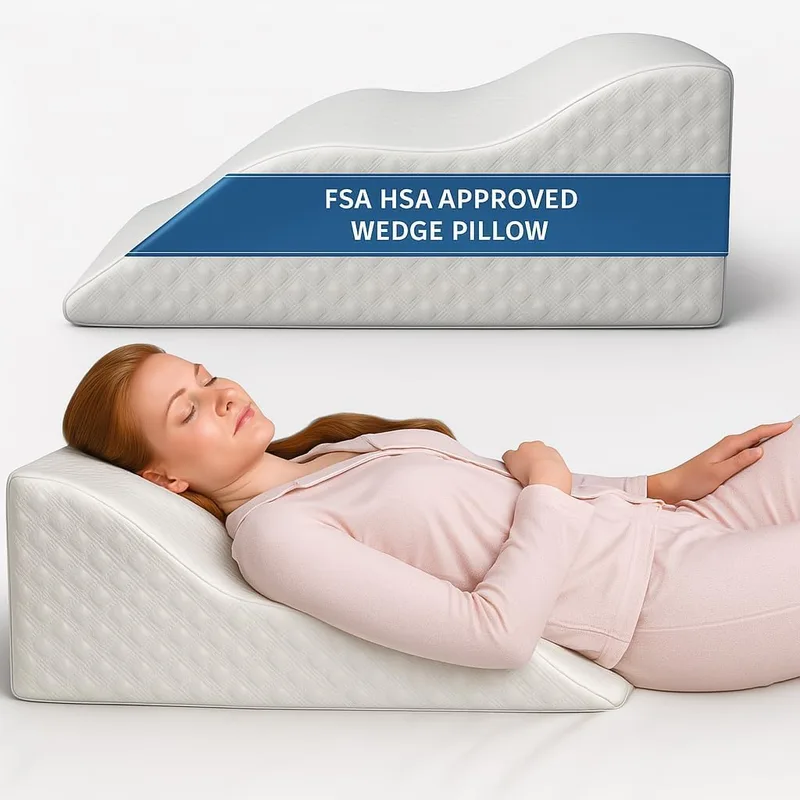
Aeris Wedge Pillow
65 × 65 cm base, 22 cm apex, 3.1 kg.
See the Aeris Wedge product details on AmazonProducts mentioned in this guide
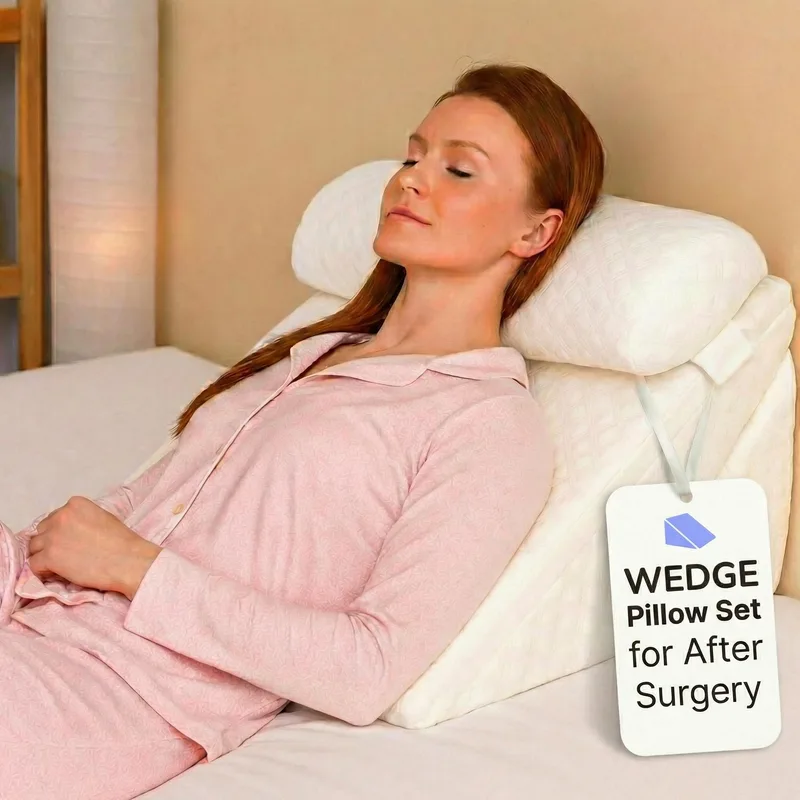 Flexicomfort Wedge Pillow Set — 28 cm over a 60 cm ramp, about 25°, with adjustable headrest
- Flexicomfort Knee Pillow — 30 × 22 × 20 cm, for knee support under a wedge pillow