Last updated: September 2026
This guide is part of our full map of wedge pillows for acid reflux, GERD, and better sleep.
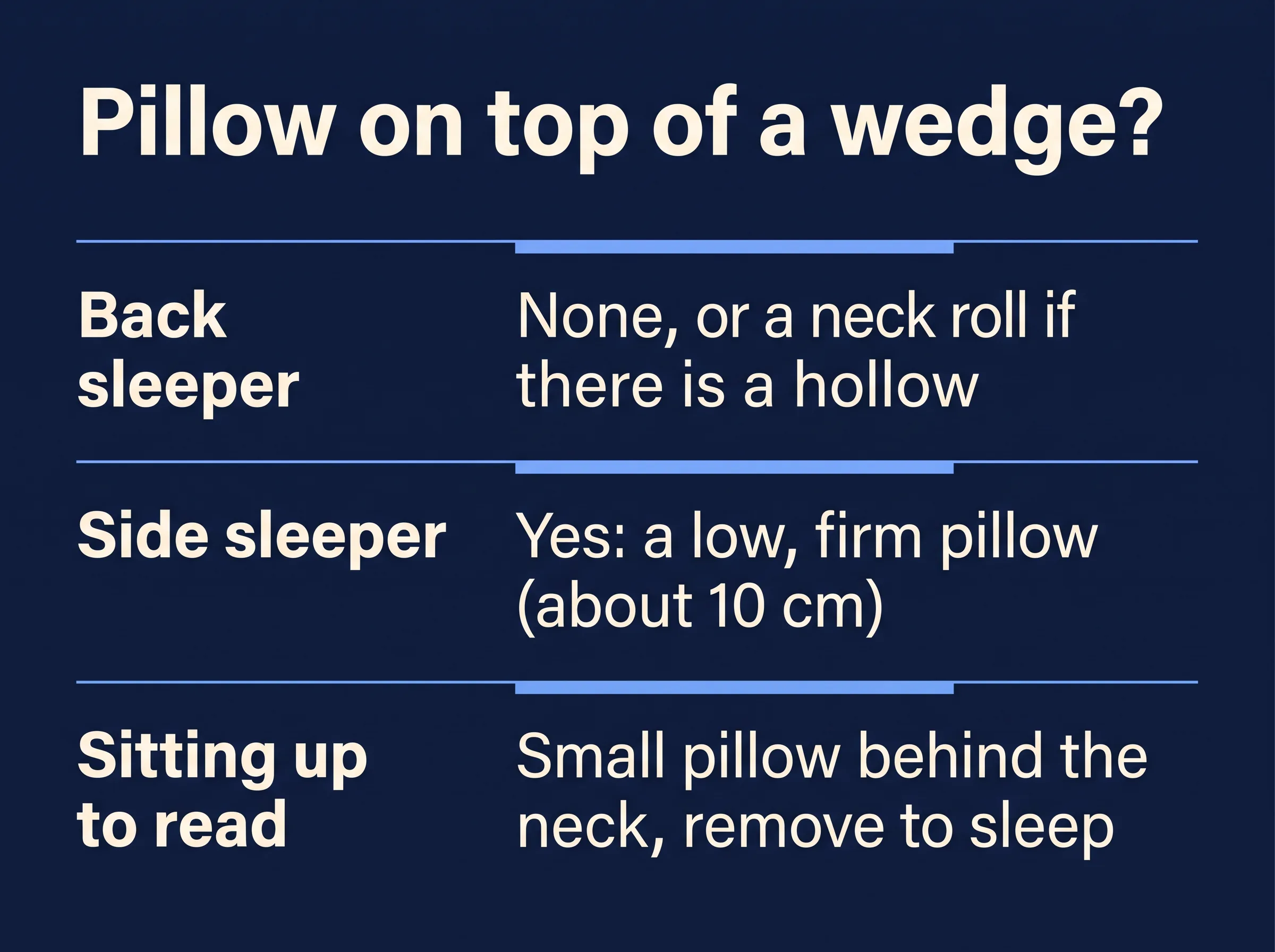
Should you put a pillow on top of a wedge pillow? It depends on how you sleep. Back sleepers on a moderate wedge usually need none, or a thin one under the neck. Side sleepers need one, but lower than on a flat bed.
A cervical pillow helps in one specific case: when the gap is under the neck rather than under the whole head. The rest of this guide shows how to tell which gap you have and what height closes it.
Key takeaways
- The wedge already raises your head; stacking a standard pillow on top adds height twice and tips the chin toward the chest.
- Wedge makers Amerisleep and Hibermate both advise against a regular pillow on a wedge; that rule fits back sleepers on a steep wedge, not side sleepers, who have a shoulder-to-head gap a bare wedge cannot fill.
- “If your neck is bent in any way for an extended period of time, you’ll get uncomfortable,” physical therapist Matthew O’Rourke tells Harvard Health.
- A 2025 biomechanics study tested side-lying pillow heights of 8 to 14 cm and found the best neck alignment with a medium height plus neck support, predicted by shoulder width.
- The simplest answer is a wedge that ships with its own head support: the Flexicomfort Wedge Pillow Set comes with an adjustable headrest sized for its slope, so you never stack a bed pillow on it.
- The Aeris Wedge Pillow rises to 22 cm over a 65 cm ramp, a moderate slope that most back sleepers use without any pillow on top.
- A firm contoured cervical pillow with a 10 cm and a 12 cm side, such as the FirmNest Extra Firm Contour Pillow, gives side sleepers two heights to test on the wedge and holds them on a slope.
Should you put a regular pillow on top of a wedge pillow?
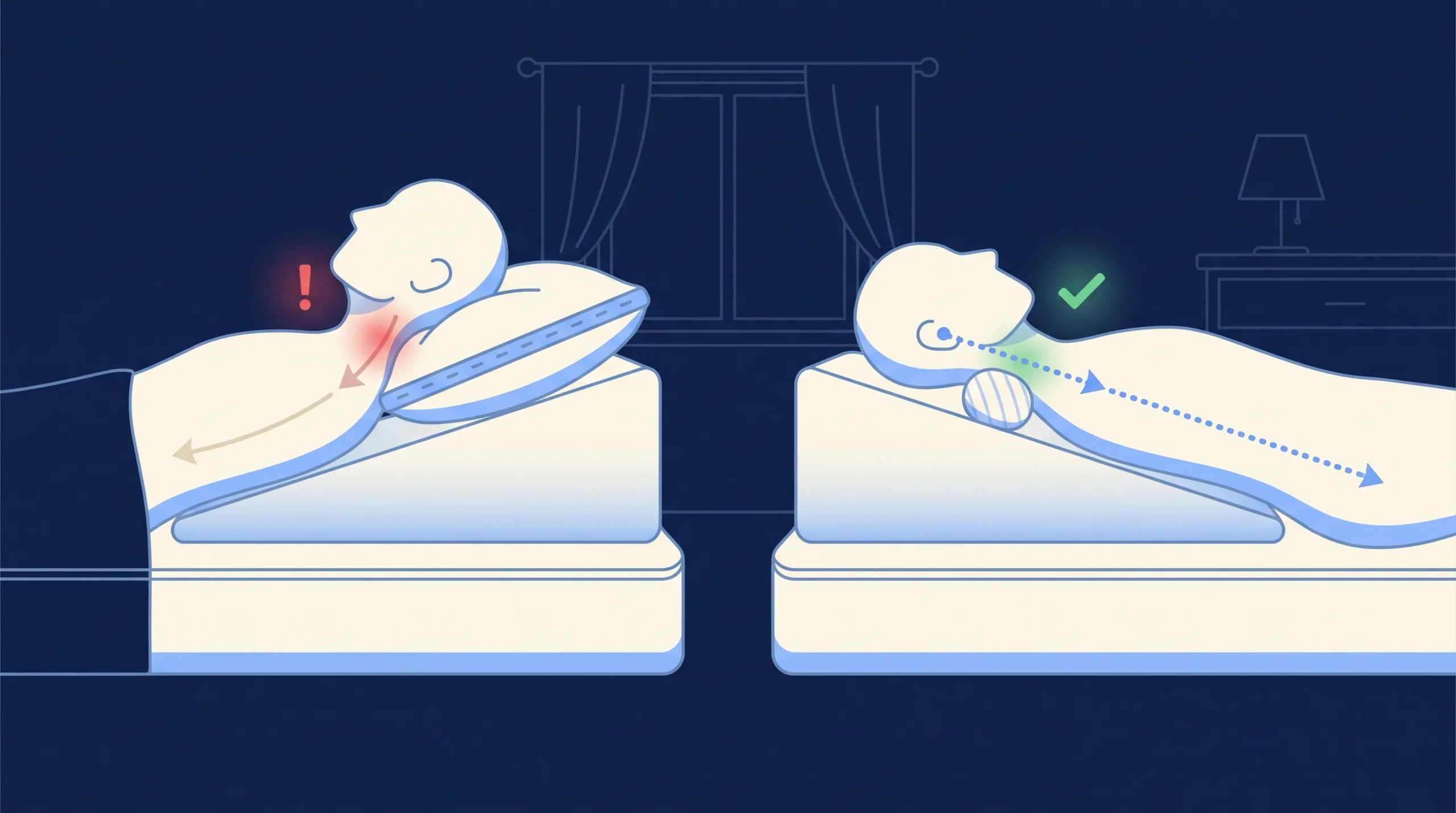
Not a full-height one, and on your back often none at all. A wedge is a head raiser. A standard bed pillow is also a head raiser. Stack them and the head is lifted twice while the shoulders are lifted once, so the neck bends forward and the chin drops toward the chest. That is the mechanism behind the stiff neck people describe after their first nights on a wedge, and it is why the makers’ instructions are so blunt about it.
The exception is the gap. On a moderate wedge a back sleeper’s head rests on the slope with the neck in a near-straight line, and nothing is missing. On a steep wedge, or for people with rounded upper backs, the head can hang slightly back with a hollow under the neck; a thin pillow or a rolled towel under the neck closes that without adding height under the skull. The test is a hand’s width: if you can slide a flat hand under your neck while lying on the wedge, fill the gap; if your chin is closer to your chest than when you stand, remove height. Our wedge pillow for acid reflux guide covers the angle side of that trade-off.
Why do wedge pillow makers say not to stack a pillow on top?
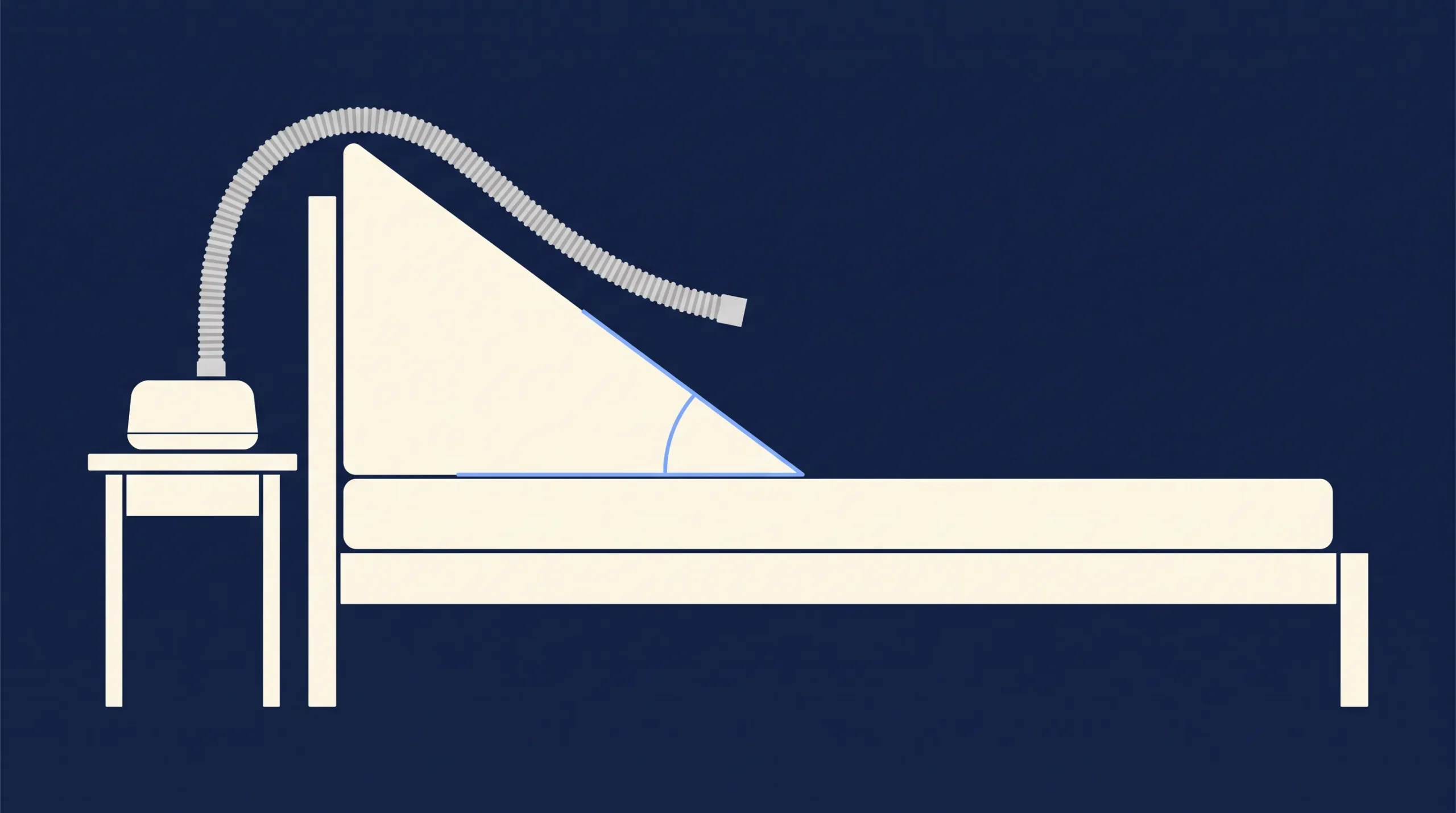
Because most of their customers sleep on their backs on a steep wedge, and for that reader the advice is right. Amerisleep’s wedge guide says a wedge “should be used on its own and not paired with a regular pillow,” warning that a pillow placed on top or underneath can make the stack unstable and “push the sleeper’s head and neck too far forward”; the same guide recommends a 30 to 45 degree incline for reflux and snoring. Hibermate says a regular pillow on a wedge “can actually do more harm than good by misaligning your neck with the rest of your body.”
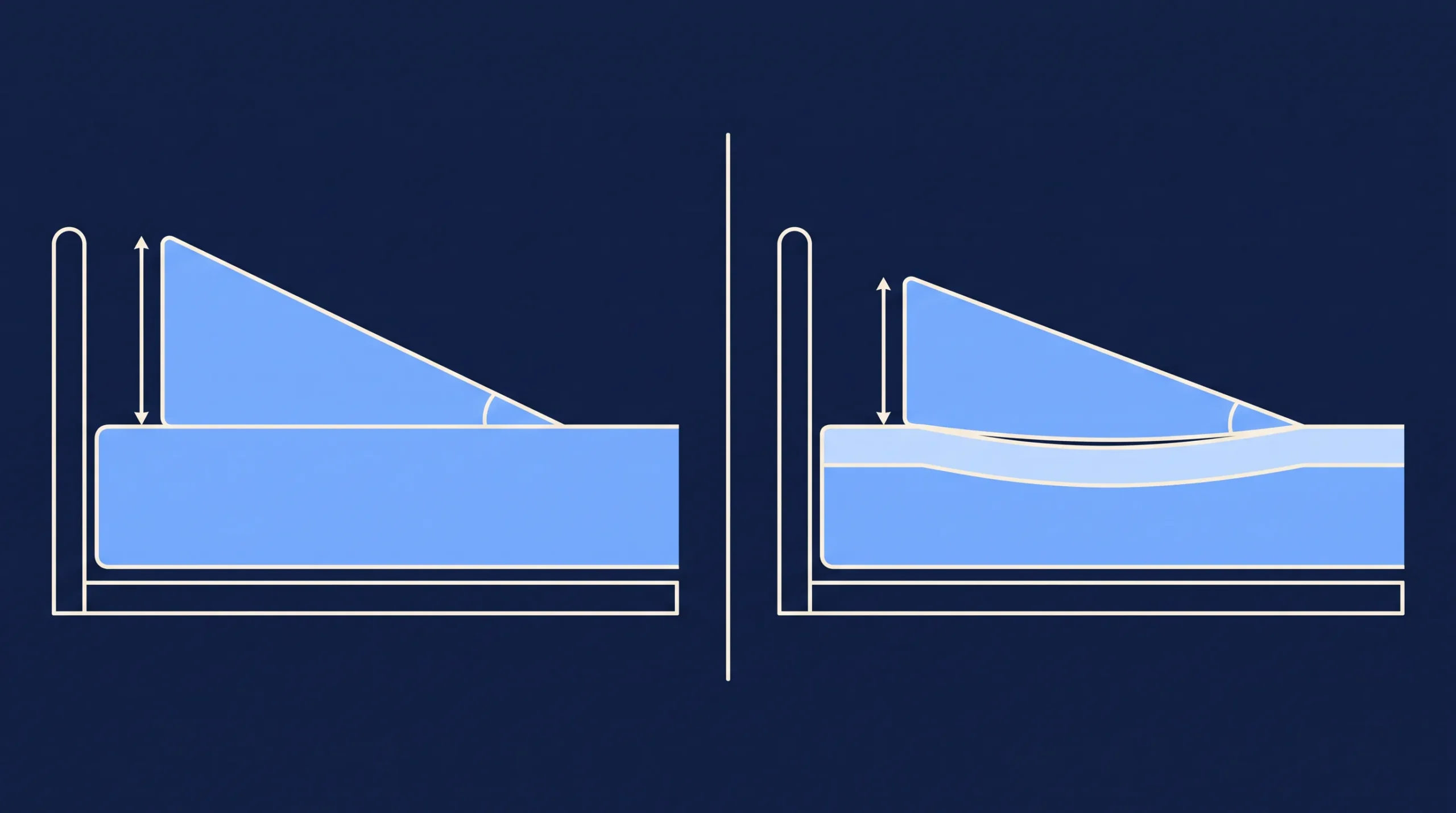
Both are retailers, and both are describing a 35 to 45 degree wedge. At that angle the head is already well above the shoulders and any pillow is too much. The advice does not address a moderate 15 to 25 degree wedge, and it does not address side sleepers, whose geometry is different. That is where the conflicting forum reports come from: two groups of people following one rule written for only one of them.
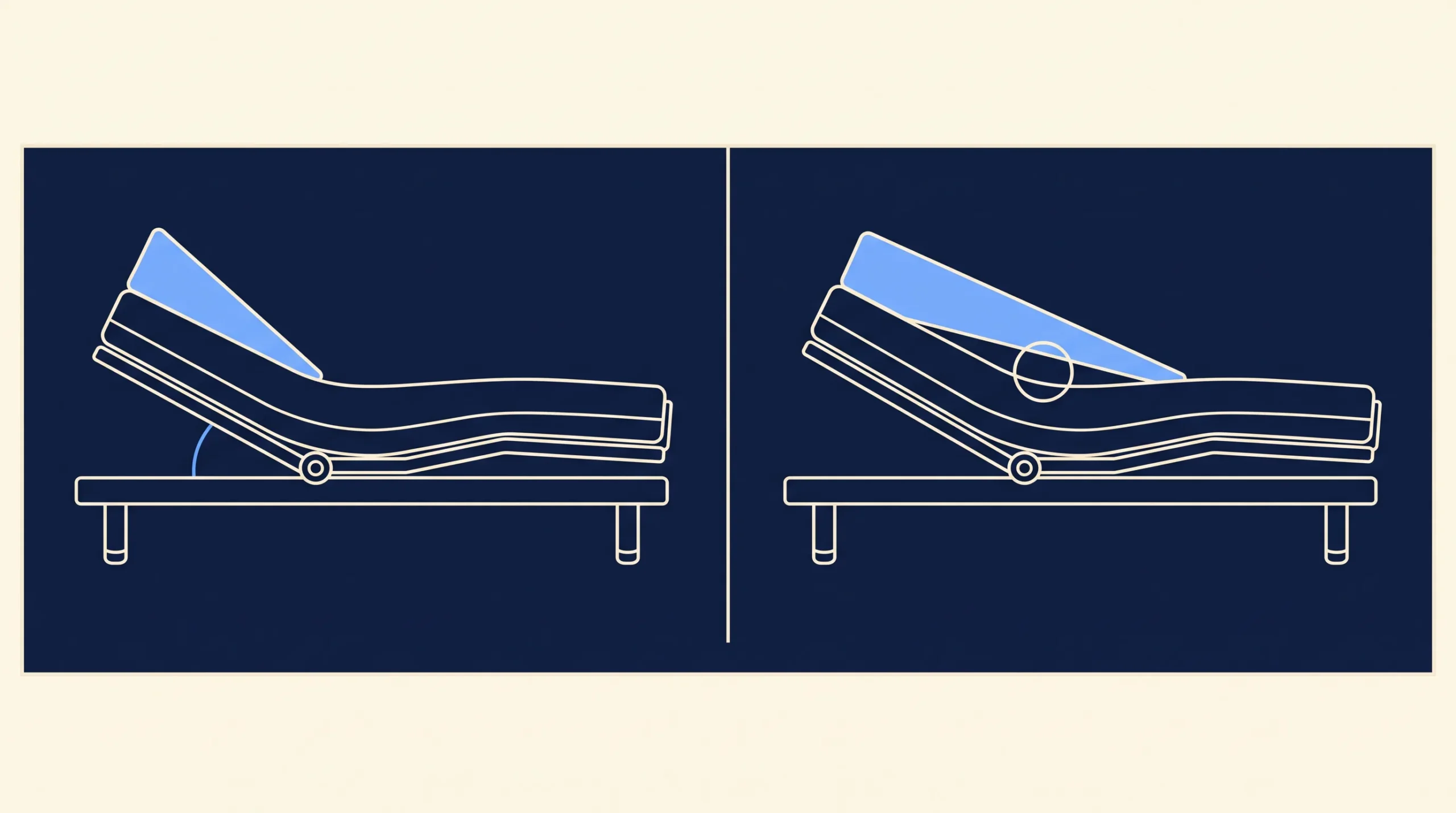
Do not put a pillow under the wedge either. Lifting the thin end with a pillow raises the whole ramp and makes it slide; lifting the thick end makes it steeper and tips it. If the wedge is the wrong height, the fix is a different wedge or a low bed riser under the head-end legs, not a pillow underneath.
When does a pillow on top of a wedge actually help?
When you sleep on your side, and when the wedge leaves a gap under your neck. Side lying puts the shoulder between the mattress and the head, so the head needs support roughly a shoulder’s depth above the surface; on a flat bed that is the ordinary job of a pillow. A wedge does not remove that gap, it only tilts it. Without something under the head the neck bends sideways toward the mattress, which is the side-sleeper version of the bent neck O’Rourke describes in Harvard Health, where the article also notes that side sleepers generally need a firmer, taller pillow than back sleepers.
How much is enough? A 2025 study in Medical & Biological Engineering & Computing had nine healthy adults lie on their sides on foam-latex pillows of 8, 10, 12 and 14 cm, with and without a raised neck-support section, while motion capture measured the cervical curve. Shoulder width predicted the best pillow height strongly (R² of 0.80 for a flat pillow, 0.82 with neck support); a medium individualized height with neck support produced the cervical curve closest to standing and the lowest simulated muscle and joint load, while a slightly lower pillow scored highest for comfort. The study is small and was done on a flat surface, so treat the numbers as a starting range, not a prescription: on a wedge the shoulder sinks into the slope, and in our hands-on testing the pillow that felt right was one to two centimetres lower than the same sleeper’s flat-bed pillow.
Regular pillow or cervical pillow: which works better on a wedge?
A cervical pillow, if your gap is under the neck; a thin regular pillow, if your gap is under the whole head. A cervical or contour pillow has a raised edge that supports the neck and a lower hollow for the skull, so it adds height where the wedge leaves a hollow without lifting the head further. A regular pillow adds the same height everywhere, which is what you want when the whole head is too low, as it is for most side sleepers.
| Your situation | Pillow on top? | Which kind | Why |
|---|---|---|---|
| Back sleeper, moderate wedge (15–25°) | Usually none | — | The slope already holds the neck straight |
| Back sleeper, steep wedge (30–45°) | None | — | Head is already above the shoulders; any pillow tips the chin down |
| Back sleeper with a hollow under the neck | Yes, neck only | Cervical / contour, low side | Fills the gap without raising the skull |
| Side sleeper, moderate wedge | Yes | Thin regular, or contour on the low side | Shoulder-to-head gap must be filled |
| Side sleeper with broad shoulders | Yes | Contour on the high side, or medium regular | Wider shoulders need more height (2025 study) |
| Any position, wedge sold with its own headrest | Yes, the headrest | The matched piece, moved up or down the slope | Sized for that slope; no stacking guesswork |
| Sitting up to read or watch TV | Optional | Small regular pillow behind the neck | Comfort, not alignment; see our reading guide |
The cleanest way out of the stacking problem is a wedge designed with the head support included. The Flexicomfort Wedge Pillow Set is our answer to this article’s question: a 60 cm ramp rising to 28 cm, sold with its own adjustable headrest, so the piece under your head was shaped for that slope rather than borrowed from a flat bed. You slide the headrest up or down the incline until the ear-shoulder-hip line is straight, which is the whole adjustment most people are trying to make with a folded pillow. In our hands-on testing it is the wedge we reach for when someone says the bare foam leaves a hollow under the neck.
The Aeris Wedge Pillow is the other case in the table: 65 cm long, 65 cm wide and 22 cm at the apex, an incline of about 19 degrees from the maker’s production spec. At that moderate angle most back sleepers in our testing used no pillow on top at all, and side sleepers used a low one. For the cervical option we point to the FirmNest Extra Firm Contour Pillow, a 60 by 40 cm high-density foam contour with a 10 cm side and a 12 cm side: the two heights let you test both side-sleeper rows without buying twice, and the extra-firm core is the property that matters most on an incline, where a soft contour compresses unevenly and lets the head roll downhill; the broader question of which pillow suits side sleepers is covered on our sister site.
How thick should the pillow on a wedge pillow be?
Lower than the pillow you use on a flat bed, by a noticeable margin. For side sleepers the 2025 study’s tested range of 8 to 14 cm on a flat surface is a reasonable place to start, then subtract for the shoulder sinking into the slope; in practice that means beginning with the 10 cm side of a contour pillow or a single thin regular pillow and only moving up if the neck still bends toward the mattress. For back sleepers the number is close to zero: a rolled towel or the low edge of a contour pillow under the neck if there is a hollow, nothing if there is not.
Firmness matters as much as thickness on a slope. A soft pillow compresses unevenly on an incline and the head rolls downhill during the night; a firmer pillow holds its height. Harvard Health’s advice that side sleepers need a firm pillow for support applies twice over on a wedge. If you are choosing the wedge itself with this in mind, our five-step guide to choosing a wedge pillow pairs height, width and firmness with sleep position.
Measure, don’t guess. Lie on the wedge in your normal position and have someone photograph you from the side. Your ear, shoulder and hip should sit on one line. Ear ahead of the shoulder means too much pillow; ear behind it, or a visible hollow under the neck, means too little. Adjust by one centimetre-class step per night.
5 signs your wedge setup is bending your neck
Most wedge neck pain announces itself within the first week. Any one of these means the pillow on top is the wrong height or the wrong kind.
- You wake with your chin near your chest. Too much height under the head: remove the pillow, or switch to a cervical pillow on its low side.
- A hollow under your neck you can slide a hand into. Too little neck support: add a rolled towel or the low edge of a contour pillow, not a full pillow.
- One shoulder is numb in the morning. The shoulder is at the thin top edge of the wedge or off its side; this is a positioning problem covered in our guide to sleeping on your side on a wedge pillow, not a pillow problem.
- The pillow is at the foot of the wedge by 2 a.m. It is too soft or too smooth; a firmer pillow, or a wedge with a cover that grips, holds position.
- Your neck is fine lying down but stiff after reading in bed. Sitting against the wedge at a steeper angle pushes the head forward; a small pillow behind the neck for reading only, as in our wedge pillow for reading and TV guide, then remove it to sleep.
If the stiffness persists after two weeks of adjusting, or you have an existing neck condition, see a doctor or physical therapist before changing anything else. Inclined sleeping is a comfort and positioning choice, and our wedge pillow side effects article lists who should be careful with it.
Do you need a pillow on top of your wedge? Answer three questions.
Frequently asked questions
Can you use a regular pillow with a wedge pillow?
A thin one, yes; a standard-height one, usually not. The wedge already raises the head, so a full pillow lifts it twice and tips the chin down. Back sleepers on a moderate wedge often need nothing; side sleepers need a low, firm pillow to fill the shoulder-to-head gap.
Do you put a pillow on top or under a wedge pillow?
On top, if anywhere. A pillow under the thin end raises the whole ramp and makes it slide; under the thick end it makes the wedge steeper and unstable. Wedge makers such as Amerisleep advise against both for that reason. If the wedge height is wrong, change the wedge, not what is under it.
Should a side sleeper use a pillow on a wedge pillow?
Yes. Side lying leaves a gap between the mattress and the head the width of a shoulder, and a wedge tilts that gap rather than removing it. Use a lower, firmer pillow than on a flat bed; a 2025 biomechanics study found side-lying pillow heights of about 8 to 14 cm worked best on a flat surface, and a wedge needs a little less.
Is a cervical pillow good on a wedge pillow?
In one case, yes: when the hollow is under the neck and the head itself is already high enough. A contour pillow’s raised edge fills that hollow without lifting the skull. For a side sleeper whose whole head is too low, a contour pillow on its higher side or a thin regular pillow works; the two-height FirmNest Extra Firm Contour lets you test both.
Why does my neck hurt after sleeping on a wedge pillow?
Usually because the head is raised twice: once by the slope and once by a pillow on top, so the chin drops toward the chest. Harvard Health quotes a physical therapist: a neck bent in any direction for hours gets uncomfortable. Remove the pillow or switch to a low contour pillow, and see a professional if pain persists beyond two weeks.
Is there a wedge pillow that comes with its own head pillow?
Yes. The Flexicomfort Wedge Pillow Set is sold with an adjustable headrest, a separate piece shaped for the wedge’s slope that you move up or down the incline instead of stacking a bed pillow. It is the setup we suggest when a bare wedge leaves a hollow under the neck and a regular pillow is too much.
How high should a wedge pillow be if you don’t use a pillow on top?
High enough to give the incline you want, with the head resting on the slope itself. The Aeris wedge’s 22 cm apex over 65 cm, about 19 degrees, is a height most back sleepers use bare; steeper 30 to 45 degree wedges are also used bare but are harder to hold on the side. Our how to choose a wedge pillow guide matches height to use.
Can I stack two wedge pillows or a wedge and a thick pillow for more height?
Stacking makes the ramp unstable and usually steeper than intended. If you need more elevation than one wedge gives, an adjustable bed base or bed risers under the head-end legs raise the bed evenly; a wedge under the knees also stops sliding without adding height at the head.
What we recommend by sleep position
If you have not bought the wedge yet, buy the pillow with it: a set with a matched, adjustable headrest such as the Flexicomfort Wedge Pillow Set removes the guesswork this whole article is about. For a wedge you already own: back sleepers on a moderate wedge, no pillow on top, and a rolled towel under the neck only if you can slide a hand into the hollow. Back sleepers on a steep wedge: nothing on top; if the chin still drops, the wedge is too steep. Side sleepers: a low, firm pillow, starting around the 10 cm mark and adjusting by small steps, or a two-height contour pillow so you can test both without buying twice. Readers and TV watchers: a small pillow behind the neck while upright, removed before sleep.
The rule the makers print is right for the reader they had in mind and wrong for everyone else, which is why the forums disagree. Decide by position and gap, change one thing per night, and if your neck is still complaining after two weeks, the next conversation is with a physical therapist, not a pillow shop. Our best wedge pillows by use guide and the wedge pillow for lower back pain article pick up from here.
Advertisement
Aeris Wedge Pillow
65 × 65 cm base, 22 cm apex, 3.1 kg — the wedge every measurement in this guide refers to.
See the Aeris Wedge product details on Amazon