Last updated: September 2026
This guide is part of our full map of wedge pillows for acid reflux, GERD, and better sleep.
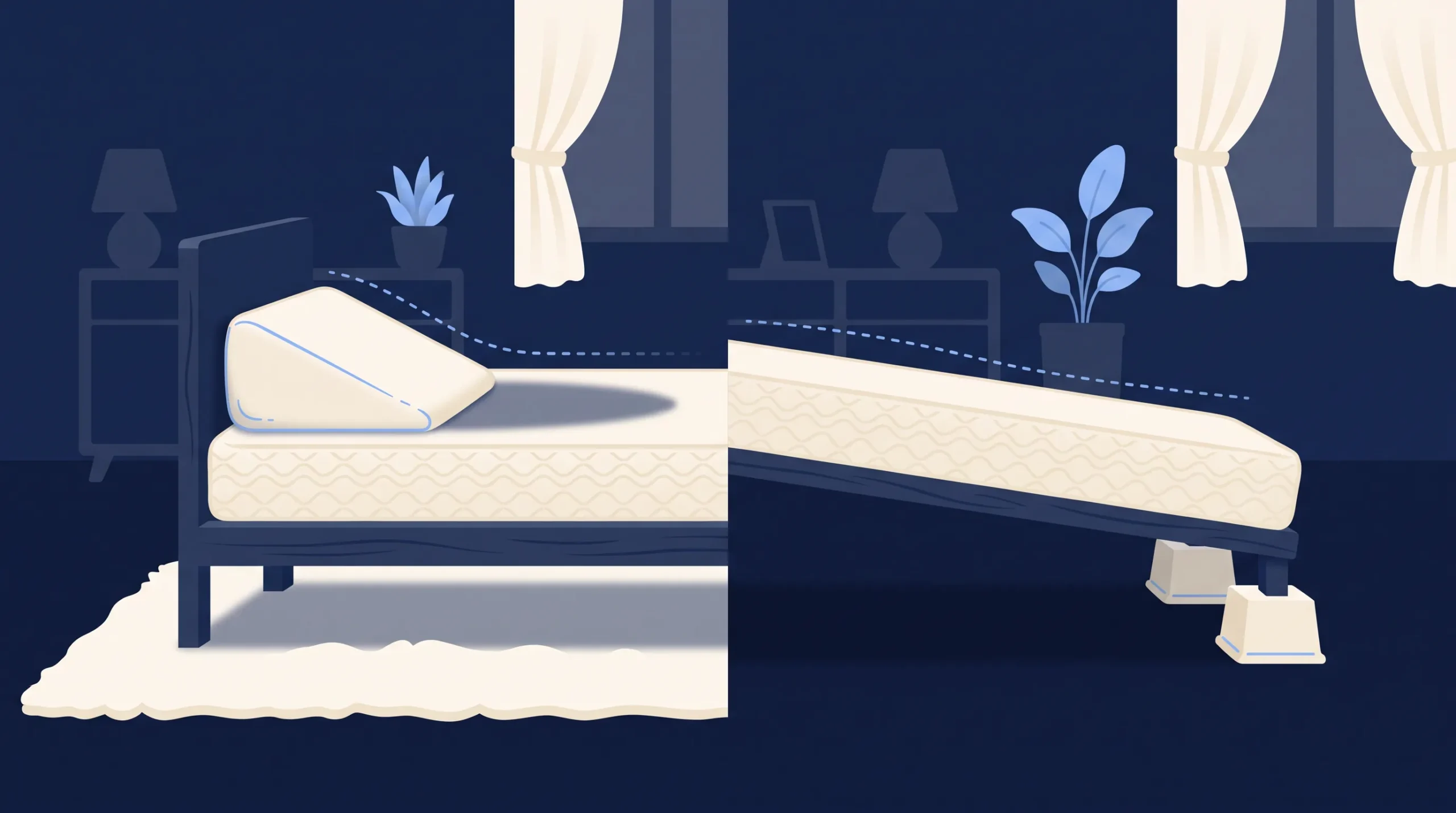
Wedge pillow vs bed risers: a wedge pillow is a foam ramp that lifts your torso on the mattress; bed risers lift the head-end legs so the whole bed tilts. Which is better depends on your bed, your partner and how you sleep.
Key takeaways
- Both methods do the same job: they raise the head end of the body. The American College of Gastroenterology’s 2022 guideline suggests elevating the head of the bed for nighttime GERD symptoms as a conditional recommendation with a low level of evidence.
- A 2021 systematic review of five trials (228 patients) found symptom improvement with head-of-bed elevation, whether the studies used bed blocks under the legs, a wedge pillow, or both.
- Trials typically raised the bed legs by about 20 cm (8 inches); consumer bed risers come in 3, 5 and 8 inch heights and stack to reach 8 inches.
- A wedge changes only your side of the bed and moves with you; risers tilt the whole mattress, so a partner sleeps on the slope too.
- Risers under only the head-end legs can let the mattress creep toward the foot of the bed, according to Amerisleep’s bed-riser safety guide; a wedge cannot tilt the frame but can let you slide down the foam.
- Cost is one order of magnitude apart: a set of four plastic risers costs less than most wedge pillows, and both cost far less than an adjustable base.
- A low riser plus a modest wedge is a common middle path when a steep wedge strains the neck.
What is the difference between a wedge pillow and bed risers?
A wedge pillow raises your body from the mattress up; bed risers raise the bed itself. The wedge is a triangular block of foam, usually 6 to 12 inches tall at the peak, that you lie on so your torso rests on an incline. Risers are short blocks, cups or stackable plastic legs that go under the two head-end feet of the frame, so the entire sleeping surface tilts a few degrees from head to foot.
The practical difference is where the bend happens. On a wedge, the bend is at your hips or lower back, because the mattress under your legs stays flat. On risers, there is no bend at all: the whole bed becomes a gentle ramp, which is why some sleepers who dislike the folded feeling of a wedge prefer it. The trade-off is that everyone in the bed sleeps on that ramp. If you are weighing a motorised base instead, our wedge pillow vs adjustable bed comparison covers that third option.
Does raising the head of the bed help with reflux and snoring?
Raising the head of the bed is one of the few sleep-position changes with formal guideline support, although the evidence is rated low. The ACG 2022 clinical guideline states that “multiple studies, including several randomized controlled trials, have demonstrated improvement in nocturnal GERD symptoms and nocturnal esophageal acid exposure with head of bed elevation or sleeping on a wedge,” and lists elevating the head of the bed as a conditional recommendation.
A systematic review published in 2021 screened 1,206 records and included five trials with 228 participants. Two trials used bed blocks under the legs, one used a wedge pillow, and two used both; the studies that reported symptoms found improvement in the elevated group, supported by better intra-oesophageal pH readings. In plain terms: the research does not crown one method. It supports the idea of elevation itself, by either route.
For snoring the picture is more anecdotal. Elevation may keep the airway more open for some back sleepers, which is why it appears in our guide to wedge pillows for snoring. Persistent loud snoring, gasping or daytime sleepiness are reasons to talk to a doctor about sleep apnea rather than to buy a taller wedge.
How high should you raise the head of the bed?
The height used in trials is about 20 cm, or roughly 8 inches, and that is the top of the consumer range for both methods. Bed blocks in the reviewed studies raised the head-end legs by around 20 cm. Consumer bed risers are sold in 3, 5 and 8 inch heights, with stackable sets rated to about 1,300 lb, so 8 inches means stacking a 3 and a 5, or buying the tallest single block.
A wedge reaches the same peak height directly: the Aeris Wedge Pillow measures 65 cm long and 22 cm (8.7 inches) at the apex by its maker’s production spec, which matches what we measured in our hands-on use, and lower profiles exist for people who only need a few inches. The difference is what that height does. Eight inches of riser tilts a 200 cm bed by about 5 to 6 degrees along its full length; eight inches of wedge over a 65 cm ramp produces a much steeper incline under the torso. Our guide to wedge angle and height for reflux explains why the two numbers are not interchangeable.
5 things that decide between a wedge and risers
Five practical factors matter more than any lab result: your bed frame, your partner, your sleep position, whether you rent or move, and money. The table sums them up.
| Factor | Wedge pillow | Bed risers |
|---|---|---|
| Works on any bed | Yes, including mattresses on the floor | Needs a frame with legs; not for platform beds or floor mattresses |
| Effect on a partner | Only your side is raised | Whole mattress tilts for both sleepers |
| Sleep position | Best on the back; side sleeping takes a wider wedge and practice | Any position, since the bend is gone |
| Sliding | You can slide down the foam; a knee pillow or lower angle helps | Mattress can creep off the frame if not anchored |
| Setup and reversibility | Seconds; remove it any night | Two people lifting the frame; leave it in place |
| Renting or moving | Packs in a bag | Risers travel, but check floor protection and frame stability |
| Typical cost | Mid-range | Lowest; a set of four is usually cheaper than a wedge |
| Steepest usable incline | Higher under the torso | Gentle, whole-bed slope |
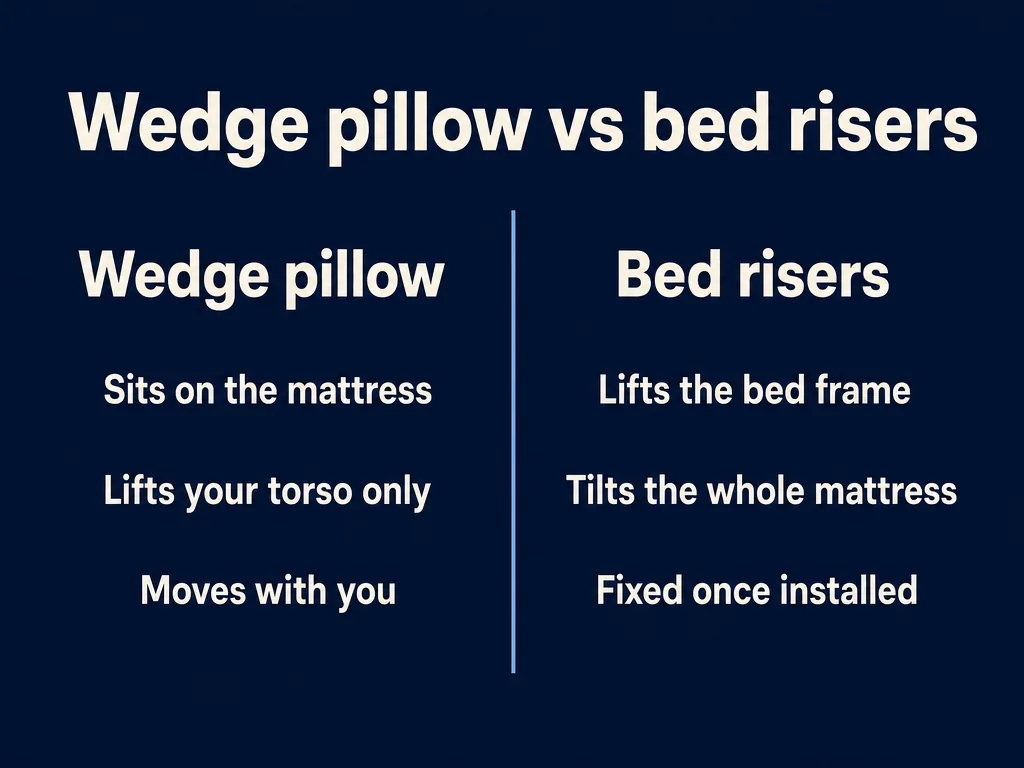
Two of those rows deserve a closer look. First, the frame: risers only work if your bed has legs that end in feet small enough to sit inside the riser cup, and the frame has to stay rigid when one end is higher. Second, the partner: a wedge is the only option that leaves the other half of the bed exactly as it was.
When do bed risers make more sense?
Risers make more sense when you sleep on your side or stomach, share the bed with someone who also wants elevation, or find every wedge you try folds you at the waist. Because the incline runs the full length of the mattress, your spine stays straight and a side sleeper’s hips and shoulders sink into the mattress as they normally would. Sleepers who woke up with a stiff neck on a wedge often report that a gentle whole-bed tilt is easier to live with, a complaint we cover in wedge pillow side effects.
Do the setup properly. Use risers made for the job rather than bricks or books, put the same height under both head-end legs, and check that the mattress does not migrate toward the foot of the bed over the first week; Amerisleep recommends contacting the frame manufacturer if you are unsure the frame tolerates uneven lifting. A non-slip pad between mattress and base, or a fitted sheet with deep corners, usually solves the creep.
Risers under only the head-end legs can let the mattress creep toward the foot of the bed over the first week. A non-slip pad between mattress and base, a deep-pocket fitted sheet, or a small board at the foot of the frame stops it. Never improvise with bricks or books under a frame that carries people.
When does a wedge pillow make more sense?
A wedge makes more sense when you cannot or do not want to alter the bed: a platform bed, a mattress on the floor, a rented room, a partner who wants a flat bed, or a recovery period after which you will go back to sleeping flat. It also wins when you want the steeper torso angle that a whole-bed tilt cannot reach, and when you want to use the same foam for sitting up to read or as a knee or leg elevation pillow during the day.
The Aeris Wedge Pillow is the version we build for this use: a 65 by 65 cm base with a 22 cm apex, firm enough that the slope holds its shape until morning instead of packing down under the shoulders, and light enough (3.1 kg) to move between the bed and the sofa. Back sleepers who find it too steep on the first nights can start with the wedge lower down under the shoulder blades and move up over a week. For a slightly taller, narrower profile there is also the Flexicomfort Wedge Pillow. Our five-step guide to choosing a wedge pillow walks through height, width and firmness before you buy.
Can you combine a low riser with a wedge?
Yes, and the combination is a common compromise. A 3 inch riser under the head-end legs gives the whole bed a barely noticeable tilt, and a low wedge or thick pillow on top adds torso elevation without the steep fold of a tall wedge alone. People who get lower-back ache from a tall wedge sometimes find this split more comfortable; our wedge pillow for lower back pain article covers the knee-pillow trick that goes with it.
Whatever you combine, change one thing at a time and give it a week. The guideline and trial evidence describe elevation as a supporting measure alongside the food, timing and medication plan you agree with your doctor, not a replacement for it. If reflux or snoring does not improve after a few weeks of consistent elevation, that is worth a medical conversation, not another gadget.
Start lower than your target. Trials used about 20 cm, but most people adapt better starting at 3 to 5 inches of riser (or the lower half of a wedge) and moving up after a week, one change at a time.
Wedge pillow or bed risers? Answer four questions.
Frequently asked questions
Is a wedge pillow or bed risers better for acid reflux?
Neither has been shown to be better than the other. The 2021 systematic review found improvement with bed blocks, with a wedge, and with both. Choose by bed, partner and sleep position: a wedge for a shared or platform bed, risers for side sleepers who dislike the fold.
How many inches should bed risers be for reflux?
The trials behind the guideline used blocks of about 20 cm, or 8 inches, under the head-end legs. Consumer risers come in 3, 5 and 8 inch heights. Many people start at 3 to 5 inches and go higher only if needed, because the whole mattress tilts and a partner feels it too.
Do bed risers on only one end damage the bed frame?
They can stress a frame that is not built for uneven lifting. Use purpose-made risers, match the height on both head-end legs, and check the frame manufacturer’s guidance, as Amerisleep advises. Metal frames tolerate it better than thin wooden slats.
Will the mattress slide off if I raise the head of the bed?
It can creep toward the foot over time. A non-slip pad between mattress and base, a fitted sheet with deep pockets, or a small board at the foot of the frame stops it. On a wedge the sliding problem is yours, not the mattress’s; a knee pillow and a lower angle help.
Can side sleepers use a wedge pillow instead of risers?
Yes, but it takes a wider wedge and a pillow between the knees to keep the hips level. Many side sleepers find whole-bed elevation easier because the mattress still cradles the shoulder. Try the wedge for a week before deciding.
Are bed risers or a wedge better for a shared bed?
A wedge, because it raises only your side. Risers tilt the entire mattress, so a partner who does not need elevation sleeps on the slope as well. If both of you want elevation, risers are the cheaper route.
Can I use bricks or books instead of bed risers?
Purpose-made risers are safer. Bricks and books can crack, slip or crush, and they do not cup the leg of the frame. Sets of four risers with a load rating are inexpensive enough that improvising is rarely worth the risk.
How long does it take to get used to sleeping elevated?
Most people need several nights to a couple of weeks. Start lower than your target height, keep the elevation every night rather than occasionally, and note whether reflux or snoring changes over a week or two before adjusting.
Choosing between a wedge and risers
Pick risers if you sleep on your side, share the incline willingly, and have a legged frame you can lift. Pick a wedge if the bed cannot change, your partner wants it flat, or you need a steeper torso angle than a whole-bed tilt can give. Either way, the elevation is what the evidence supports; the hardware is a comfort and household decision. The Aeris Wedge Pillow covers the wedge side of that choice, and a set of risers costs little enough to test the other.
Our pick for the wedge side
Aeris Wedge Pillow
65 × 65 cm base, 22 cm apex, 3.1 kg — the wedge every measurement in this guide refers to.
Check the Aeris Wedge price on Amazon