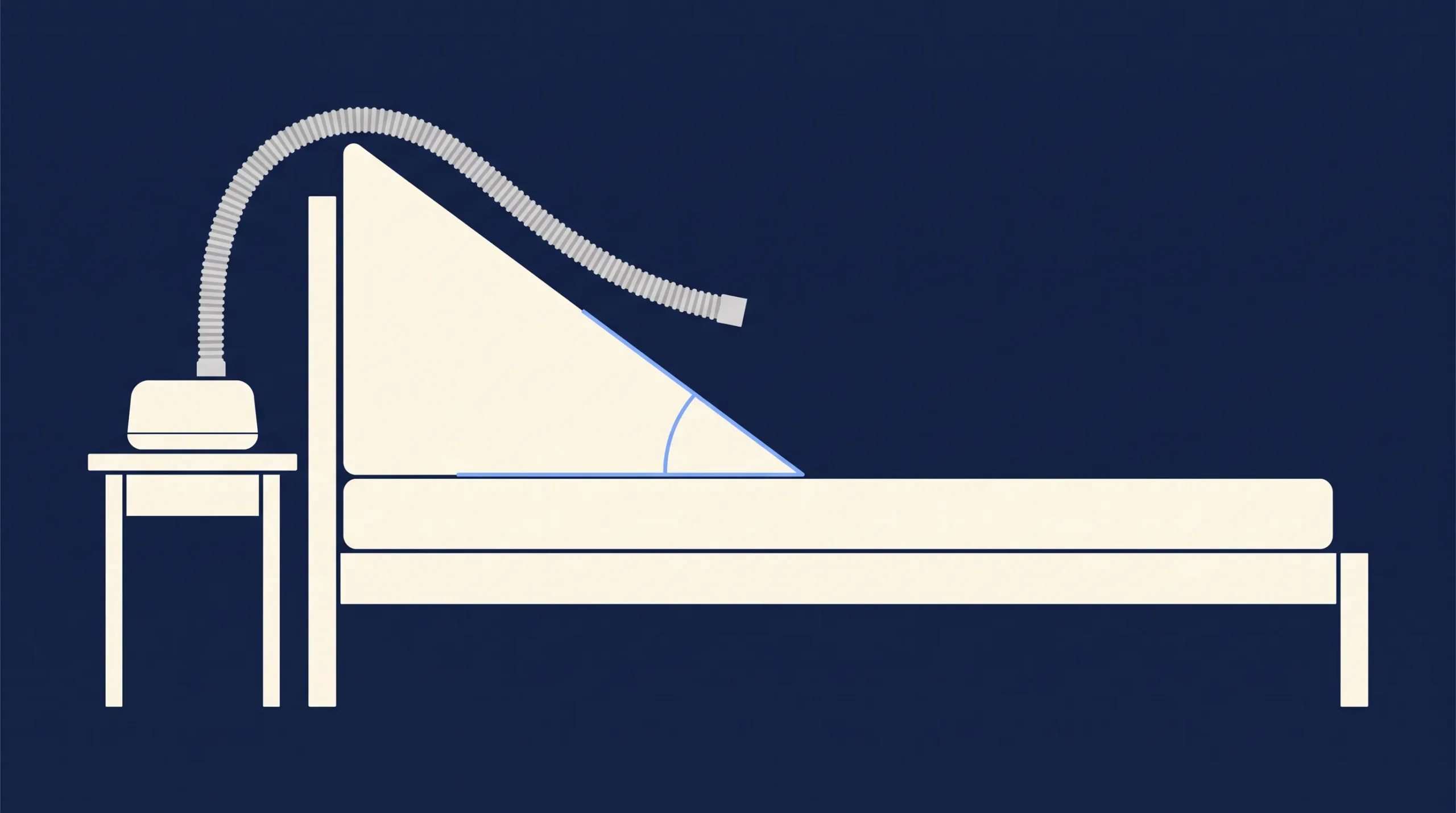
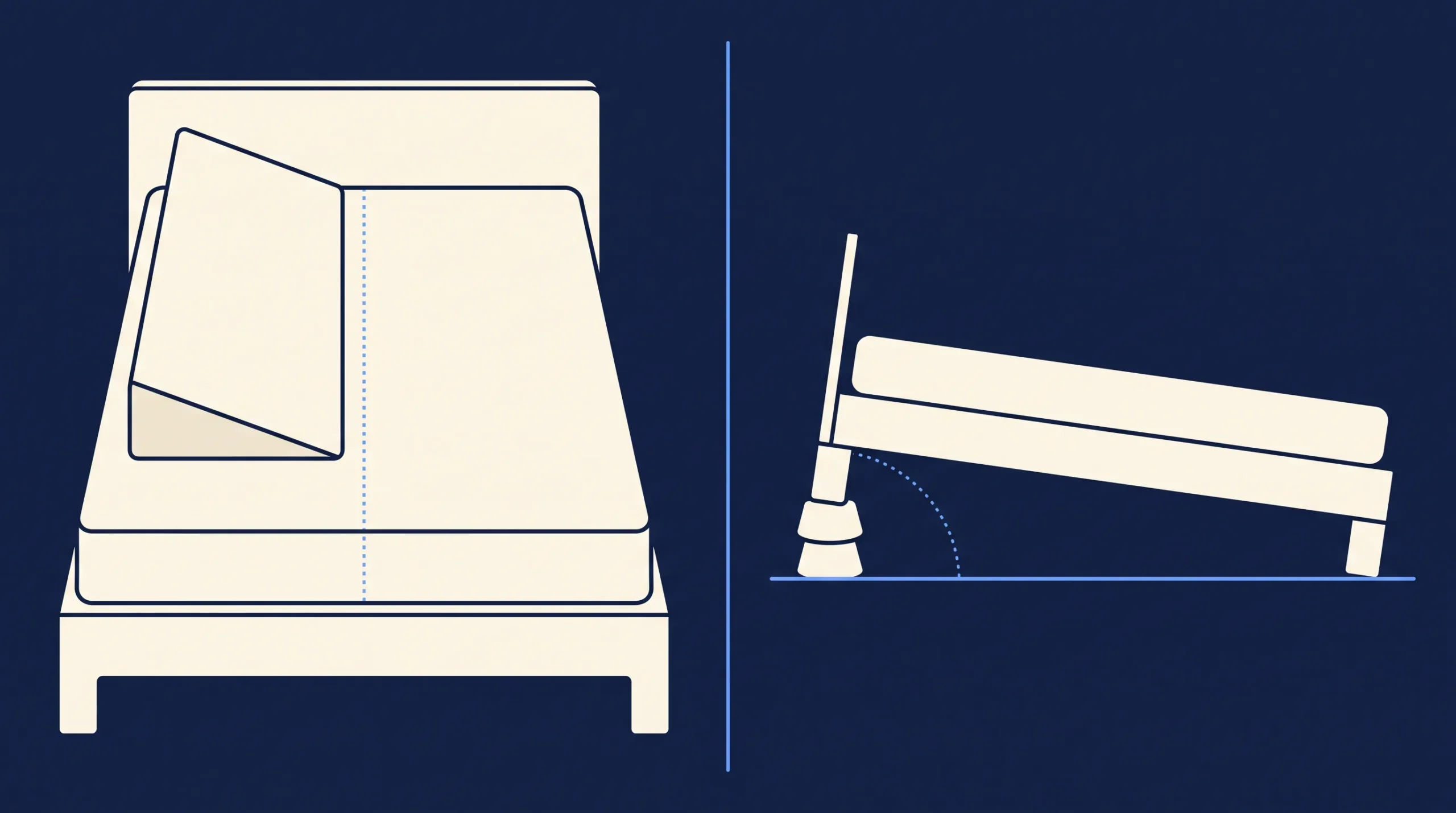
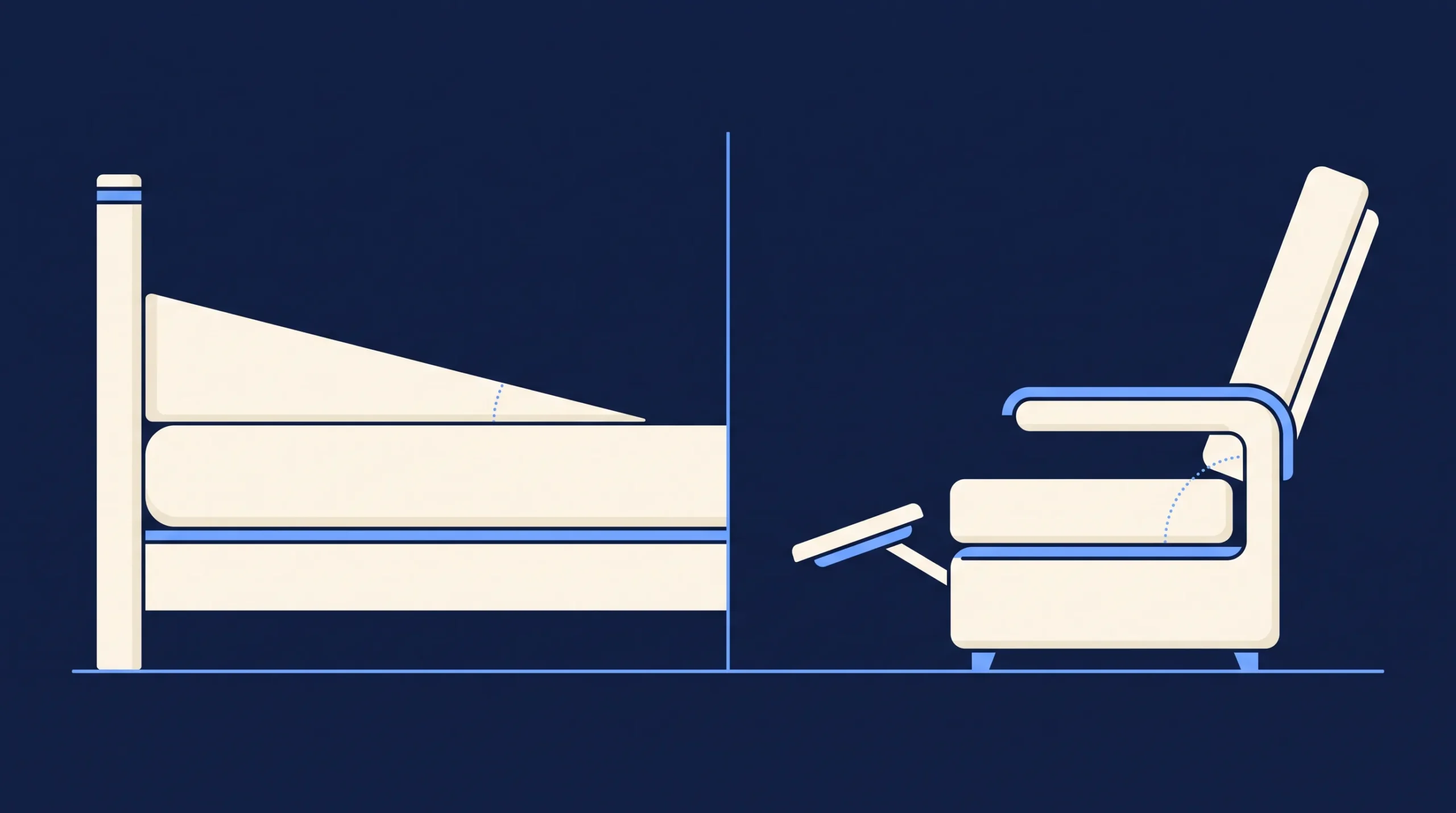
A wedge pillow is a triangular foam support that holds your torso, back, or legs at a fixed elevation angle — and choosing one is a chain decision, not a feature hunt. Most wedge-pillow buying guides hand you a feature list and leave you to guess. The problem is that the features only make sense in order: your use case decides the angle (the incline, or slope), the angle decides the height (the apex), your body decides the size, and only then does foam matter. This guide runs that whole chain in one place. It is the hub for the wedge pillow site; for the reflux-specific version, see the acid reflux and GERD guide.
How do you choose a wedge pillow?
Start from why you are propping yourself up, then work down a fixed chain: use case → angle → height → size → foam. Skip the chain and you end up with a wedge that is the wrong slope for what you need it to do, no matter how good the reviews were.
The rest of this page is that chain, one link at a time, ending in a 60-second pick.
5 Steps to Choosing the Right Wedge Pillow
- Use case — why you are propping yourself up sets everything that follows.
- Angle — the use case fixes the incline, or elevation angle (about 30–45 degrees for reflux).
- Height — the angle decides how tall the wedge has to be at the apex (its peak).
- Size and length — your body decides torso-only or full-body.
- Foam and firmness — only after the above does material and ILD matter.
What incline angle do you need?
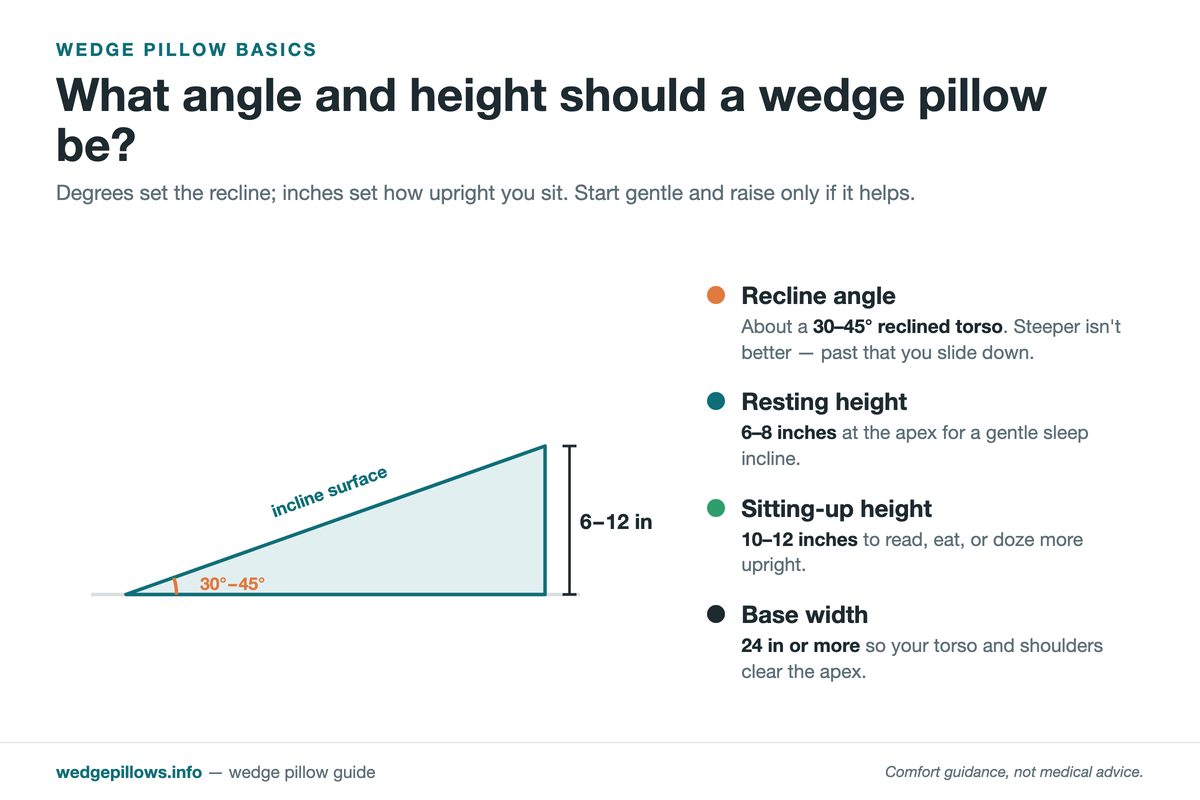
The use case sets the angle before anything else — a reflux wedge, a leg wedge, and a reading wedge are not the same slope, roughly 30 to 45 degrees for reflux versus a low 15 to 20 degrees for legs. This is the decision most people get backwards by shopping for “a wedge pillow” instead of “a wedge for this.”
| Use case | Typical incline | Why |
|---|---|---|
| Acid reflux / GERD | gentle, ~30-45° reclined torso | hold the torso up without sliding (reflux guide) |
| Sitting up / reading / TV | steeper back angle | upright support (TV & reading guide) |
| Leg / knee elevation | low, under the legs | raise the legs slightly, not the torso |
| General propped sleeping | gentle | comfort on an incline (sleeping upright) |
How tall should the wedge be?
Height is the apex measurement, and once the angle is right, height is mostly about your size and how much elevation you want — typical wedges run 6 to 12 inches at the top. A taller apex (the peak height) gives more elevation but is steeper to lie on unless the base is long enough to keep the slope gentle.
The trap is buying on height alone. A 12-inch wedge with a short base is a steep ramp you will slide off; a 7-inch wedge with a long, gentle base can be more comfortable and still do the job.
What size and length — torso or full-body?
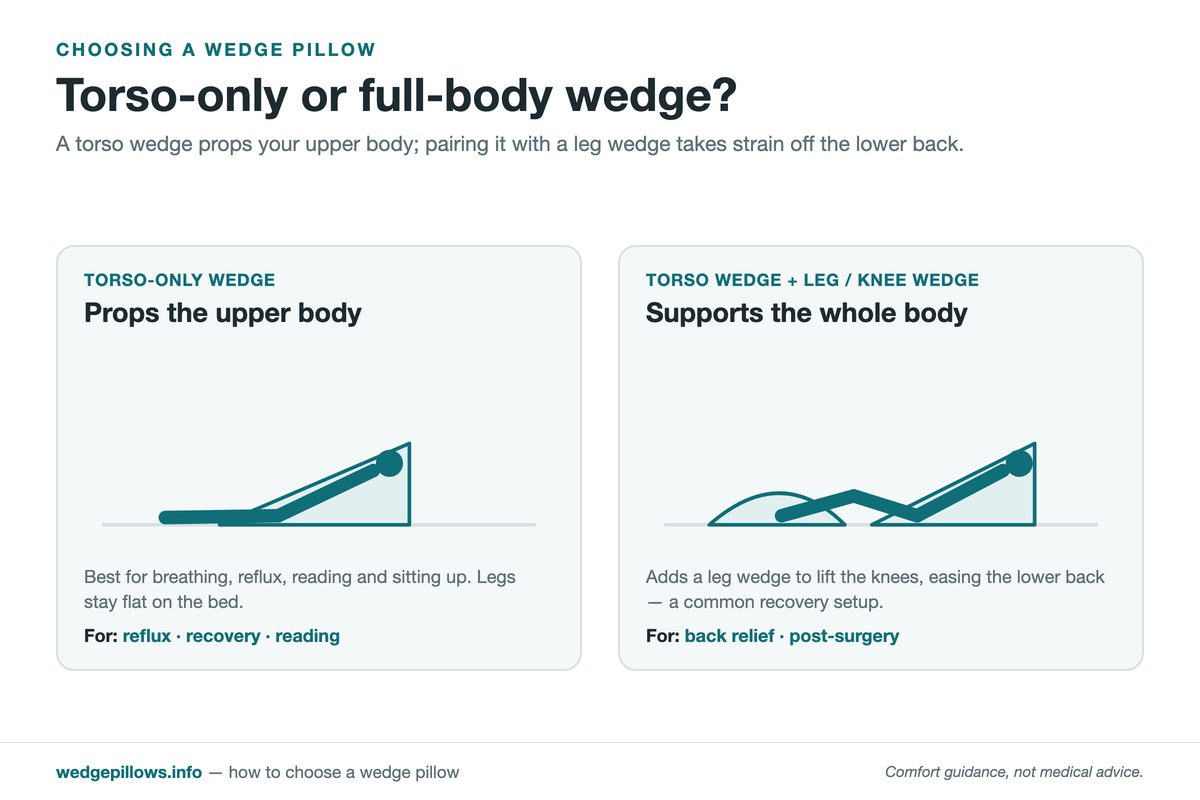
Match the length to your body frame: the wedge has to be long enough that your shoulders stay on the slope instead of hanging off the apex. This is the attribute almost every buying guide ignores, and it is the difference between a wedge that works and one that makes your neck do all the work.
| Body frame | Length guidance |
|---|---|
| Shorter frame | a standard torso wedge usually covers hips-to-shoulders |
| Taller frame | choose a longer wedge so the shoulders stay supported |
| Also elevating legs | consider a full-body or a second leg wedge |
Base width matters too: 24+ inches keeps your whole trunk supported rather than balancing on a narrow ramp.
Which foam is best?
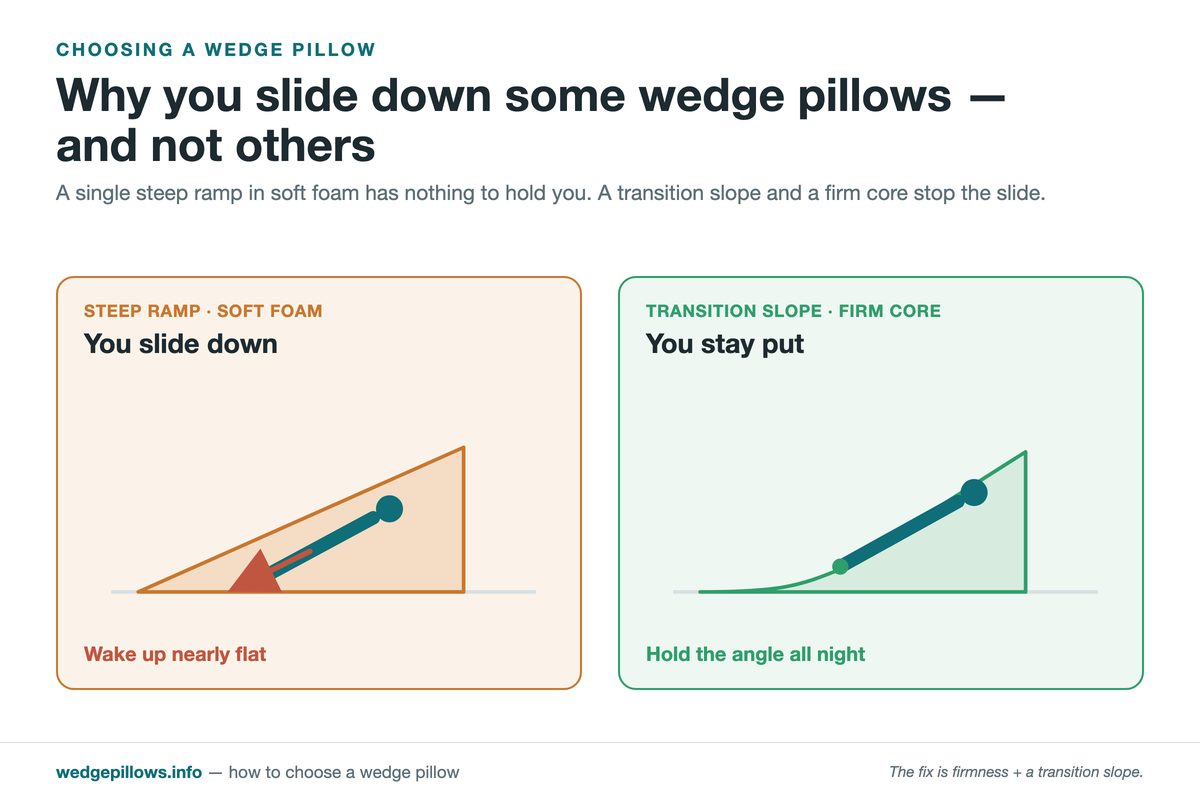
Memory foam contours and stays quiet; firmer polyfoam rebounds and resists sinking; latex is firm and durable but heavier and pricier — for a wedge, you want enough firmness to hold the angle, with a comfortable top. A common, good-value build is a firm support core under a softer memory-foam top: it feels comfortable but does not collapse.
- Memory foam — body-contouring, quiet, can sleep warm.
- Polyfoam — springier, often firmer, holds an angle well.
- Latex — firm, durable, heavier, costs more.
What firmness (ILD) holds the angle?
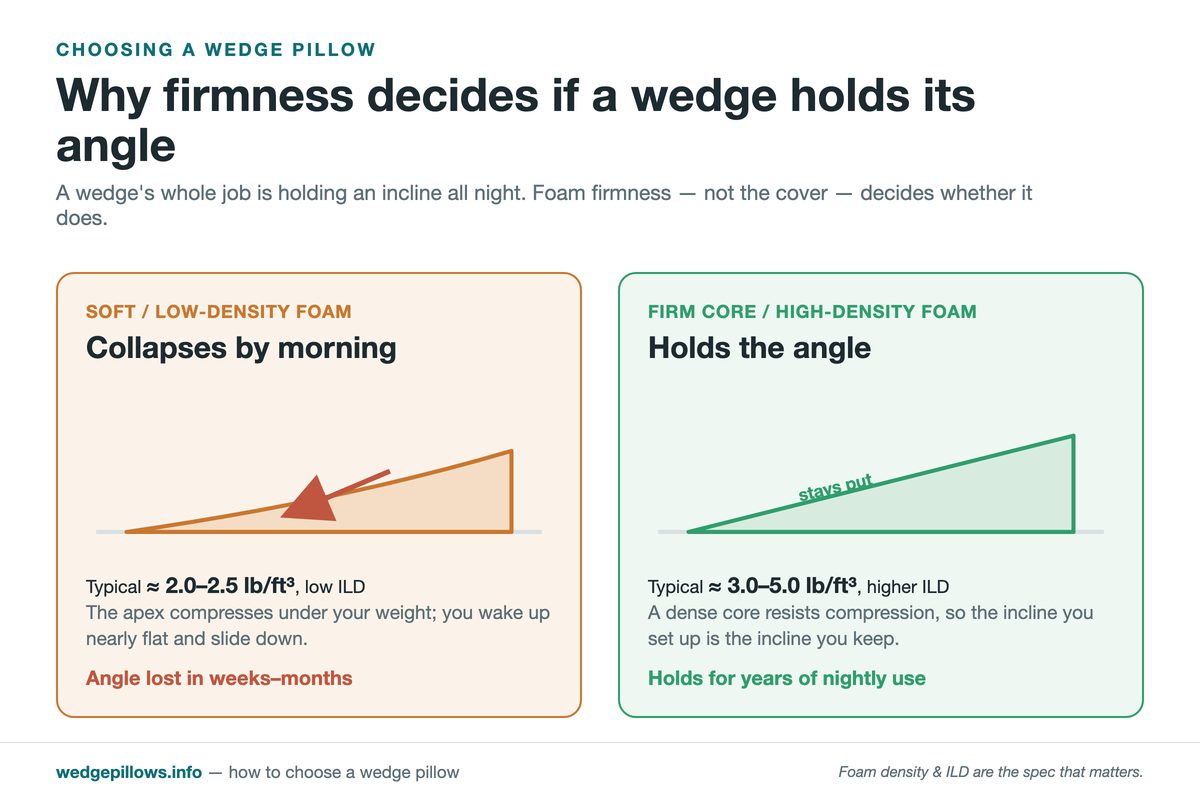
A wedge lives or dies on whether it holds its angle under your weight all night, and that is what firmness — measured as ILD — tells you. A wedge sold only as “soft and plush” is the one most likely to flatten by morning; that is fine for a cushion, not for a wedge whose whole job is the angle.
You will not always see an ILD (indentation load deflection — the standard foam-firmness rating) number, but you can read the proxy: a wedge that markets firmness and angle-retention is built for the job; one that markets only softness is not.
Fixed or adjustable wedge?
An adjustable or two-stage wedge lets you change the angle, which is genuinely useful if more than one person or more than one use case shares it — but every extra seam and layer is a place that can shift or slide. A well-made fixed wedge in the right angle is simpler and often holds its shape better; an adjustable wins when you truly need more than one angle.
Decide by honesty: if you only need one angle, fixed is less to go wrong.
What are the most common buying mistakes?
Three failures account for most returned wedges — too steep, too soft, and too short — and each is avoidable once you know to look for it.
- Too steep — bought on height, ends up a ramp you slide off. Fix: check the base length, not just the apex.
- Too soft — collapses overnight, angle gone by 3 a.m. Fix: buy firmness/angle-retention, not just plushness.
- Too short — shoulders hang off the apex, neck strains. Fix: match length to your frame.
The 60-second pick
- Use case? That sets your angle. (Reflux → gentle; reading → steeper; legs → low.)
- Your height? That sets your length. (Taller → longer wedge.)
- Firmness: pick one that markets angle-retention, not just softness.
- Foam: memory-foam top over a firm core is the safe default.
- Match to a product below.
Frequently asked questions
What size wedge pillow do I need?
Long enough that your shoulders stay on the slope — taller frames need a longer wedge — and a base of 24+ inches for full trunk support.
What angle is best for a wedge pillow?
It depends on the use: a gentle ~30-45° reclined torso for reflux, steeper for sitting up and reading, low for leg elevation.
What is the best material for a wedge pillow?
A firm support core with a memory-foam top is the common best-value build — comfortable but firm enough to hold the angle.
Is an adjustable wedge pillow better?
Only if you genuinely need more than one angle. A fixed wedge in the right angle has fewer parts to shift or slide.
Related questions
- How often should you replace a wedge pillow?
- Are wedge pillows good for stomach sleepers?
- Can a wedge pillow cause side effects?
Which wedge pillow should you buy?
With your elevation angle, apex height, size, and foam settled, the last step is to choose the wedge that holds them night after night. The best wedge pillows guide ranks current options by use case, and our Aeris memory-foam wedge pillow review and Flexicomfort bed wedge pillow review cover wedges built to hold their angle. Shopping for reflux specifically? Start with the acid reflux and GERD guide.
Related guides
- Wedge Pillows for Acid Reflux, GERD, and Better Sleep: How to Choose
- 5 Wedge Pillow Positions and Use Cases: One Cushion, Many Angles
- How to Clean a Wedge Pillow: Cover Washing, Foam Care, Drying Steps
Two makers’ wedges compared, with real numbers
We build both the Aeris and Flexicomfort wedges, so we can compare them on exact production specs rather than guesses. A higher, gentler angle suits reading and acid-reflux positioning; a steeper, shorter wedge suits leg elevation and a firmer sit-up.
| Aeris wedge | Flexicomfort wedge | |
| Footprint | 65 × 65 cm (25.6 × 25.6 in) | 60 × 56 cm (23.6 × 22 in) |
| Apex height | 22 cm (8.7 in) | 28 cm (11 in) |
| Incline | about 19° (gentler) | about 25° (steeper) |
| Weight | 3.1 kg (6.8 lb) | 3.5 kg (7.7 lb) |
| Top profile | S-curve sculpted | straight ramp |
| Cover | diamond-quilted viscose | removable cover |
Advertisement
Aeris Wedge Pillow
65 × 65 cm base, 22 cm apex, 3.1 kg — the wedge every measurement in this guide refers to.
See the Aeris Wedge product details on Amazon