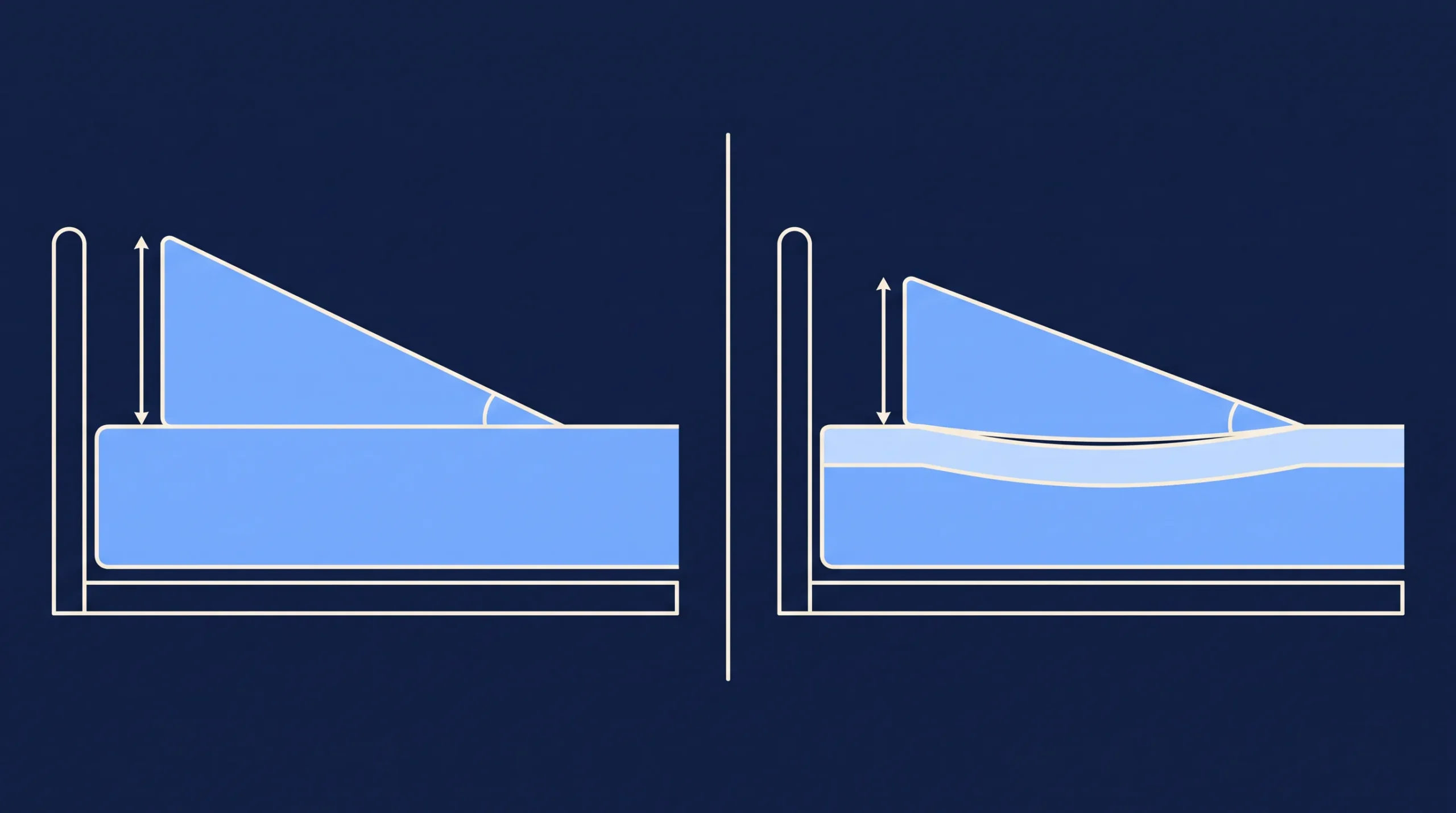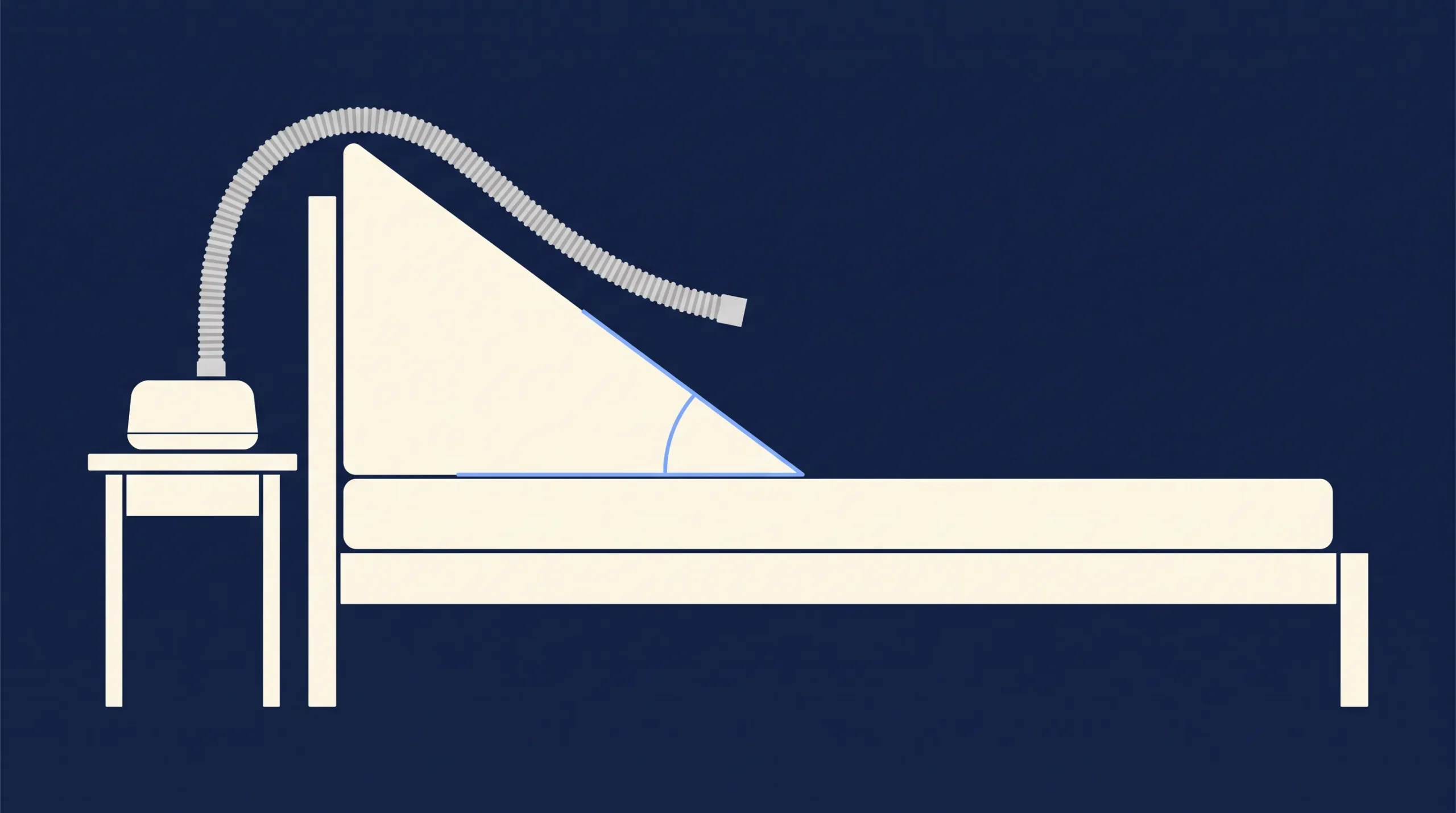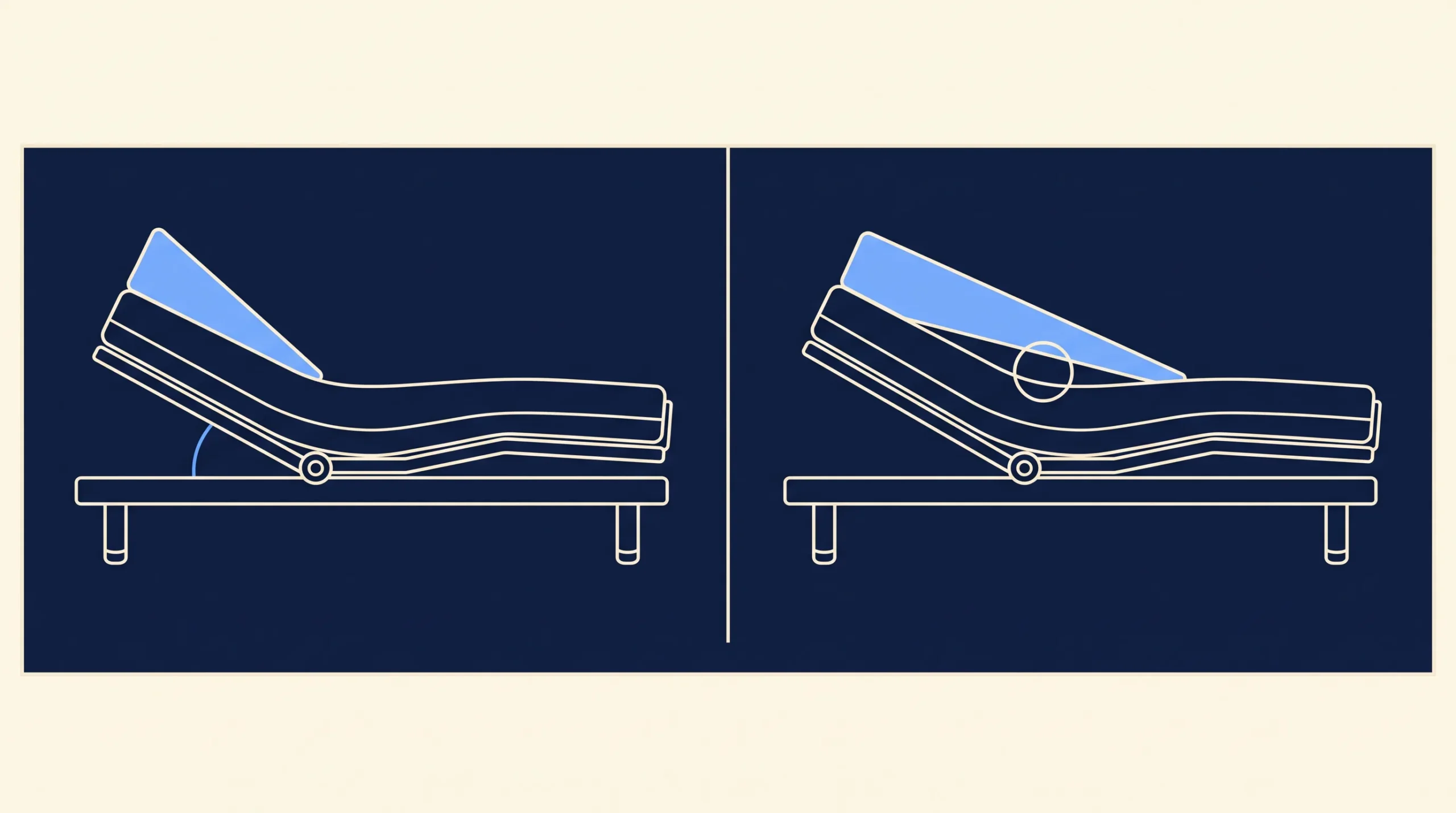
Last updated: November 2026
This guide is part of our full map of wedge pillows for acid reflux, GERD, and better sleep.
Yes, you can use a wedge pillow on an adjustable bed at the same time, and the two angles roughly add up — but only if the wedge pillow lies entirely on the raised head section, not across the hinge.
This guide covers how the two slopes combine, why the hinge is the part that decides whether the setup works, and the few situations where using both is better than using either alone.
Key takeaways
- A wedge pillow lying wholly on a raised head section adds its own angle to the base’s angle. On catalogue dimensions, the 18.7° of the Aeris Wedge Pillow on a base raised 20° gives about 38.7° in total.
- The hinge is the constraint. A wedge pillow longer than the raised section bridges the fold, so its thin end sits on the flat middle of the bed and the slope is no longer additive.
- Short wedges suit this better. An adjustable-bed maker, Sleep Number, sells a 24 × 20 × 8 inch wedge pillow, about 18.4°, adjustable to 2, 4, 6 or 8 inches with foam inserts.
- Steeper totals cost stability. The share of your weight pulling you down a slope is the sine of its angle: about 0.32 at 18.7°, 0.64 at 40°.
- Most elevation research used one method at a time. In the 2021 systematic review of five trials, every trial raised the head with bed blocks, a foam wedge, or both; two of the wedges described were 20 and 25 cm high, at 20° and 22°.
- Head-section angle ranges differ by model; check your base’s manual rather than a generic figure.
Can you put a wedge pillow on an adjustable bed?
Yes. An adjustable base does not keep a wedge pillow from sitting on the mattress, and many owners already do it for reading or for a slope the base cannot give on its own. The question is not whether it is allowed but whether the two parts cooperate.
They cooperate when each does a different job. The base sets a broad, gentle lift from the hips up; the wedge pillow adds a local, firmer slope under the shoulders and upper back. They fight when the wedge pillow is laid over the fold of the base, because a rigid foam ramp cannot bend where the mattress bends.
If you are still deciding between the two rather than combining them, our wedge pillow versus adjustable bed page compares cost, angle range and sleep position, and the pillow for sleeping upright guide covers backrests too.
How do the two angles add up?
When the wedge pillow lies flat on the raised head section, its slope stacks on top of the section’s slope, so the total is close to the sum of the two. The table is arithmetic on catalogue dimensions — slope as the arctangent of apex over base length — not a measurement of any bed.
| Wedge pillow | Base × apex | Own slope | Head section at 10° | at 20° | at 30° |
|---|---|---|---|---|---|
| FirmNest Extra Firm Wedge | 61 × 61 cm, 19 cm apex | 17.3° | 27.3° | 37.3° | 47.3° |
| Aeris Wedge Pillow | 65 × 65 cm, 22 cm apex | 18.7° | 28.7° | 38.7° | 48.7° |
| Sleep Number Adjustable Wedge | 24 × 20 in, 8 in apex | 18.4° | 28.4° | 38.4° | 48.4° |
| Flexicomfort Wedge Pillow | 60 × 56 cm, 28 cm apex | 25.0° | 35.0° | 45.0° | 55.0° |
Two cautions keep the table honest. The mattress sits between the deck and the wedge pillow and compresses under load, so the real figure is usually a little lower — the mechanism is explained on our soft mattress and topper page. And the totals rise quickly: a base at 30° plus almost any wedge pillow passes 45°, which is closer to sitting than lying.
For context, the studied setups were far gentler. The 2017 sleep apnea study measured head-of-the-bed elevation at 7.5°, where the apnea-hypopnea index fell from 15.7 to 10.7 events an hour in 52 patients. Two reflux trials in the review used foam wedges of 20° and 22°. Doubling up is not required to reach the angles that have been studied.
Why does the hinge decide whether it works?
Because a wedge pillow is a rigid ramp and an adjustable base bends. When the head section rises, the mattress folds roughly where the raised deck meets the flat middle of the bed, and anything lying across that fold has to bridge it.
A wedge pillow that fits inside the raised section moves with it as a single unit. One that is longer than the section rests its thick end on the raised deck and its thin end on the flat part, touching the mattress at two edges with a gap under the middle. The slope is then set by those two contact points rather than by the wedge pillow’s own angle, and the unsupported span can rock when you shift.
This is why length matters more on an adjustable base than on a flat bed. The catalogue base lengths above run from 60 to 65 cm — about 24 to 26 inches — and Sleep Number’s own wedge pillow is 24 inches long. Our wedge pillow height guide explains how length and apex together set the angle on a flat surface.
4 things to check before you stack a wedge pillow on a raised base
Each needs a tape measure and the base’s remote. None needs any new equipment.
- The raised section’s length. Raise the head and measure along the mattress surface from the head end to where it starts to fold. Head-section lengths are rarely printed on spec sheets, so measuring is the only reliable figure. Compare it with your wedge pillow’s base length.
- Where your hips land. Lie down with the base raised and no wedge pillow. Your hips should sit at or just below the fold; if they sit above it, the base is bending you at the waist before any wedge pillow is added.
- The gap under the wedge pillow. Put the wedge pillow in place and slide a hand under its thin end. A gap means it is bridging the fold — move it towards the head end or use a shorter wedge pillow.
- The total angle you actually need. Lower the base until the wedge pillow alone, plus a few degrees from the base, feels right. Starting low and adding is easier than starting high and sliding.
When is using both better than using one?
Three situations come up repeatedly, and each gives the two parts a separate job.
The first is a top-up: the base runs out of range in one direction you want, or its lowest raised setting is steeper than you like while flat is too flat. A low base angle plus a short wedge pillow gives an intermediate slope that neither setting offers on its own.
The second is a firmer surface under the upper back. An adjustable base lifts the whole mattress, so the slope you lie on is still the mattress’s own comfort layer. A dense wedge pillow on top gives the shoulders and upper back a firmer ramp without changing the mattress — useful if you use a CPAP mask and want the head held steadier, a set-up our wedge pillow with a CPAP page covers.
The third is a shared bed. On a single-section base, raising the head raises both sides. A wedge pillow on one side only gives one sleeper extra elevation, which is the approach in our guide to elevating just your side of a shared bed.
Does a steeper combined angle make you slide more?
It can, and the physics is simple. The share of your body weight acting down the slope is the sine of the angle: about 0.17 at 10°, 0.32 at the Aeris Wedge Pillow’s 18.7°, 0.64 at 40° and 0.71 at 45°. Doubling the angle from 20° to 40° nearly doubles the pull towards the foot of the bed.
Sliding was the most common complaint in the research too. In the 2020 trial of bed blocks summarised in the review, 39 of 63 participants reported mostly minor adverse events at 14 weeks, 24 of them bed-related, such as bed slipping and unsteadiness. That trial used 20 cm wooden blocks rather than a wedge pillow, but the lesson carries: more slope means more effort to stay put.
An adjustable base with a foot or knee lift can help here, because raising the knees puts a stop below your hips. The sliding section of our acid reflux and GERD guide covers the other options.
What about a wedge pillow under the mattress of an adjustable bed?
Not on the moving deck. An under-mattress wedge is designed to sit between a flat foundation and the mattress; on an articulating base it sits across the same fold a wedge pillow would, and it changes how the mattress bends at the hinge. Check the base manufacturer’s guidance before putting anything between the deck and the mattress.
If your bed does not articulate, the comparison between lifting under the mattress and on top is on our wedge under the mattress or on top page, and lifting the whole frame is covered on the wedge pillow versus bed risers page.
Frequently asked questions
Can you put a wedge pillow on an adjustable bed?
Yes. A wedge pillow can sit on the mattress of an adjustable bed like any other surface. It works best when it lies wholly on the raised head section, so it moves with the deck as one unit. Laid across the fold, it bridges the hinge and can rock.
Do the angles of a wedge pillow and an adjustable bed add together?
Roughly, when the wedge pillow lies flat on the raised section. An 18.7° wedge pillow on a head section raised 20° gives about 38.7° on catalogue dimensions. Mattress compression usually takes a little off, and a wedge pillow bridging the hinge does not add its full angle.
What size wedge pillow fits an adjustable bed?
One whose base length is shorter than the raised head section, measured along the mattress from the head end to the fold. Head-section lengths are rarely published, so measure yours. Shorter wedge pillows, around 24 inches long, are the easier fit.
Is a combined angle of 45 degrees too steep for sleeping?
It is steep. At 45°, about 0.71 of your weight acts down the slope, compared with 0.32 at 18.7°, so more effort goes into staying in place. The studies cited here used 7.5° to 22°. If you need a steep angle for a medical reason, ask your doctor what to aim for.
Should I raise the base or the wedge pillow first?
Start with the wedge pillow on a flat bed, then add a few degrees from the base. Starting low and adding small amounts makes it easier to find the angle where you stop sliding, and it keeps your hips at the fold rather than above it.
Can I use the foot raise with a wedge pillow?
Yes. A knee or foot lift places a stop below your hips, which can reduce sliding down a steeper combined slope. It also changes where your hips sit relative to the fold, so check the gap under the wedge pillow again after adjusting.
Will a wedge pillow damage an adjustable base?
A wedge pillow sits on the mattress, not the mechanism, and adds only its own weight — a few kilograms. Placing objects between the deck and the mattress is a different matter; follow the base manufacturer’s manual for that.
Choosing a wedge pillow to pair with an adjustable bed
The useful specification here is base length first, firmness second: a wedge pillow has to fit on the raised section before its angle counts. Our walkthrough in how to choose a wedge pillow starts from the use case and works down to dimensions.
The three below cover a gentle slope on a firm core, a mid slope on the longest base, and the steepest of the three for owners who keep the base low. Methodology note: dimensions come from the makers’ production specifications and the research cited above, with angles calculated as the arctangent of apex over base.
Advertisement
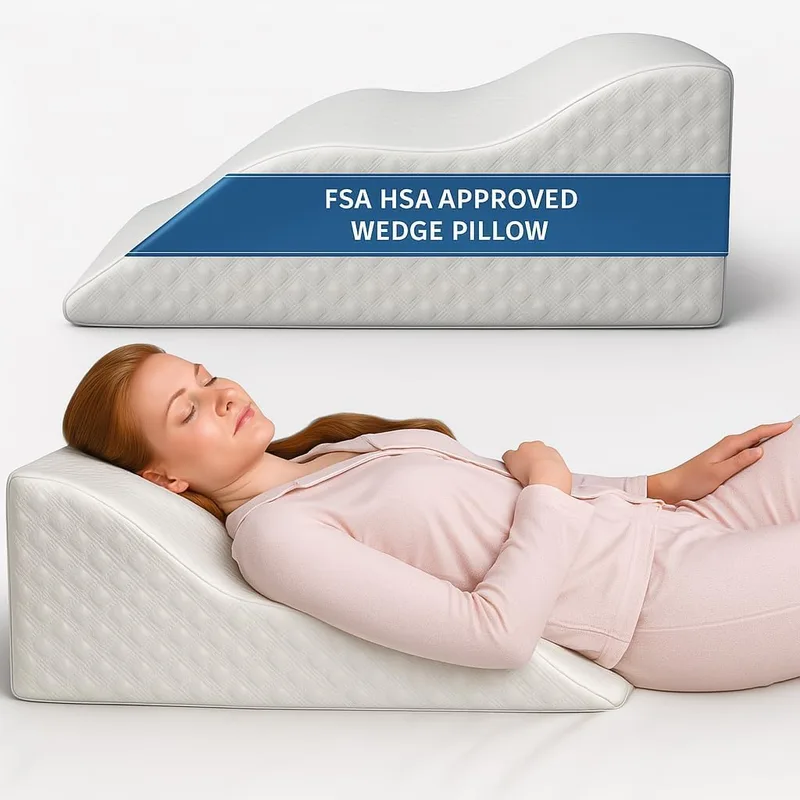
Aeris Wedge Pillow
65 × 65 cm base, 22 cm apex, 3.1 kg.
See the Aeris Wedge product details on AmazonProducts mentioned in this guide
- FirmNest Extra Firm Wedge Pillow — 61 × 61 cm base, 19 cm apex, about 17.3°
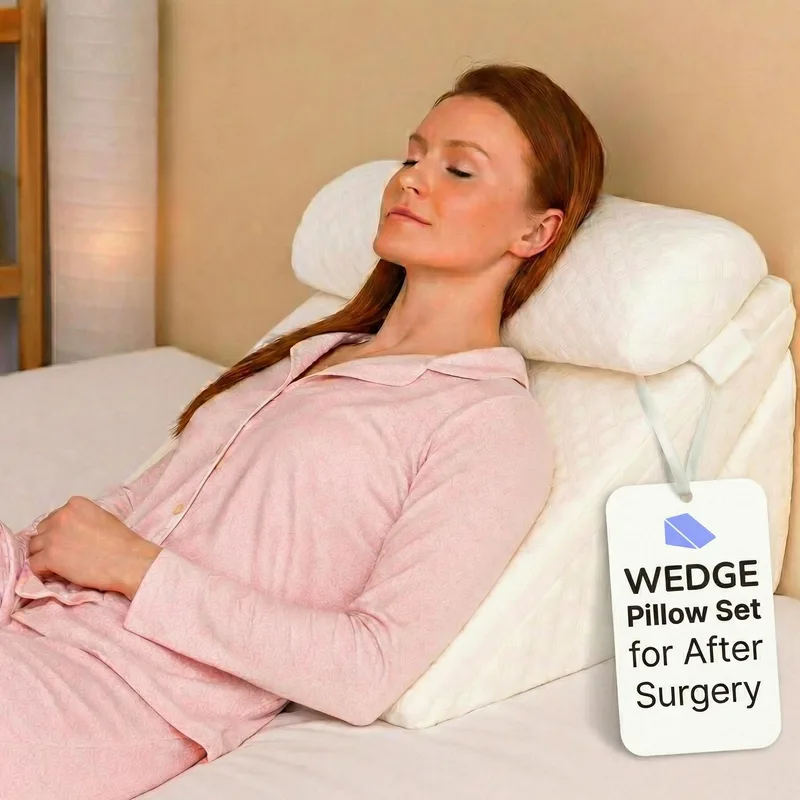 Flexicomfort Wedge Pillow — 60 × 56 cm base, 28 cm apex, about 25.0°