Last updated: September 2026
This guide is part of our full map of wedge pillows for acid reflux, GERD, and better sleep.
Wedge pillow height is only half the story: the angle depends on the wedge’s length too. For sleeping with reflux or snoring, 7.5 to 9 inches on a 24 inch ramp is the sweet spot; 10 to 12 inches is for sitting up.
Height is the number everyone shops by, so this guide puts the length next to it, shows what the studies actually used, and ends with a three-question chooser.
Key takeaways
- Height sets how far your head rises; height divided by length sets the angle. A 7.5 inch wedge that is 24 inches long is about 17 degrees; the same 7.5 inches over 18 inches is 23 degrees.
- Mild elevation works in the research: a 2017 study of 52 sleep-apnea patients found a 7.5 degree head-of-bed tilt cut the apnea-hypopnea index from 15.7 to 10.7 events per hour.
- The reflux trials used about 20 cm (8 inches) of lift: a 2021 systematic review of five studies, and a 2021 crossover trial that used a 20 cm high, 62 cm long, 20 degree memory-foam wedge.
- Steeper is not automatically better: at 30 degrees a 2026 study still saw apnea improve, but sleepers slide and necks bend more on a steep slope, so most people cannot hold it all night.
- 10 to 12 inch wedges are reading and recovery heights: the angle is for sitting, not for sleeping on your back for eight hours.
- Retail “30 degrees = 7 to 8 inches, 45 degrees = 10 to 12 inches” charts assume one fixed length and are wrong for most wedges; measure both numbers before you buy.
- Our own range covers all three tiers: the FirmNest Extra Firm Wedge at 7.5 inches over 24 (about 17 degrees), the Aeris Wedge Pillow at 8.7 inches over 25.6 (about 19 degrees), and the Flexicomfort Wedge Pillow Set at 11 inches over 23.6 (about 25 degrees) with its own headrest.
What does wedge pillow height actually change?
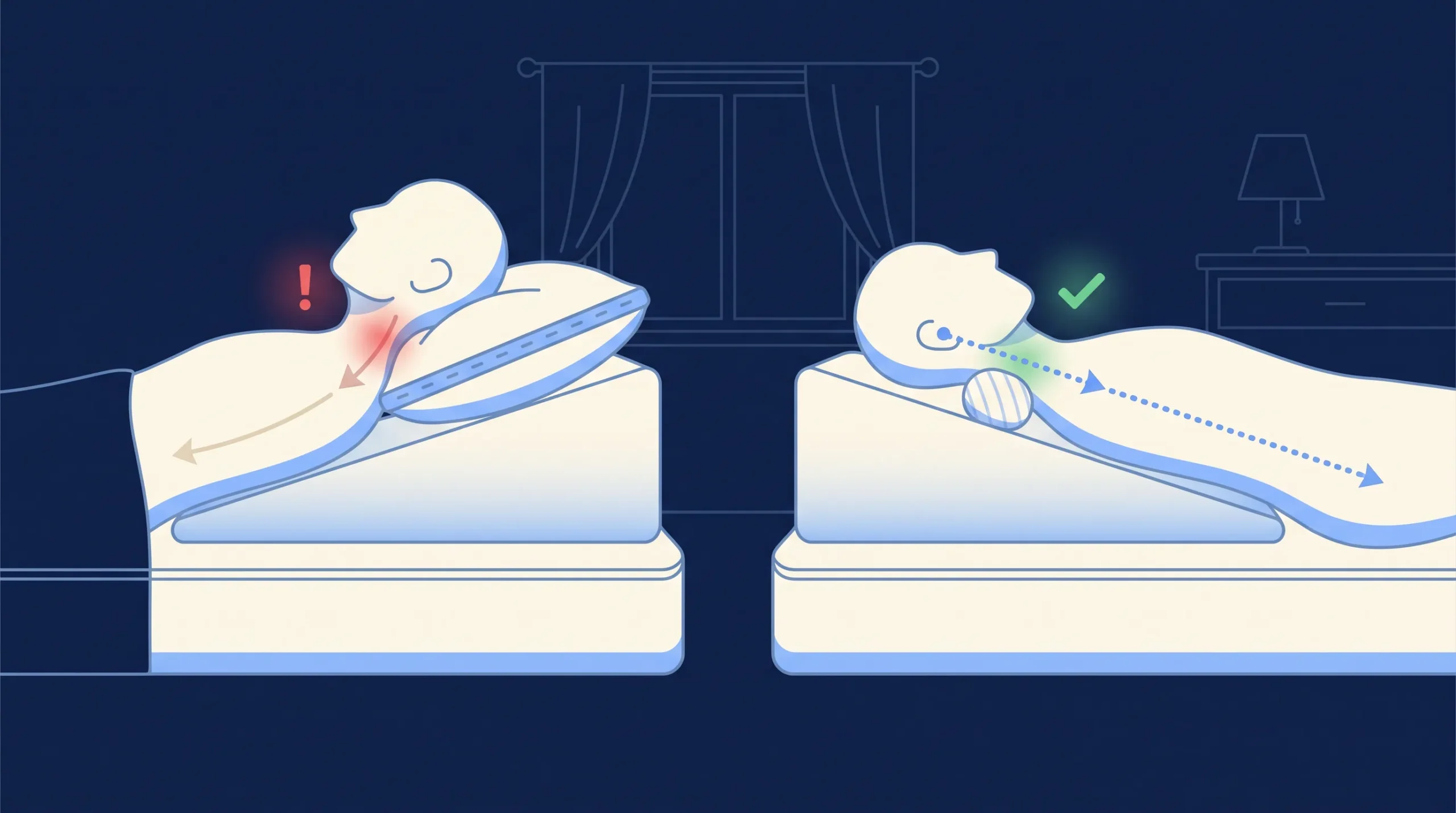
Height changes two things at once: how high your head ends up, and, together with the length of the ramp, how steep the slope under your torso is. The first number is what reflux and snoring care about, because both respond to the head and chest being above the stomach and throat. The second is what your neck, shoulders and hips care about, because a steep slope bends the body at the waist and lets you slide.
That is why two wedges with the same height can feel completely different. A 10 inch wedge that is 30 inches long is a gentle 18 degree ramp you lie along; a 10 inch wedge that is 20 inches long is a 27 degree step that props your shoulders and leaves your lower back on the flat mattress. The retail habit of quoting height alone, or of pairing heights with fixed angles, hides this. Puffy’s size guide, for example, says a 30 degree wedge is “7 to 8 inches” and a 45 degree wedge is “10 to 12 inches”; that is only true if every wedge is about 13 inches long, and almost none are. Our five-step guide to choosing a wedge pillow puts length next to height for that reason.
How high should a wedge pillow be for acid reflux?
About 8 inches, which is what the trials used, and lower is better than steeper if you have to choose. The American College of Gastroenterology’s 2022 guideline suggests elevating the head of the bed for night-time symptoms as a conditional recommendation with a low level of evidence. The 2021 systematic review behind that advice pooled five trials with 228 patients, most raising the head end by about 20 cm (8 inches) with bed blocks or a wedge, and found symptom improvement across them.
The one trial in that literature that describes its wedge precisely is useful here: Huang and colleagues, 2021 ran a two-week crossover in 14 patients with reflux after esophageal surgery, using a memory-foam wedge 20 cm high, 62 cm long, at a 20 degree angle, alongside medication. Reflux symptom scores were lower with the wedge than with medication alone, and the authors describe the combination as “may be beneficial.” That geometry, 8 inches over about 24 inches, is the shape most reflux wedges should copy. Our wedge pillow for acid reflux guide covers the sliding problem that comes with going steeper. None of this replaces the plan you make with your doctor; elevation is a supporting measure in the guideline, not a treatment.
How high should a wedge pillow be for snoring and sleep apnea?
Lower than you think: a mild tilt already changes the airway. In a 2017 study in Sleep Breath, 52 patients with obstructive sleep apnea slept one night flat and one night with the head of the bed raised by only 7.5 degrees. The apnea-hypopnea index fell from a median of 15.7 to 10.7 events per hour and minimum oxygen saturation rose from 83.5 to 87 percent, with sleep architecture unchanged; in a subset who went back to flat, the index returned to baseline. Seven and a half degrees is a very low wedge or a small riser under the bed legs, not a tall foam block.
A steeper tilt helps too, but with diminishing returns. A 2026 study in The Laryngoscope measured 30 degree head-of-bed elevation in apnea patients: the index fell from 22.6 to 16.4 events per hour, and lying on the side reduced it further to 11.7. The authors call the findings hypothesis-generating. The practical reading is that a 7.5 to 9 inch wedge over a 24 inch ramp, which lands between 17 and 20 degrees, captures most of the benefit while staying sleepable, and that side sleeping matters at least as much as height. Our wedge pillow for snoring and wedge pillow for sleep apnea guides go deeper, and sleep apnea itself needs a diagnosis and a treatment plan from a sleep physician; a wedge is not a substitute for one.
Degrees, not inches, is what the studies measured. 7.5 degrees over a 6.5 foot bed is a 10 inch lift at the head end of the frame, but on a 24 inch wedge the same angle is only 3 inches. When a study says “head-of-bed elevation,” check whether it tilted the whole bed or used a wedge before copying the number.
7.5 vs 10 vs 12 inches: 3 heights and what each is for
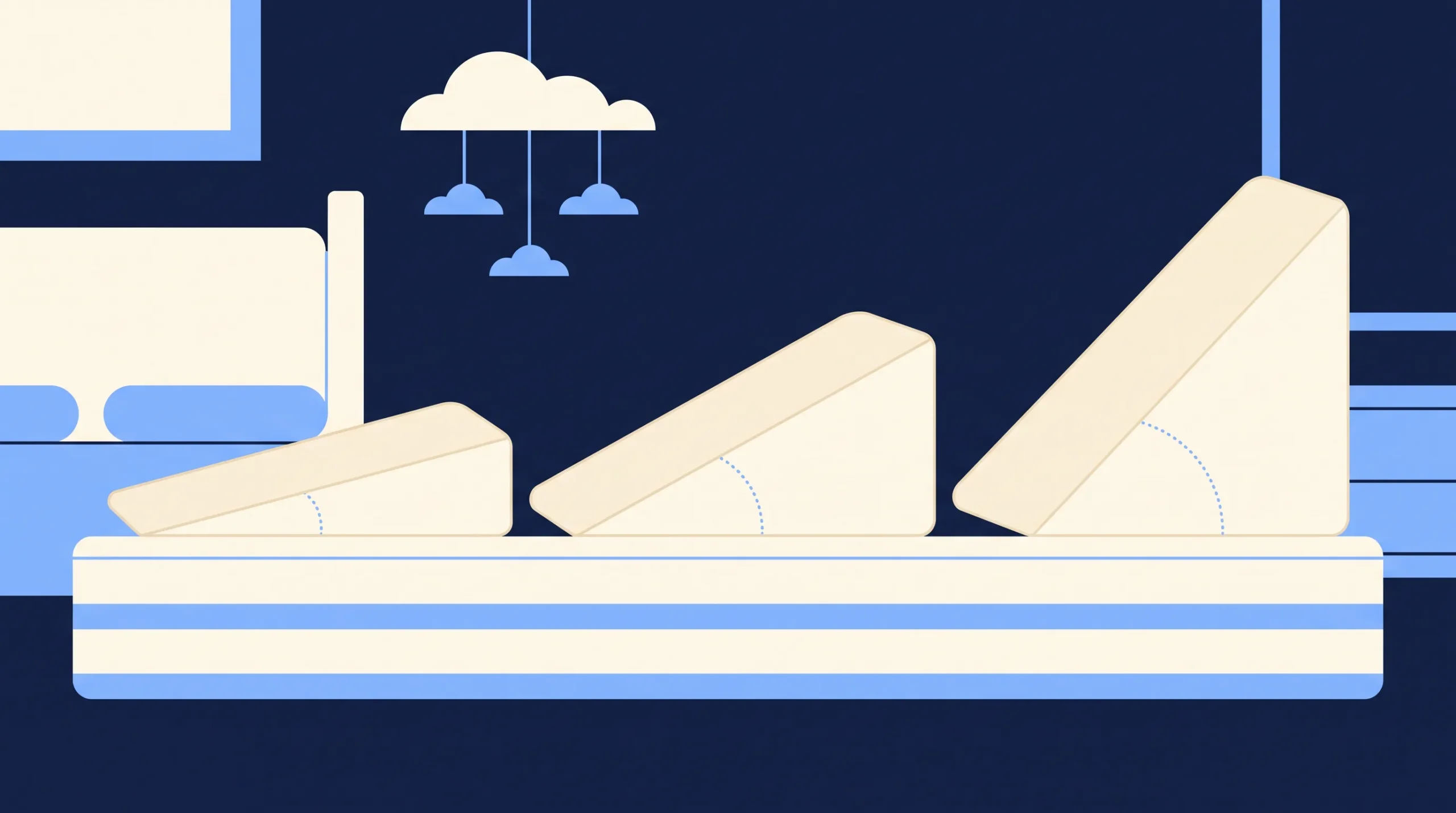
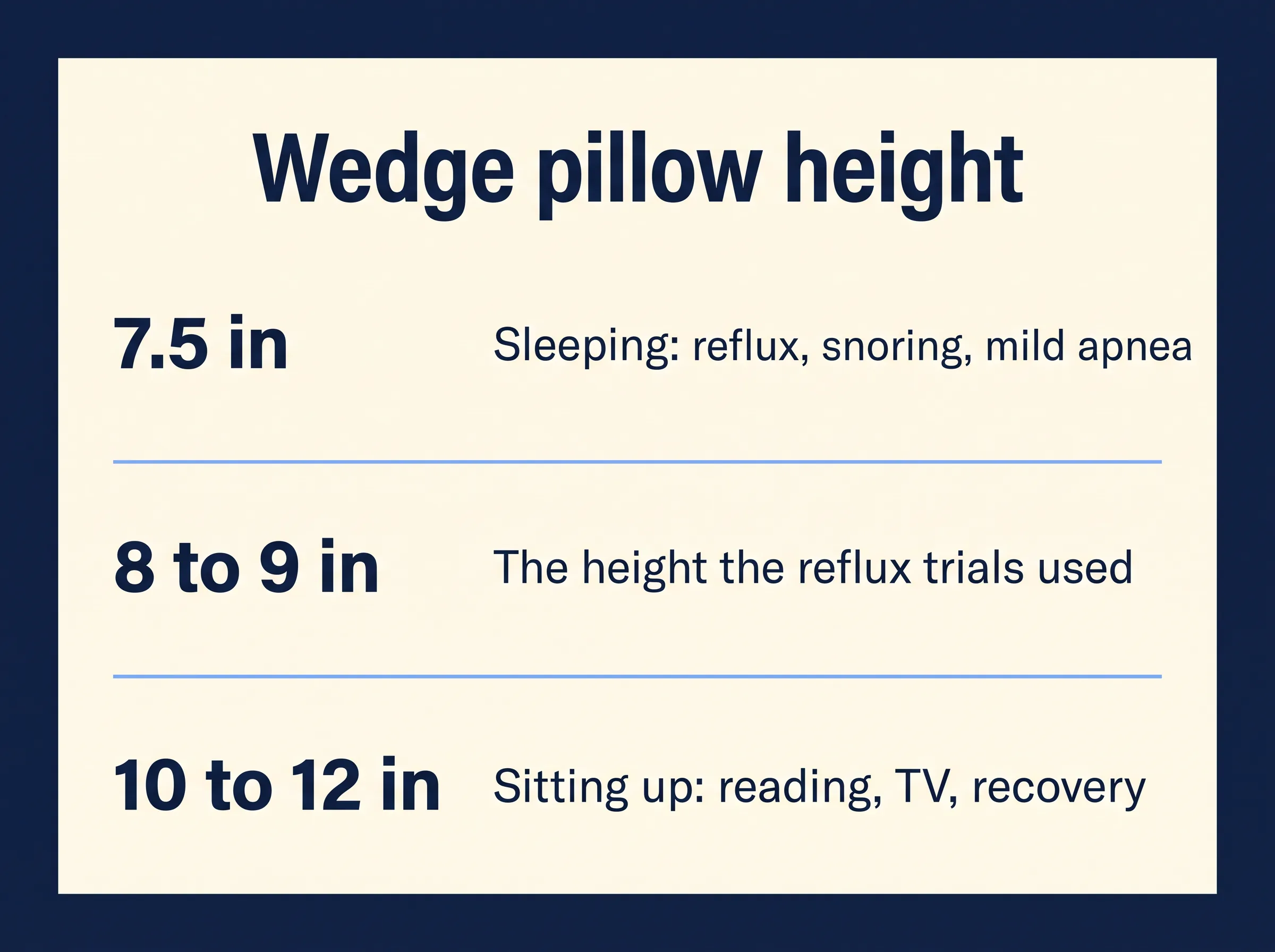
Three heights cover the market, and each has a job. Angles below assume a 24 inch (61 cm) ramp; a longer wedge is gentler, a shorter one steeper.
| Height | Angle on a 24 in ramp | Best for | Sleep position | Watch out for |
|---|---|---|---|---|
| 7.5 in (19 cm) | about 17° | Night-time reflux, snoring, mild apnea, post-nasal drip; the FirmNest tier | Back, and side with a knee pillow | Too low for sitting up to read |
| 8 to 9 in (20–23 cm) | 18–21° | The trial height for reflux; the all-round sleeping wedge | Back; side with a wide wedge | Needs a thin or no head pillow |
| 10 in (25 cm) | about 23° | Reflux when 8 in was not enough; recovery from surgery; reading | Back only for most people | Sliding; lower-back ache without a knee pillow |
| 12 in (30 cm) | about 27° | Sitting up: reading, TV, laptop, post-op upright rest | Reclined sitting, short naps | Not a sleeping angle for most; neck pushes forward |
Two rules of thumb come out of that table. If the wedge is for sleeping on all night, stay at or below 9 inches unless a doctor has told you otherwise. If it is for sitting up, 10 to 12 inches earns its height; our wedge pillow for reading and TV and sleeping upright guides cover those uses, and the post-surgery recovery article explains why recovery wedges run taller for a few weeks and then feel too steep.
Does wedge pillow length matter as much as height?
Yes, and for side sleepers and tall people it matters more. Length decides where the slope starts on your body. A 24 inch wedge placed with your hips at its bottom edge lifts your torso from the waist up; a 30 inch wedge starts under the hips and turns the same height into a gentler, longer incline that is easier to hold on your side; an 18 inch wedge starts at the shoulder blades and props you like a bolster.
The wedges we make show the trade-off in numbers, one per tier. The FirmNest Extra Firm Wedge Pillow is 61 by 61 by 19 cm, 7.5 inches over a 24 inch ramp, about 17 degrees, in a high-density extra-firm foam that does not pack down under the shoulders; it is the lowest sleeping height in our range and the closest to the mild tilts in the apnea study, and it is expected on Amazon in early October 2026. The Aeris Wedge Pillow is 65 by 65 cm with a 22 cm apex, which is 8.7 inches over a 25.6 inch ramp, about 19 degrees: the trial height on a long, wide base, which is why it is our default for reflux and snoring and for people who sleep on their side on a wedge. The Flexicomfort Wedge Pillow Set is 60 by 56 by 28 cm, 11 inches over 23.6 inches, about 25 degrees, and it ships with an adjustable headrest: that is the sitting-up and recovery geometry, and the headrest solves the neck problem a steep wedge creates. In our hands-on testing the Aeris is the one people sleep on all night; the Flexicomfort is the one they read on and use for the first weeks after a procedure; the FirmNest is for sleepers who found even 8.7 inches too much, or who want the firmest slope. All three sets of figures come from the makers’ production specifications.
Measure your bed before you measure the wedge. Lie flat and have someone measure from the mattress to the top of your shoulder as you lie on your side; a sleeping wedge should not be much taller than that number plus 2 inches, or your head will hang forward once a pillow goes on top. Our pillow on top of a wedge pillow guide explains the neck side of this.
Which wedge pillow height do you need? Answer three questions.
Frequently asked questions
Is a 7.5 inch wedge pillow enough for acid reflux?
Often, yes. The trials used about 8 inches of lift, and a 7.5 inch wedge on a 24 inch ramp, the FirmNest Extra Firm Wedge’s geometry, gives a 17 degree slope that most people can hold all night. If symptoms persist after two weeks, try the left side and an earlier dinner before going taller, and raise it with your doctor.
What is the best wedge pillow height for sleep apnea?
The research shows benefit from very mild tilts: a 7.5 degree head-of-bed elevation reduced apnea events in a 2017 study of 52 patients, and 30 degrees helped further in a 2026 study. A 7.5 to 9 inch wedge over 24 inches sits between those. Sleep apnea needs a physician’s diagnosis and treatment plan; a wedge supports it, it does not replace it.
Is a 12 inch wedge pillow too high for sleeping?
For most people, yes. Twelve inches over a 24 inch ramp is about 27 degrees, a sitting angle: you slide, your lower back arches, and any head pillow pushes the chin down. It is the right height for reading, TV and the first weeks after surgery, then most people move down to 8 or 9 inches for sleep.
How many degrees is a 10 inch wedge pillow?
It depends on the length. Ten inches over 24 inches is about 23 degrees; over 30 inches it is 18 degrees; over 20 inches it is 27 degrees. Retail charts that fix “10 to 12 inches = 45 degrees” assume a very short wedge. Divide height by length and look up the arctangent, or use our table above.
Should a taller person buy a taller wedge pillow?
A longer one, not a taller one. Height should match the use (sleeping versus sitting); length should match the body, so the slope starts at the waist rather than the shoulder blades. A 6 foot 2 back sleeper is better served by 8.7 inches over a 25.6 inch ramp than by 12 inches over 20.
Can I make a low wedge higher by adding pillows?
Not well. A pillow under the wedge lifts and tilts it; a pillow on top lifts the head twice and bends the neck. If you need more lift, a low set of bed risers under the head-end legs plus the same wedge raises everything evenly, and a wedge under the knees stops the sliding.
Is a lower wedge pillow safer for people with back or neck problems?
Usually gentler, yes: a lower angle bends the body less at the waist and lets the neck stay closer to neutral. Our wedge pillow side effects article lists who should be careful with inclined sleeping at all; if you have an existing spine condition, ask a physical therapist before choosing any height.
Our recommendation by use
Sleeping with reflux, snoring or congestion: 7.5 to 9 inches on a ramp of 24 inches or more; the Aeris at 8.7 inches over 25.6 is the shape we would start everyone on, and the FirmNest at 7.5 over 24 is the step down for people who want less lift or a firmer slope. Sitting up, reading, or recovering from surgery: 10 to 12 inches, and the Flexicomfort set at 11 inches with its headrest is built for exactly that. Unsure: buy the sleeping height first, because a wedge you can stay on all night beats a taller one you abandon by 2 a.m.
Whatever height you choose, read the length on the spec sheet next to it, give the first week to adaptation, and change one thing at a time. The best wedge pillows by use guide picks specific models for each row of the table above.
Advertisement
Aeris Wedge Pillow
65 × 65 cm base, 22 cm apex, 3.1 kg — the wedge every measurement in this guide refers to.
See the Aeris Wedge product details on Amazon