Last updated: November 2026
This guide is part of our full map of wedge pillows for acid reflux, GERD, and better sleep.
Is a wedge pillow FSA or HSA eligible? It can be, if you buy it primarily because of a medical condition, not for comfort. Amazon’s label doesn’t decide that: your FSA plan does, and with an HSA your records must show it.
The test is the same for a health FSA (the employer plan you fund from your paycheck) and an HSA (the account that goes with a high-deductible health plan). The paperwork and the deadlines differ: FSA money is tied to a plan year, while HSA money does not expire.
Key takeaways
- Your reason for buying is the test. IRS Publication 502 counts costs “primarily to alleviate or prevent a physical or mental disability or illness”, not those “merely beneficial to general health”; a wedge pillow for reading in bed fails it.
- No list settles it. FSAFEDS, the federal employees’ FSA program, has no wedge or pillow entry; WEX lists an “Acid Reflux Pillow” as eligible, and sleeping pillows only “in rare cases”, with a doctor’s note or prescription and only for the cost above a regular pillow.
- Amazon’s label is a checkout check. Amazon says it comes from “an industry standard list” (Amazon); it means the card can pay for that item, not that the purchase is medical care for you.
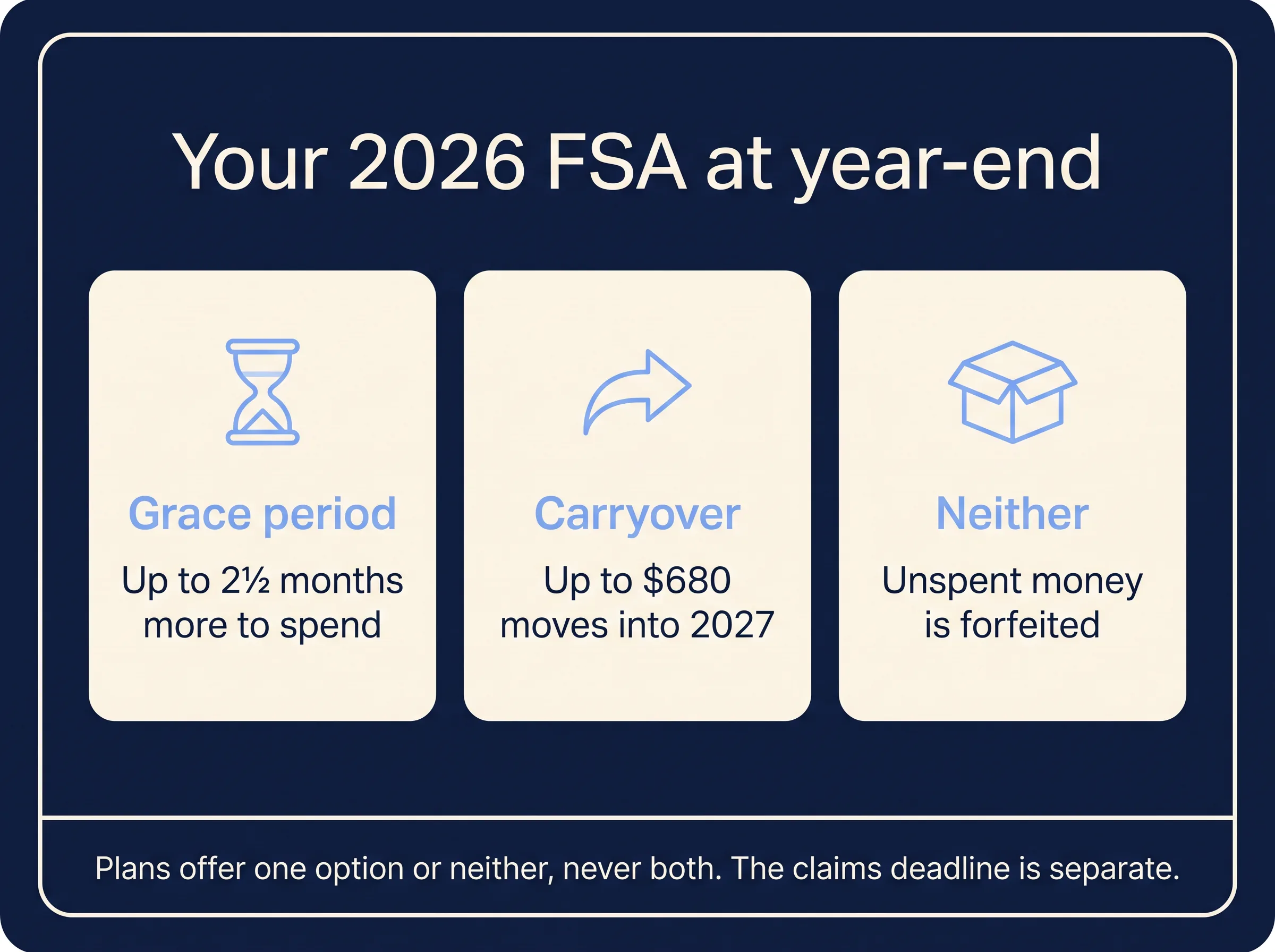
- 2026 year-end: a plan may offer a grace period of up to 2½ months (Publication 969) or a carryover of up to $680 of unused 2026 money (IRS), never both. The deadline to file claims is separate and set by your plan (April 30, 2027 at FSAFEDS). HSA money does not expire.
- Amazon charges an FSA card at shipment, not at order, so leave a margin before your plan year ends and ask your plan how it dates online purchases.
- The route: check your plan’s rules, confirm the label on the exact item, pay with the card (or pay another way and file a claim), and keep the itemized receipt.
- Some plans want a letter of medical necessity from a doctor or other licensed practitioner (FSAFEDS). The IRS has warned against companies claiming that notes “based merely on self-reported health information” make personal spending medical.
Is a wedge pillow FSA eligible under the IRS rules?
Only when its main purpose is medical care. Medical care expenses “must be primarily to alleviate or prevent a physical or mental disability or illness” and do not include those “merely beneficial to general health, such as vitamins or a vacation” (IRS Publication 502). The same section 213 test governs FSAs and HSAs (IRS FAQ), and within it an FSA pays the expenses “specified in the plan” (Publication 969).
So a wedge pillow can go either way. The same foam ramp can be bought because of a medical condition or for reading in bed, and only the first is medical care. For nighttime GERD symptoms, for example, the American College of Gastroenterology’s 2022 guideline suggests elevating the head of the bed, a conditional recommendation based on a low level of evidence. Our acid reflux and GERD guide covers where a wedge pillow fits in. That guidance is about sleeping position; it says nothing about what an FSA or HSA pays for.
A doctor’s suggestion is not automatically enough. The IRS says exercise stays a general-health expense “even if recommended by a doctor”, and in a September 2026 answer on wearable sleep and fitness trackers it put the principle plainly: “A generalized desire to monitor or improve health is not sufficient” (IRS FAQ). By the same logic, wanting to sleep better in general is not a medical reason.
Why do lists disagree on whether a wedge pillow is eligible?
Because each list is one organization’s reading of the IRS test, and the test turns on your reason for buying, which no list can see. Two published lists, read in November 2026, show the gap: FSAFEDS, the federal employees’ FSA program (320 entries), and WEX, a benefits administrator (673 entries).
| Item, as the list names it | FSAFEDS | WEX |
|---|---|---|
| Wedge pillow or bed wedge | No entry | No entry |
| “Acid Reflux Pillow” | No entry | “Eligible” |
| “Pillows (sleeping)” | No entry | “Rx/MN” (doctor’s note or prescription), only “in rare cases” and only for the cost above a regular pillow |
Neither list settles the wedge question. FSAFEDS names no pillow at all, and WEX does not say which pillow entry applies to a wedge. Where both lists do name an item, they can contradict each other outright: FSAFEDS lists a “Recliner ($1000 max)” with a letter of medical necessity plus detailed receipt, while WEX marks “Recliner Chairs” as “Not Eligible”; our wedge pillow vs recliner guide compares a recliner with a wedge. A page that calls wedge pillows “FSA eligible” without naming a plan gives you one list’s reading, not a rule.
Your own plan’s rules are the ones that count, and some plans are narrower than either list: a limited-purpose FSA, the kind you can hold alongside an HSA, covers a narrower set of costs, such as dental, vision and preventive care (Publication 969).
What does Amazon’s “FSA or HSA eligible” label mean?
It means Amazon treats the item as one an FSA or HSA card can pay for at its checkout. Amazon “uses an industry standard list to determine if an item is FSA or HSA eligible” and shows the label, which it calls a badge, on search results or the product page (Amazon FSA/HSA store).
FSA cards also come with IRS rules of their own. Since 2008, stores outside health care may take FSA cards only if they run an inventory information approval system (IRB”>Notice 2006-69). Those notices cover FSA and HRA (health reimbursement arrangement) cards; with an HSA card, keeping the records is your job (Publication 969).
So the label answers a different question from the IRS test: whether the card works for this item. Amazon says it works with the list publisher to “make sure that all sizes and colors of an item are eligible”, so check the label on the exact size and color in your cart.
We make and sell the Aeris Wedge Pillow, and the same applies to it. At the time of writing (November 2026), Amazon’s product page for the Aeris Wedge Pillow shows the “FSA or HSA eligible” label. That is Amazon’s classification, not a guarantee: it covers the checkout, not your reason for buying, which the checkout cannot see. If you file an FSA claim, your plan decides and may ask for a letter of medical necessity; with an HSA, your records must show the medical reason. Either way, keep the receipt. We apply the same caution to any wedge listing that calls itself “FSA eligible”, as in our Vekkia vs Bueoure comparison.
When do your 2026 FSA funds expire?
At the end of your plan year, unless your plan adds one of the two extras below. Your 2026 election, capped at $3,400 (IRS), is tied to that plan year; FSAFEDS, a calendar-year plan, requires 2026 expenses to be incurred between January 1 and December 31 (FSAFEDS).
A plan may add one extra, never both, and may offer neither (Publication 969):
- A grace period of up to 2½ months, in which you can still spend leftover money.
- A carryover of up to $680 of unused 2026 money into 2027 (IRS), or less if the plan sets a lower cap; at FSAFEDS it applies only if you re-enroll for at least $100.
The claims deadline is a separate date set by your plan. It gives you time to file, not to buy; FSAFEDS’s is April 30, 2027 (FSAFEDS).
Online orders need a margin. Amazon charges an FSA card when the item ships, and no source we found says whether a plan dates an online purchase by the order, the shipment or the delivery, so a wedge ordered in the last days of December could fall into the next plan year. Ask your plan how it dates online purchases.
HSA money does not expire; unused balances carry over (Publication 969). The full FSA vs HSA rules, including the 2026 limits, are in the companion guide on pillows and other sleep products.
How do you buy a wedge pillow on Amazon with an FSA or HSA card?
Check your plan, add the card, confirm the label, pay, and keep the receipt. The Amazon rules quoted below come from its FSA/HSA store page:
- Check your plan’s rules. Your plan administrator or employer can tell you whether the plan covers a wedge pillow for your condition and whether it wants a letter of medical necessity; if it does, have the letter ready.
- Add the card to your Amazon account as an FSA or HSA card, not as an ordinary credit card. Amazon accepts FSA and HSA cards with U.S. billing addresses only, for eligible items (Amazon payment help). If you register the card as a credit card, “you’ll be responsible for ensuring the card is used only for eligible products”.
- Confirm the label on the exact item. Look for “FSA or HSA eligible” on the product page for your size and color; search results can also be filtered by it.
- Pay with the card. With ineligible items in the cart, or gift wrap on an eligible one, add a second payment method and Amazon “will charge the correct amount to each card or payment method”. The card also covers tax and shipping on eligible items.
- Expect the charge at shipment. “Your FSA card will not be charged until shipment of your item(s)”, which is why a late-December order needs the margin described above.
- Download the receipt and keep it. Amazon offers downloadable receipts for FSA- and HSA-eligible orders. A card statement is not enough: FSAFEDS says credit card receipts “do not meet the requirements for acceptable documentation” (FSAFEDS). If you return the item, Amazon says “A refund will be issued to the original FSA/HSA card.”
Can you pay with another card and claim the wedge pillow later?
Yes, and it is the fallback when the label is missing on the size or color you want, the card is not accepted, or you have already paid another way. Amazon keeps past orders in Your Orders and refers you to your plan administrator or employer for “how to provide appropriate documentation for reimbursement” (Amazon).
An FSA claim needs “a written statement from an independent third party stating that the medical expense has been incurred and the amount of the expense” (Publication 969), plus anything your plan adds, such as a letter of medical necessity. Ask your plan whether the Amazon receipt is enough. If a claim is denied for missing documents, FSAFEDS, for one, gives you 30 days from the denial to resubmit (FSAFEDS).
With an HSA, you can reimburse yourself later with “no time limit”, as long as the expense came after the account was opened (Notice 2004-50), and the records stay with you (Publication 969). Side by side:
| Paying for a wedge pillow | Health FSA | HSA |
|---|---|---|
| Proof of a medical purpose | What your plan asks for: the itemized receipt, plus a letter if required | Your own records: the receipt and any letter, kept with your tax records |
| Last day to buy | End of your plan year, or of a grace period if your plan has one; with a carryover, the carried amount pays for expenses in the next plan year | No deadline; unused money carries over |
| Last day to claim | Set by your plan (FSAFEDS: April 30, 2027, for 2026 expenses) | No time limit, if the HSA was open when you bought |
| If the wedge is not a medical expense | Not reimbursable | Taxed as income, plus a possible 20% additional tax |
When does a wedge pillow need a letter of medical necessity?
When your plan asks for one, which is most likely when you pay another way and file a claim. FSAFEDS, for example, reimburses some expenses “only when a doctor or other licensed health care practitioner certifies that they are medically necessary” (FSAFEDS); its expense list has no wedge entry, and WEX’s “Rx/MN” status for sleeping pillows asks for similar proof. Where the letter comes from matters too, because the IRS warned in March 2024: “Some companies mistakenly claim that notes from doctors based merely on self-reported health information can convert non-medical food, wellness and exercise expenses into medical expenses, but this documentation actually doesn’t” (IR-2024-65). If your plan asks for a letter, ask the doctor who manages the condition.
4 things to check before you buy any wedge pillow
Whichever account pays, the wedge pillow still has to fit your body and your bed. Four checks cover it.
- Length and width. The thin end sits near your hips, and the wedge pillow should be long enough that your shoulders stay on the slope instead of hanging off the apex; see our guide to choosing a wedge pillow and raising one side of a shared bed.
- Apex height and base length. Together they set the angle, the arctangent of apex over base: 22 cm of lift over a 65 cm base, the Aeris Wedge Pillow’s dimensions, is about 19° of incline. If a clinician has given you a height or angle, that figure comes first; the wedge pillow height guide compares common heights.
- Firmness. A wedge pillow holds its angle only if the foam resists sinking, and a soft mattress or topper underneath can take some of the rise; see wedge pillows on a soft mattress or topper and how often to replace a wedge pillow.
- A cover that comes off for washing. Something you sleep on every night needs a cover that unzips and washes; our cleaning guide covers the cover, the foam core and drying.
Frequently asked questions
Is a wedge pillow FSA eligible without a doctor’s note?
It depends on how you pay. If the exact item shows Amazon’s “FSA or HSA eligible” label and your FSA card is accepted, IRS rules generally treat an approved card purchase as substantiated without a receipt. If you pay another way and file a claim, your plan may want a note. Either way the IRS test applies, and a note “based merely on self-reported health information” does not change that.
Can I use my HSA to buy a wedge pillow?
An HSA can pay for one under the same IRS test: the wedge must be bought primarily for medical care, not comfort. Keep the itemized receipt and any clinician’s letter with your tax records. A non-medical withdrawal is taxed as income and may carry an additional 20% tax, which no longer applies after 65 or a disability.
Does Amazon’s “FSA or HSA eligible” label mean my plan will pay for the wedge pillow?
Not by itself. The label comes from “an industry standard list” and tells you the card is accepted for that item at checkout. Whether the purchase is medical care for you is a separate question: with an FSA claim your plan decides, and with an HSA your records must show it. Check the label on the exact size and color, and keep the receipt.
Is there an FSA- or HSA-approved wedge pillow?
“Approved” describes the checkout, not the product’s medical status. For FSA cards, IRS Notice 2006-69 describes store systems that approve or reject each card transaction by item code; Amazon’s own word for items its checkout accepts is “FSA or HSA eligible”. Either way, that covers paying with the card; the IRS medical-purpose test still applies to your reason for buying.
Can I spend leftover 2026 FSA money on a wedge pillow in December?
It can work, if the wedge is a medical expense for you under your plan and the purchase falls inside your plan year or grace period. Amazon charges an FSA card when the item ships, so leave a margin and ask your plan how it dates online orders. If your plan has a carryover instead, up to $680 of unused 2026 money moves into 2027, and anything above the cap is forfeited.
What receipt do I need to claim a wedge pillow bought on Amazon?
An itemized receipt rather than a card statement: FSAFEDS does not accept credit card receipts, canceled checks or balance-forward statements. Amazon offers downloadable receipts for FSA- and HSA-eligible orders, and past orders are listed in Your Orders. Ask your plan whether that receipt is enough, and send any letter of medical necessity it wants with it.
Can I use my FSA to buy a wedge pillow for my spouse or child?
Your FSA can pay for one, if it is for their medical care. An FSA can pay qualified medical expenses for you, your spouse, the dependents you claim on your tax return and your child under 27 at the end of your tax year. The same medical-purpose test applies to them.
Buying a wedge pillow with FSA or HSA money
Settle the medical reason and your plan’s rules first; the product comes last.
The wedge pillow below is the one we make and sell. The Aeris Wedge Pillow is a single-piece memory-foam wedge with a curved, sculpted top and a machine-washable viscose-blend cover that zips off. It has a 65 × 65 cm base (about 25.6 × 25.6 in) and a 22 cm apex (about 8.7 in), about 19° of incline, and weighs 3.1 kg (about 6.8 lb). At the time of writing (November 2026), its Amazon product page shows the “FSA or HSA eligible” label; check that it still shows on the exact item at checkout. The label is Amazon’s classification, not a guarantee: with an FSA claim your plan decides, and with an HSA your records must show the medical reason, so keep the receipt and ask whether your plan wants a letter of medical necessity. Methodology note: specifications come from our production spec sheet; rules, limits and dates come from IRS, FSAFEDS, WEX and Amazon pages read in November 2026, and the clinical line from the American College of Gastroenterology’s 2022 guideline. This is not tax or medical advice.
Advertisement
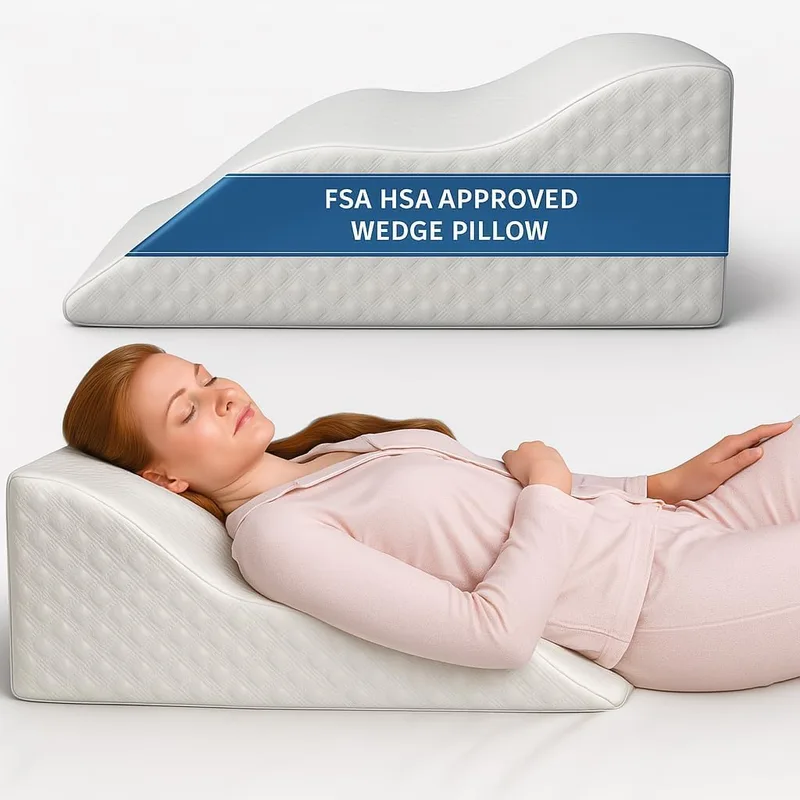
Aeris Wedge Pillow
65 × 65 cm base, 22 cm apex, 3.1 kg.
See the Aeris Wedge product details on Amazon