Last updated: November 2026
This guide is part of our full map of wedge pillows for acid reflux, GERD, and better sleep.
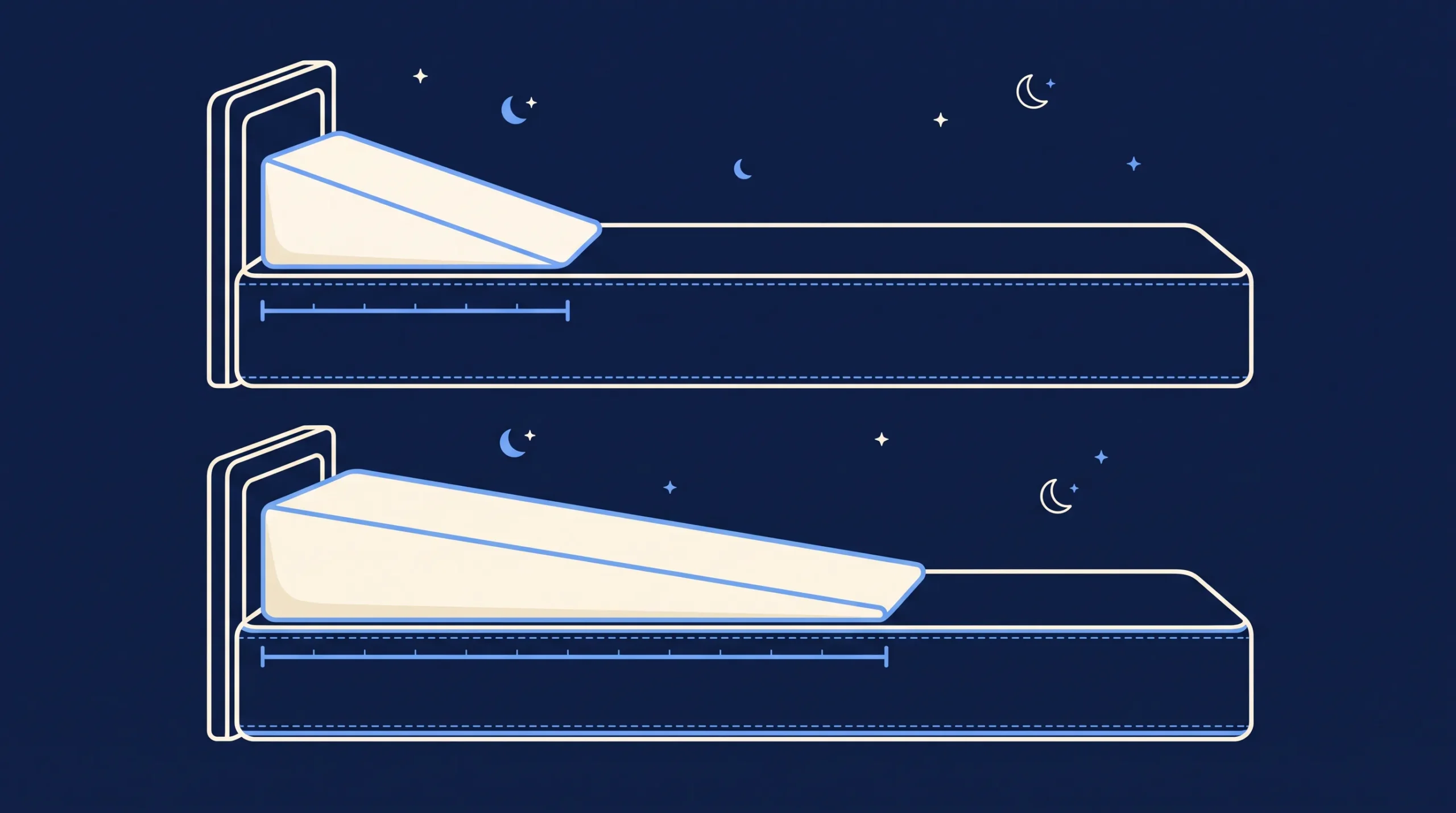
The best wedge pillow for tall people is the one long enough to reach your hips, because ramp length, not the wedge’s height, decides the fit. On a long torso, a standard 24 to 26 inch ramp can end mid-back.
This guide explains why that matters, how to measure your own fit in two minutes, and which sizes and setups suit sleepers over about six feet.
Key takeaways
- Most sleeping wedge pillows have a base of about 24 to 26 inches; the Aeris Wedge Pillow, for example, is 65 cm (25.6 in) long with a 68.6 cm slope.
- Extra-long models run about 31 inches; the Vekkia and Bueoure wedges covered in our Vekkia vs Bueoure comparison are both 31 inches long.
- The NHS describes raising the head of the bed so “your chest and head are above your waist”, and warns that additional pillows “can increase pressure on your belly”.
- The trials in a 2021 systematic review used 20 cm bed blocks, a 20 cm wedge at 20° and a 25 cm wedge at 22°: height sets the angle, length sets where you bend.
- A full mattress is 75 inches long, so a sleeper of 6’4″ (76 inches) is longer than the bed before a wedge pillow takes any of it; mattress makers point sleepers of 6’2″ and taller to 80-inch beds (Amerisleep).
- An under-mattress wedge tilts the whole torso from the hips, which avoids the mid-back bend altogether.
Why does a wedge pillow fit tall people differently?
Because the ramp has a fixed length and your torso does not. A wedge pillow supports you from its apex down to its thin end; wherever that thin end falls on your back is where your body meets the flat mattress, and that is where it bends.
On a shorter sleeper, a 25-inch ramp under the head and shoulders usually ends close to the waist. On a taller sleeper the distance from shoulder to hip is longer, so the same ramp runs out higher up the back, around the lower ribs. The wedge pillow is the same object in both cases; it is the body on it that changes.
That one difference explains the two complaints tall sleepers report most often: sliding down the slope and an ache in the middle of the back. Both come from a body that is partly on a ramp and partly off it, with the hinge in the wrong place.
Where should your body bend on a wedge pillow?
At or near the hips, so the chest and head sit on one straight incline. The NHS puts the goal in plain words: raise the head of the bed “so your chest and head are above your waist”, and do not use additional pillows instead, “as this can increase pressure on your belly”.
A bend above the waist behaves more like a stack of pillows than a ramp. The upper back is lifted, but the fold sits across the stomach area rather than below it, which is the pattern the NHS advises against. Our guide to wedge pillows for acid reflux and GERD covers the angle side of the setup; this page covers the length side.
The same principle explains why a recliner can feel wrong for sleep: its hinge is fixed by the seat, not by your body, as our wedge pillow vs recliner comparison sets out.
How long are standard and extra-long wedge pillows?
Standard sleeping wedge pillows have a base of roughly 24 to 26 inches; extra-long ones run to about 31 inches. The slope you actually lie on is a little longer than the base, because it is the diagonal.
| Wedge pillow | Base length | Apex height | Slope length | Angle |
|---|---|---|---|---|
| Aeris Wedge Pillow | 65 cm (25.6 in) | 22 cm (8.7 in) | 68.6 cm (27.0 in) | about 18.7° |
| FirmNest Extra Firm Wedge Pillow | 61 cm (24.0 in) | 19 cm (7.5 in) | 63.9 cm (25.2 in) | about 17.3° |
| Flexicomfort Wedge Pillow | 60 cm (23.6 in) | 28 cm (11.0 in) | 66.2 cm (26.1 in) | about 25.0° |
| Vekkia 31″ extra-long | 31 in (79 cm) | 7.5 in | 31.9 in (81 cm) | about 13.6° |
| Bueoure 31″ extra-long | 31 in (79 cm) | 5.5 in | 31.5 in (80 cm) | about 10.1° |
Methodology note: dimensions come from the makers’ production specifications and Amazon listings; slope length and angle are our arithmetic from base and apex.
Two patterns stand out. Extra-long wedges buy their length by being lower, so their angle is gentler than a standard wedge pillow’s. And a taller apex on a short base, like the 28 cm Flexicomfort, gives a steeper ramp without adding any length.
How do you check whether a wedge pillow is long enough for a tall person?
Measure your own torso and compare it with the slope. It takes two minutes and a tape measure.
- Lie on your back on the bed with your head where it would rest on the wedge pillow.
- Have someone measure from the top of your shoulder to the crease at the front of your hip, where your thigh meets your body.
- Add the part of the slope your head and neck will use. If you rest your head on the upper part of the slope, add a few inches; if your head rests on a pillow at the top, shoulders at the apex, add nothing.
- Compare the total with the wedge pillow’s slope length from the table or the listing.
- Read the result. If the slope is shorter than your total, the ramp will end above your hip crease, and you can expect the bend to fall across the stomach area.
If the gap is only a couple of inches, setup can close it: moving your shoulders up to the apex and putting a flat pillow on top changes where your hips land. Our guide to using a pillow on top of a wedge pillow covers which kind of pillow keeps the neck neutral.
4 things that decide the fit for a tall sleeper
Length comes first, but three other measurements decide whether a wedge pillow works in a tall person’s bed.
1. Slope length against your shoulder-to-hip distance. This is the measurement above. It decides where you bend, and it is the one most buying guides leave out.
2. Apex height, which sets the angle. Height and length together make the angle. The trials in the 2021 review used 20 to 25 cm of rise; our wedge pillow height guide compares 7.5, 10 and 12-inch options. A taller wedge pillow does not fit a tall person better by itself; it only makes the slope steeper.
3. Bed length. A full mattress is 54 × 75 inches, while a queen and a twin XL are 80 inches long and a California king 84 inches, according to Amerisleep’s size chart. A 31-inch wedge pillow on a 75-inch bed leaves 44 inches for the hips, legs and feet; on an 80-inch bed it leaves 49.
4. Width and a partner. Both 31-inch wedges in the table are 24 inches wide, sized for one sleeper. On a 54-inch full bed that leaves 30 inches beside it. Our guide to raising one side of a shared bed covers the options when only one person needs the incline.
Why do tall people slide down a wedge pillow, and what helps a tall sleeper stay put?
Partly gravity and partly fit. Anyone can slide on a slope, but when the ramp ends above the hips, the body has no seat to rest against, so it tends to drift down until the hips find the flat mattress.
The practical steps start with the length check above, because a ramp that reaches the hips gives them something to sit against. After that, the common practical steps are the ones Puffy lists: push the wedge pillow firmly against the headboard or wall, put a non-slip mat under it, and choose a textured pillowcase over silk or satin.
Firmness can matter as well: foam that compresses under the shoulders may lower the upper part of the ramp and add a dip. If sliding continues after a week or two, our two-week check helps you tell a setup problem from an adjustment period.
Is an under-mattress wedge better than a wedge pillow for tall people?
It can be, because it removes the length problem rather than working around it. An under-mattress wedge lifts the mattress itself, so the whole torso tilts together from the hips, and there is no ramp end to land on.
The trade-offs are the bed and the reversibility. It needs a flat foundation, it tilts your partner’s side too unless the bed is split, and lifting a mattress to fit or remove it is a two-person job. Our comparison of a wedge under the mattress vs a wedge pillow sets out which beds suit each.
Frequently asked questions
What size wedge pillow is best for a tall person?
Choose by slope length first. Measure from your shoulder to your hip crease while lying down and pick a wedge pillow whose slope is at least that long. Standard wedge pillows have a base of about 24 to 26 inches; extra-long models are around 31 inches, which usually suits sleepers over about six feet.
Do tall people need a taller wedge pillow?
Not necessarily. Apex height sets the angle, not the fit. A taller wedge pillow on the same base makes the slope steeper but ends at the same point on your back. If the ramp ends above your hips, you need more length, or an under-mattress wedge, rather than more height.
Why does my back hurt on a wedge pillow if I am tall?
A common cause is a ramp that ends in the middle of the back, so the body bends where the foam ends instead of at the hips. Measure your shoulder-to-hip distance against the slope. If back pain persists or is severe, it is worth discussing with a doctor or physiotherapist.
Is a 31-inch wedge pillow too big for a full bed?
It fits, but it takes a large share of the length. A full mattress is 75 inches long, so a 31-inch wedge pillow leaves 44 inches for the rest of the body. Sleepers over about 6’2″ are usually pointed to 80-inch mattresses such as a queen or twin XL.
Can a tall person use a standard wedge pillow?
Often, yes, with setup. Move your shoulders up to the apex and rest your head on a flat pillow on top, so more of the slope sits under your torso. If the ramp still ends above your hip crease, an extra-long wedge pillow or an under-mattress wedge will fit better.
How do I stop sliding down my wedge pillow?
Check the length first, because a ramp that reaches your hips gives them something to rest against. Then push the wedge pillow against the headboard, use a non-slip mat underneath, and use a textured pillowcase. Firmer foam also holds the slope better through the night.
Choosing a wedge pillow when you are tall
If your slope check comes out short by more than a few inches, an extra-long wedge pillow or an under-mattress wedge is the straightforward answer; if it comes out close, a standard wedge pillow with your shoulders at the apex is worth trying first. Either way, keep the angle you are comfortable with and change one thing at a time, as our adjustment period guide suggests, and use our five-step guide to choosing a wedge pillow for firmness and cover.
The three below cover a standard-length wedge pillow for sleepers whose check came out close, and two 31-inch options at different heights. Methodology note: figures come from the makers’ production specifications and Amazon listings, and the published sources cited above.
Advertisement
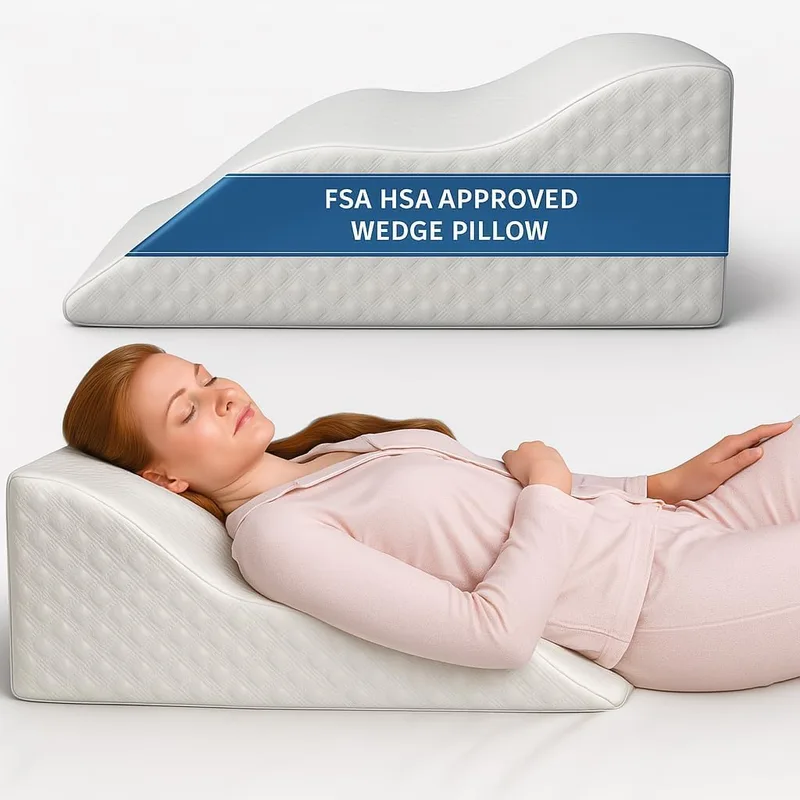
Aeris Wedge Pillow
65 × 65 cm base, 22 cm apex, 3.1 kg.
See the Aeris Wedge product details on AmazonProducts mentioned in this guide
- Vekkia 31″ Extra-Long Wedge Pillow — 31 × 24 inches, 7.5 inch rise, about 13.6°
- Bueoure 31″ Extra-Long Wedge Pillow — 31 × 24 inches, 5.5 inch rise, about 10.1°