Last updated: September 2026
This guide is part of our full map of wedge pillows for acid reflux, GERD, and better sleep.
Yes, a wedge pillow for snoring helps some people a little — the one home trial that measured it found 7% less snoring time at a 12-degree incline, and clinic studies show elevation opens the soft palate but not the tongue base.
Key takeaways
- The measured effect is single-digit. Twenty-five snorers tracked 1,181 nights at home, four weeks flat then four at a 12° incline: snoring duration fell 7% (JMIR Formative Research, 2022).
- What people felt was two to three times larger than what the trackers recorded — 14% better sleep quality by self-report, against 4% fewer awakenings objectively.
- A steeper 30° tilt moved snoring more. In 45 patients on polysomnography, the share of the night spent snoring fell from 17.3% to 12.5% (Journal of Clinical Medicine, 2022).
- Elevation changes the palate, not the tongue. That study filmed the airway at both angles: velum and lateral wall collapse were reduced at 30°, tongue-base and epiglottis collapse statistically unchanged.
- Roughly four in ten people get nothing from it. A 7.5° tilt cut apnoea events by 31.8% on average across 52 patients, but 20 of the 52 were non-responders (Sleep and Breathing, 2017).
- The NHS does name a bed wedge for snoring — to keep you on your side, listed beside a tennis ball sewn to your sleepwear, not as an elevation device (NHS).
Does a wedge pillow help with snoring?
For light, positional snoring it can help modestly, and that help has now been measured rather than guessed. Three small studies bracket the answer, and none tested a wedge pillow of the kind you buy — they raised the whole bed, or used a motorised base — so the numbers transfer by geometry rather than directly.
The most relevant ran at home. Danoff-Burg and colleagues had 25 self-reported snorers sleep on their own mattresses for eight weeks — four flat, four at a 12° incline — recording nightly with consumer trackers. Across 1,181 nights, snoring duration was 7% lower on the incline (P=.001).
Seven per cent is real but small: a bad night made slightly less bad, not silence. Two caveats belong with it — the same participants reported improvements of 14% to 20%, and a bed manufacturer funded the study. Our wedge pillow and sleep apnoea page covers what the same elevation does to breathing events rather than sound.
| What was tested | People | Elevation | What changed |
|---|---|---|---|
| Adjustable bed base, at home, 4 weeks vs 4 weeks | 25 | 12° | Snoring duration −7%; awakenings −4%; deep sleep +5% |
| Hospital bed, split-night polysomnography | 45 | 30° head and trunk | Share of night snoring 17.3% → 12.5%; apnoea-hypopnoea index 23.8 → 17.7 |
| 15 cm blocks under the head-end legs, sleep laboratory | 52 | 7.5° | Apnoea-hypopnoea index 15.7 → 10.7 events/h; lowest oxygen saturation 83.5% → 87% |
Why does lying flat make snoring worse?
Because the tissues that make the noise relax and narrow when you are asleep, and lying on your back lets gravity press them together. The NHS describes snoring as your tongue, mouth, throat or nasal airways vibrating as you breathe, and lists sleeping on your back among the things that make it more likely, along with excess weight, smoking and alcohol.
An incline does not change any of that anatomy. It changes the direction gravity loads it from, which is why the effect is partial and varies so much between people. In the 52-patient laboratory study the benefit landed where you would expect: the largest reductions were in hypopnoeas and in events while lying on the back.
That is also why a wedge pillow is not a fix but a positioning aid, like a pillow under your knees to stop you sliding — hardware that changes posture and nothing else.
What angle of elevation did the snoring studies use?
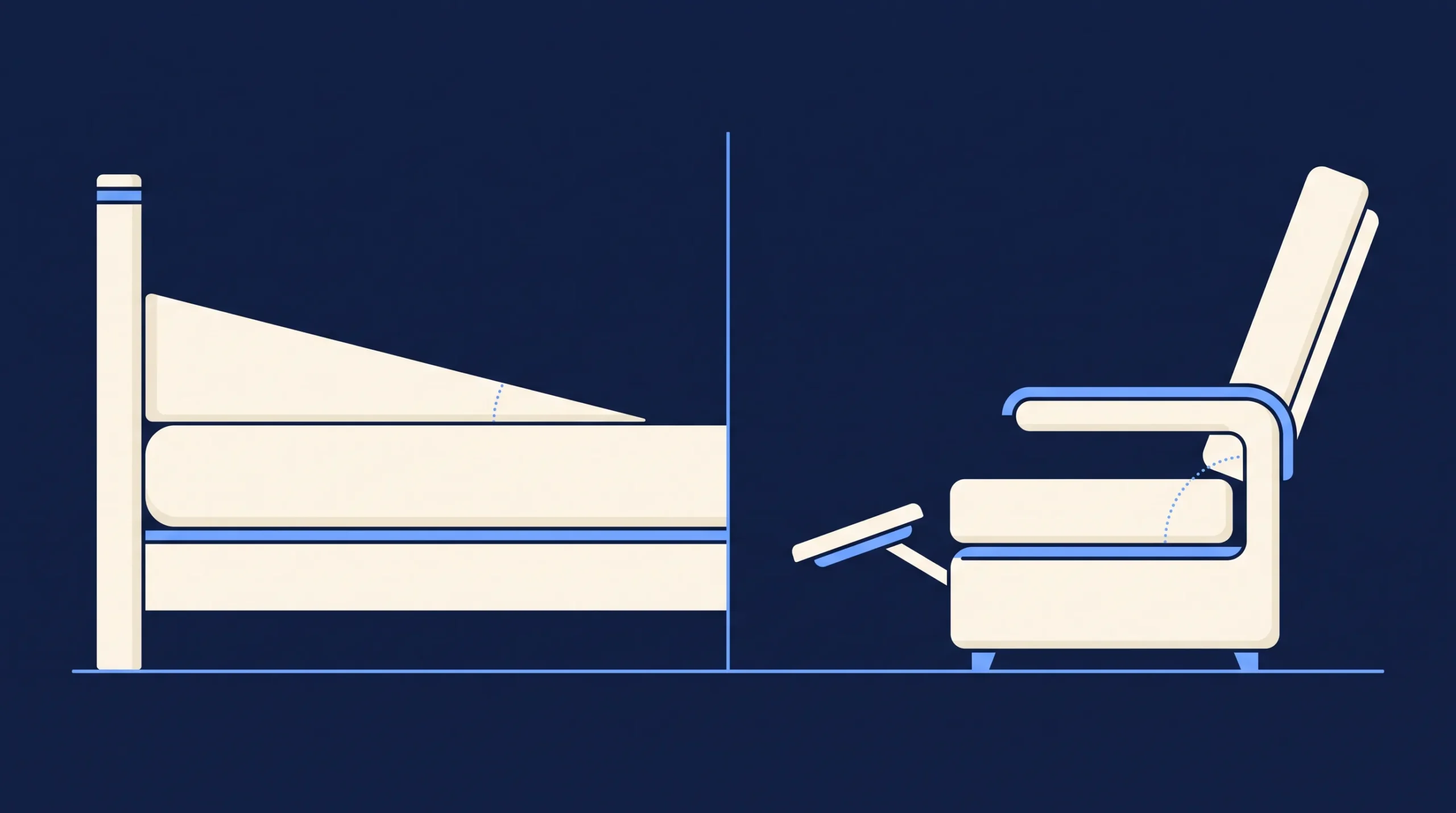
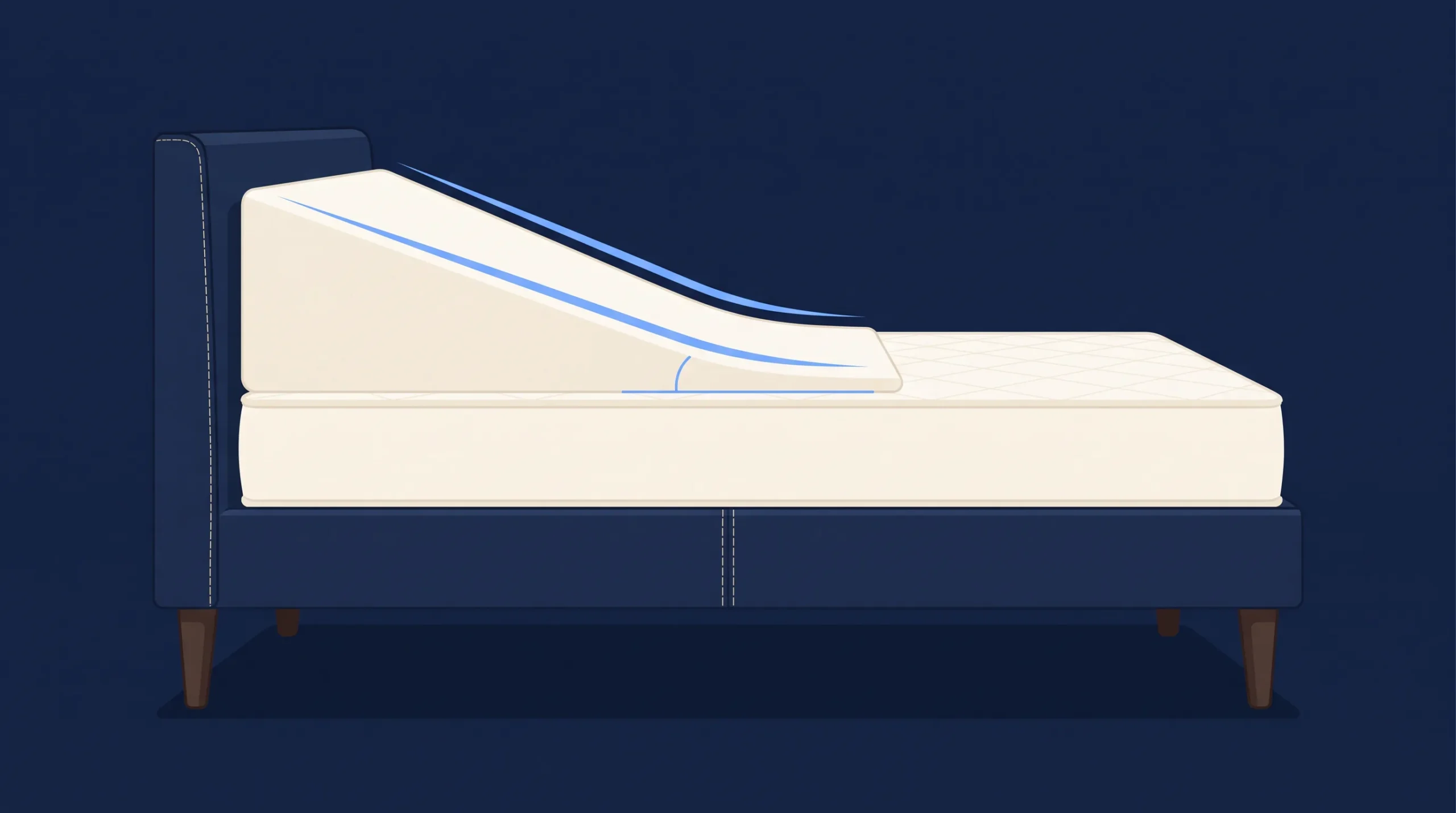
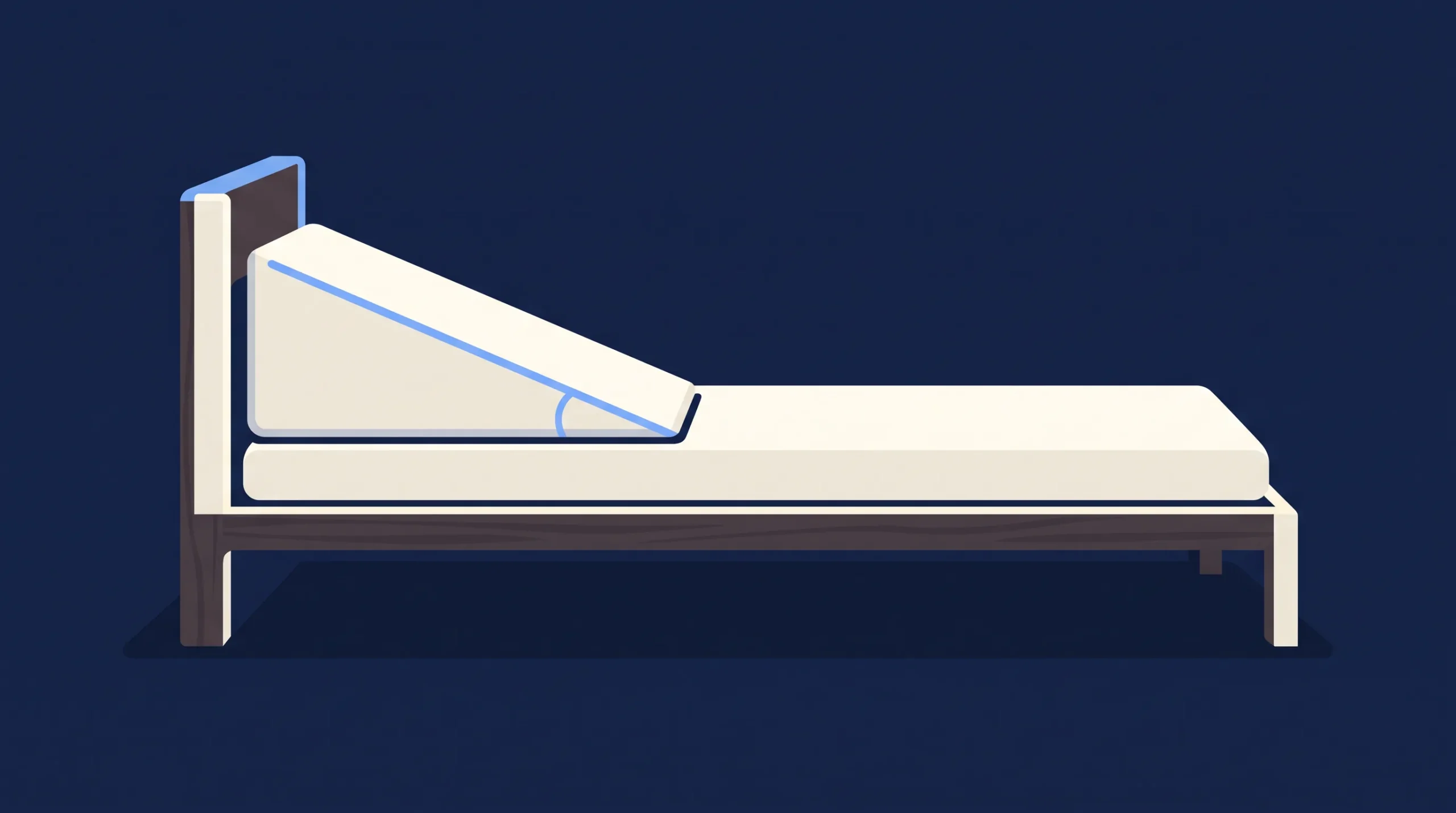
Between 7.5° and 30°, and the two ends of that range behave differently. This matters when you translate research into a pillow, because an advertised apex height is not a bed angle: a ramp’s slope is its apex height divided by its length.
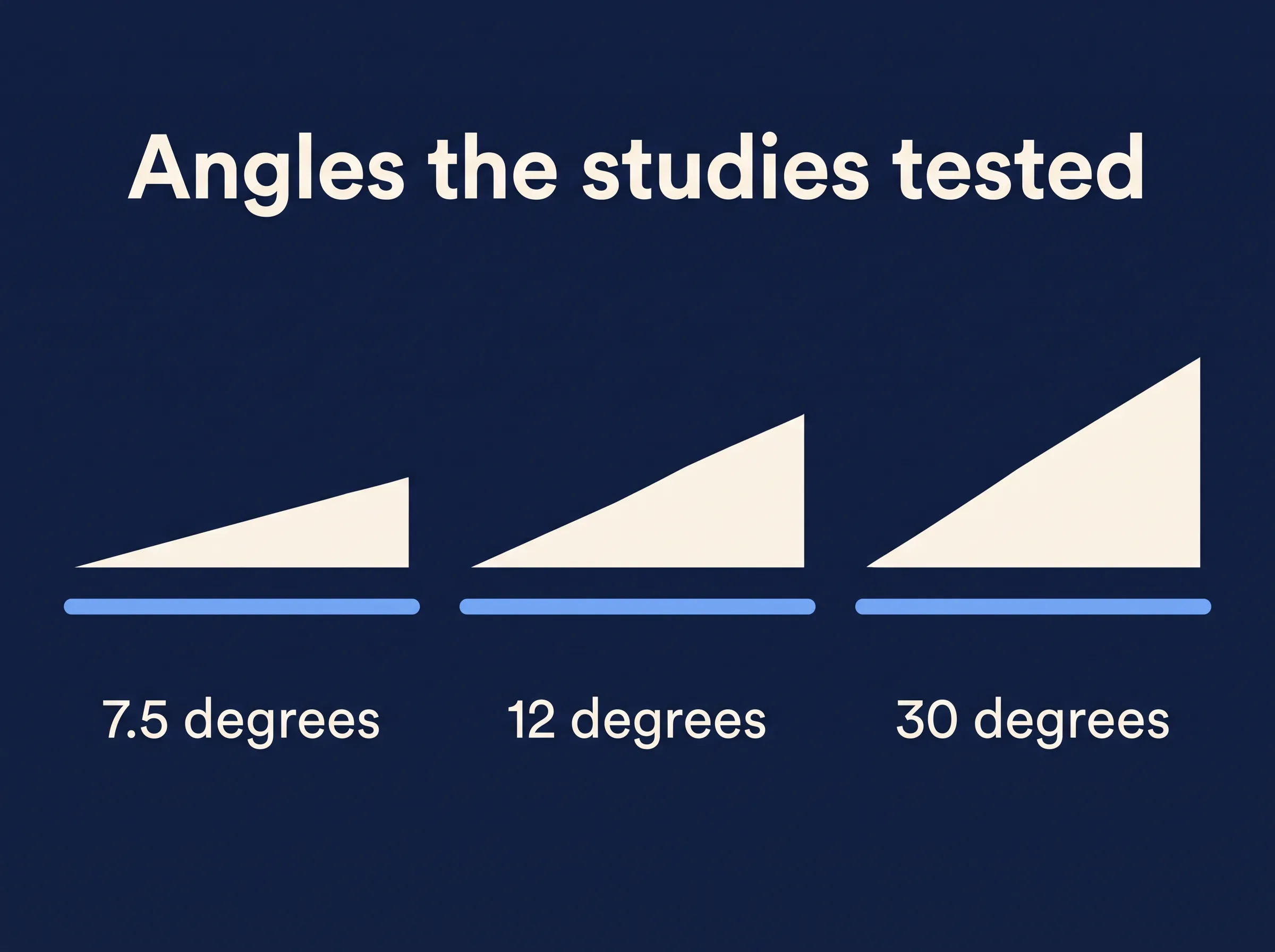
Run that arithmetic on two wedges we make and they land inside the tested range: 22 cm of apex over a 65 cm ramp is about 19°, and 28 cm over 60 cm about 25°. So an ordinary sleeping wedge sits between the 12° home study and the 30° clinic study, which is the most useful thing geometry can tell you here. Our wedge pillow height guide works apex height against torso length.
The old advice to aim for “6 to 8 inches” is not wrong, but it is incomplete without the base length. Height alone describes a step; height over length describes a slope.
Tolerance is the real ceiling, not steepness. About 75% of the 45 patients at 30° said they could sleep like that nightly, while the 2017 team had already dropped a 20 cm wedge in piloting because participants reported a sensation of falling.
Which kind of snoring does elevation actually change?
The kind that comes from the soft palate and the side walls of the throat — not the kind that comes from the base of the tongue. It is the most useful finding in the literature and the one competing pages omit.
The 2022 study filmed each patient’s airway under sedation at 0° and again at 30°, scoring where it collapsed. Velum and lateral oropharyngeal wall collapse were reduced when raised. Tongue base and epiglottis collapse showed no statistical difference at all (P>0.05). Elevation lifts the soft tissue at the top of the throat away from itself; it does nothing measurable to a tongue that falls backwards.
| Where your airway narrows | Does elevation change it | Practical reading |
|---|---|---|
| Soft palate (velum) | Reduced at 30° | The group elevation was measured to help |
| Lateral walls of the oropharynx | Reduced at 30° | Same group |
| Base of the tongue | No statistical change | A slope is unlikely to be your answer |
| Epiglottis | No statistical change | Same |
You cannot tell which you are from the outside — that distinction is made with a camera — which is this table’s honest limitation. What it explains is why a wedge pillow changes one person’s nights and does nothing for another, and why the NHS lists a mandibular advancement device, which pulls the tongue forward, as the treatment for tongue-related snoring rather than any change of position.
4 things to fix before you give up on a wedge pillow for snoring
Work through these one at a time. Changing two at once tells you nothing about either.
- Check that you are still on it at 3 a.m. If you slide down, you spent most of the night flat and measured nothing. Sliding tracks slope and foam firmness, and stacked pillows come apart fastest.
- Put the apex under your shoulder blades, not your neck. A high point under the neck folds the chin toward the chest, narrowing the airway you were trying to open.
- Take the pile of pillows off the top. The wedge already raises your head; a full pillow raises it again and tips the chin down. One thin or contoured pillow is a different arrangement, covered in what to put on top of a wedge pillow.
- Add side sleeping rather than more angle. Both act on positional snoring, and the NHS recommends the side-sleeping one directly. Our side sleeping guide covers shoulder and knee position on a slope.
If four weeks of that produces nothing you can sleep in, the next step is a different method rather than a steeper wedge — risers under the head-end legs or an adjustable bed raise the bed evenly, which is what every study above did.
Is a wedge pillow or side sleeping better for snoring?
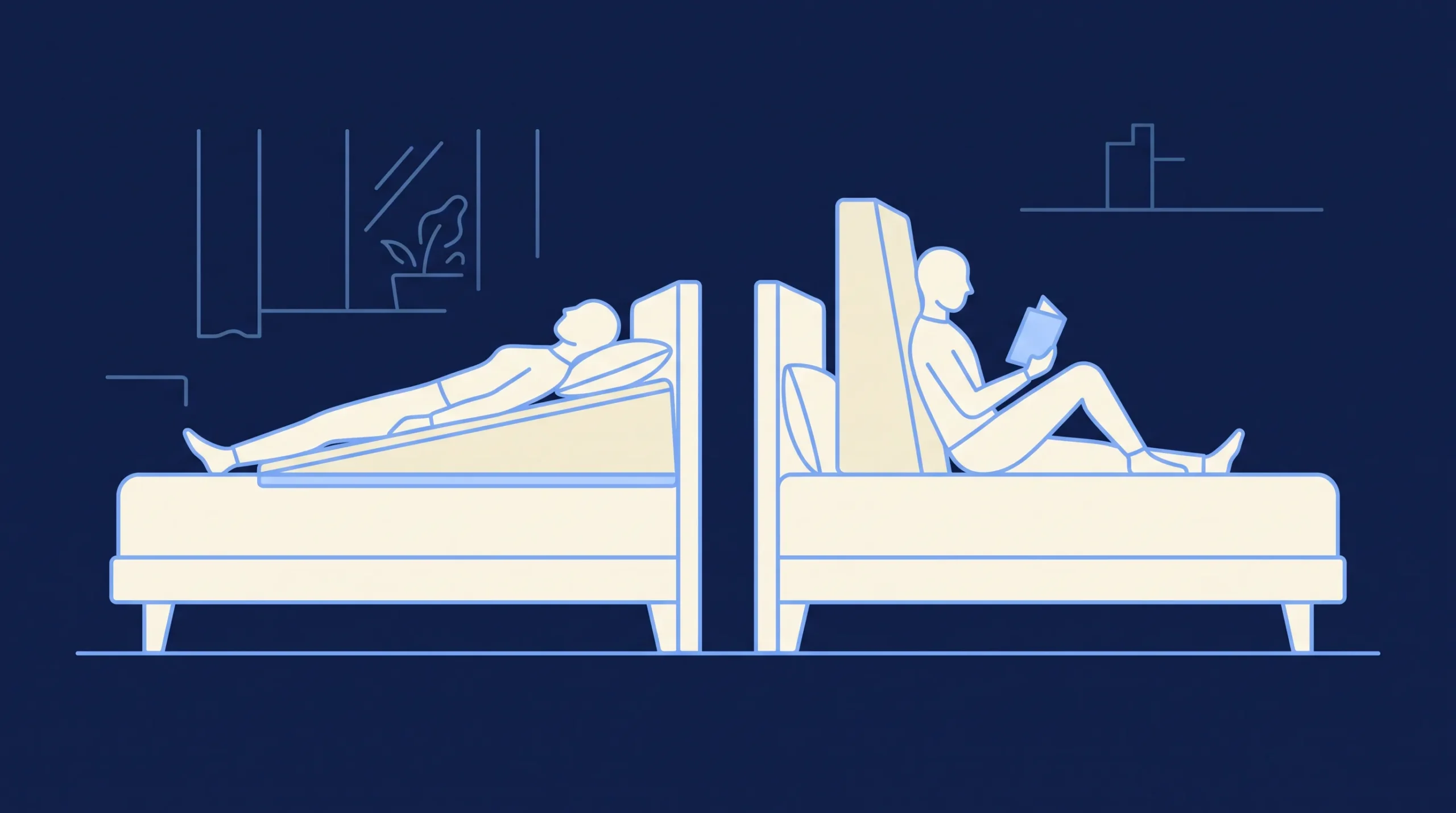
Side sleeping has the clearer official backing, and the two are not alternatives. The NHS snoring page lists sleeping on your side under things you can do, and in the same sentence names the hardware: a tennis ball taped or stitched to the back of your sleepwear, or “a special pillow or bed wedge to help keep you on your side”.
Read that carefully, because it is easy to misread as an endorsement of elevation. The wedge appears there as a side-sleeping aid — something that keeps you off your back — not as a way of raising your head. A wedge can do either job, but they are different mechanisms and only one is what the NHS is recommending.
There is a hint the two may not simply add up. Among the 52 patients in the 2017 study, 13 had positional apnoea, and in that subgroup the 7.5° tilt produced no statistically significant improvement (P=.174) — plausibly because people whose problem is lying on their back already get most of the benefit from turning over.
When is snoring a reason to see a doctor?
When it is loud most nights, when it comes with pauses in your breathing, gasping or choking, or when you are exhausted during the day however long you slept. The NHS lists those as possible signs of sleep apnoea and says to see a GP — as it does if lifestyle changes are not helping, or if the snoring badly affects your life or your partner’s.
The severity scale is worth knowing, because the studies above are reported in it. The NHS grades the apnoea-hypopnoea index as 5 to 14 mild, 15 to 30 moderate, above 30 severe. The 7.5° study moved a median patient from 15.7 to 10.7, crossing from moderate into mild; the 30° study moved 23.8 to 17.7, staying inside moderate. Elevation nudges people along that scale but does not take anyone off it, and sleep apnoea is treated with a diagnosis and usually a CPAP machine.
The decision rule has not changed: snoring plus gasping or daytime exhaustion is a medical conversation, not a shopping one. Our page on who should be careful with a wedge pillow covers where propped sleeping is the wrong tool.
Methodology: based on the studies tabled above, each read in full rather than from a summary, on current NHS guidance for snoring and sleep apnoea, and on the production specs of the wedge pillows named, whose angles were calculated from apex height and ramp length.
Frequently asked questions
Does a wedge pillow help with snoring?
It can help modestly with light, positional snoring. The one home trial found 7% less snoring time at a 12° incline, and a clinic study at 30° saw the share of the night spent snoring drop from 17.3% to 12.5%. It is a positioning aid, not an anti-snore device.
What angle or height should a wedge pillow for snoring be?
The research used tilts between 7.5° and 30°. An ordinary sleeping wedge, about 22 cm of apex over a 65 cm ramp, works out at roughly 19°, inside that range. Comfort sets the ceiling rather than steepness.
Why did a wedge pillow do nothing for my snoring?
Possibly because your airway narrows at the base of the tongue. When researchers filmed the airway at 0° and 30°, palate and side-wall collapse improved but tongue-base collapse did not change at all. In a separate 52-patient study, 20 people were non-responders.
Is it better to sleep on my side or use a wedge pillow?
The NHS recommends side sleeping and mentions a bed wedge as a way of keeping you there. The two are usually combined rather than chosen between, though people whose snoring is worst on their back may find turning over captures most of the benefit.
Can a wedge pillow help my partner’s snoring?
It may make ordinary positional snoring quieter, and the measured improvement is small — single digits in the only home study, where participants perceived a much larger improvement than the trackers recorded.
Is my snoring sleep apnoea?
Loud snoring with pauses in breathing, gasping or choking noises, or daytime tiredness regardless of hours slept can be signs of sleep apnoea, and the NHS advises seeing a GP. Severity is graded from the apnoea-hypopnoea index: 5 to 14 mild, above 30 severe. A pillow is not a substitute for that assessment.
Choosing a wedge pillow for snoring
The properties that matter are the two you cannot adjust afterwards: the slope, the variable every study manipulated, and the firmness of the core, because a soft wedge lets you slide back to flat and quietly ends the experiment. The Aeris Wedge Pillow is 65 × 65 cm with a 22 cm apex, about 19° — the milder end of the tested range, on a base wide enough to turn over on. The Flexicomfort Wedge Pillow Set is 60 × 56 cm with a 28 cm apex, about 25°, nearer the geometry that moved snoring most in the clinic, and ships with a headrest sized for its own slope.
What goes under your head is the other half, since a chin pressed toward the chest undoes the angle: a firm contoured pillow holds its height where a soft one compresses unevenly. If you are still choosing between methods rather than products, our five-step guide takes the questions in order, and the acid reflux and GERD guide covers the other reason people raise the head of the bed.
Advertisement
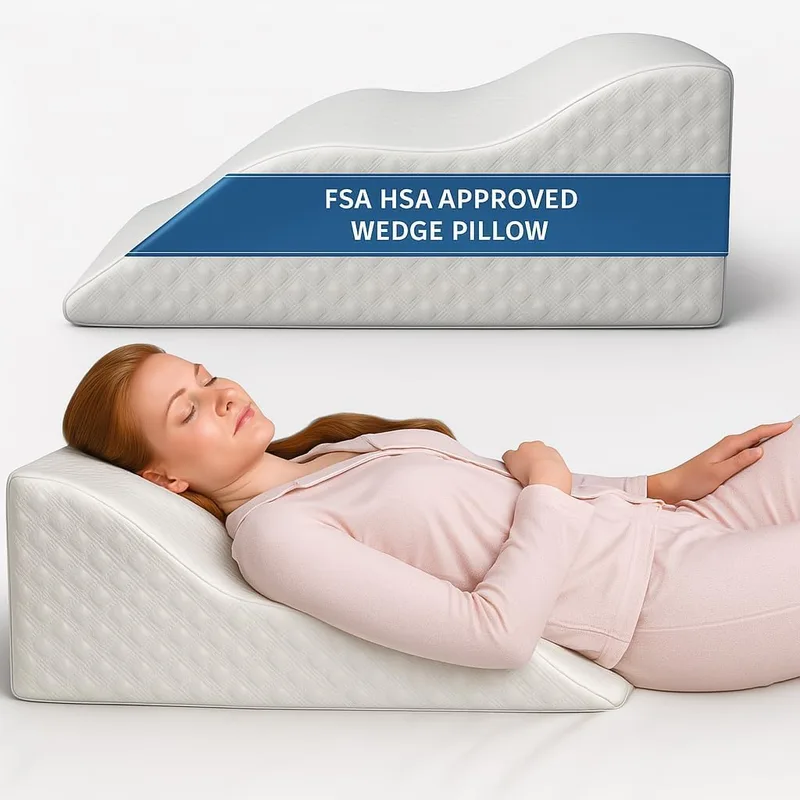
Aeris Wedge Pillow
65 × 65 cm base, 22 cm apex, 3.1 kg.
See the Aeris Wedge product details on AmazonProducts mentioned in this guide
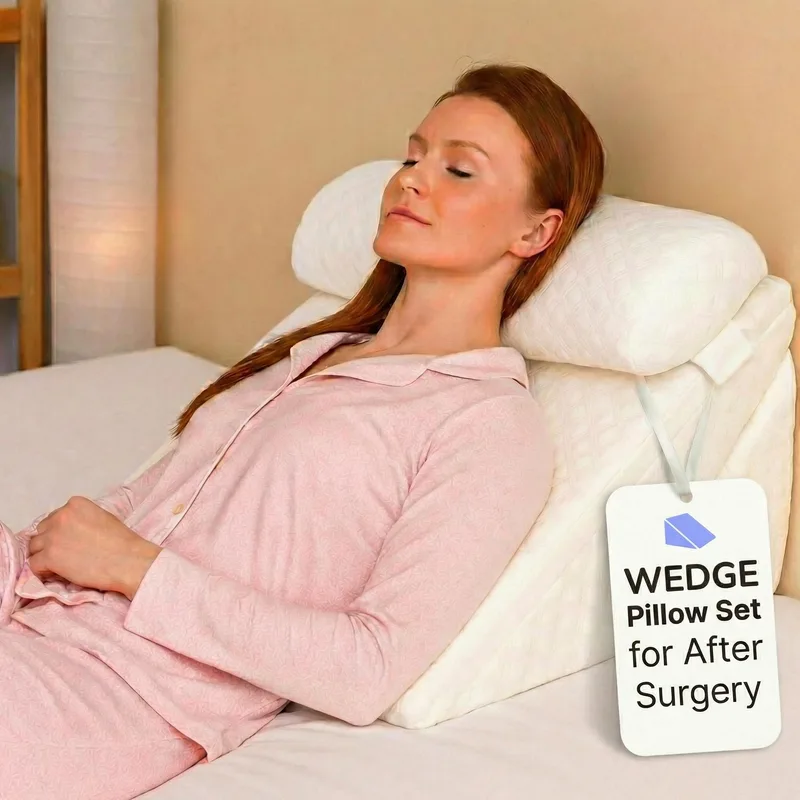 Flexicomfort Wedge Pillow Set — 60 × 56 cm base, 28 cm apex (about 25°), memory foam, with adjustable headrest
- FirmNest Extra Firm Contour Pillow — 60 × 40 cm high-density foam, 10 cm and 12 cm sides