Last updated: September 2026
This guide is part of our full map of wedge pillows for acid reflux, GERD, and better sleep.
Should the wedge go under your mattress or on top of it? It depends on your bed and who shares it. In the one trial that measured both, acid exposure was the same — tolerance and practicality decide.
Key takeaways
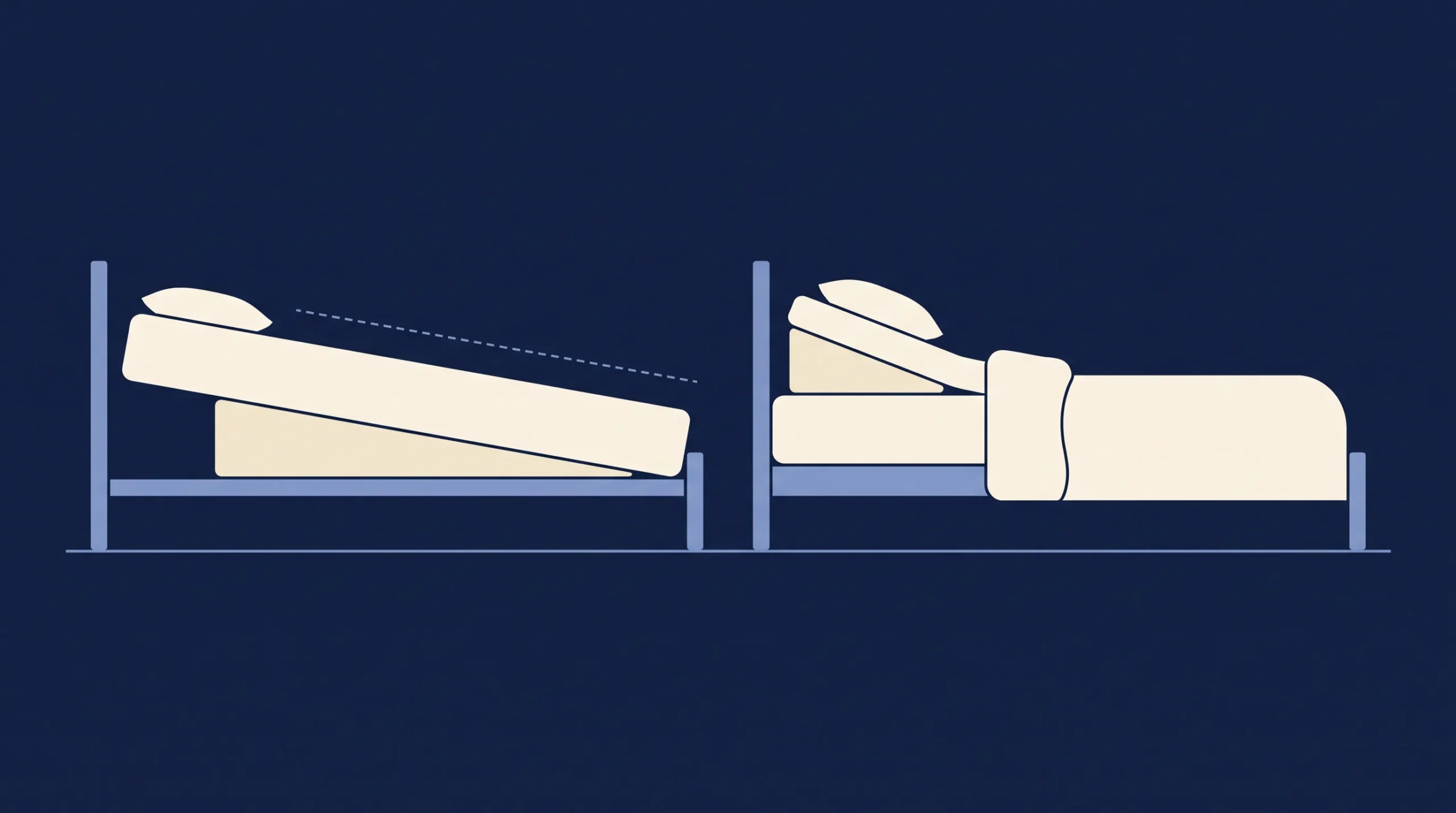
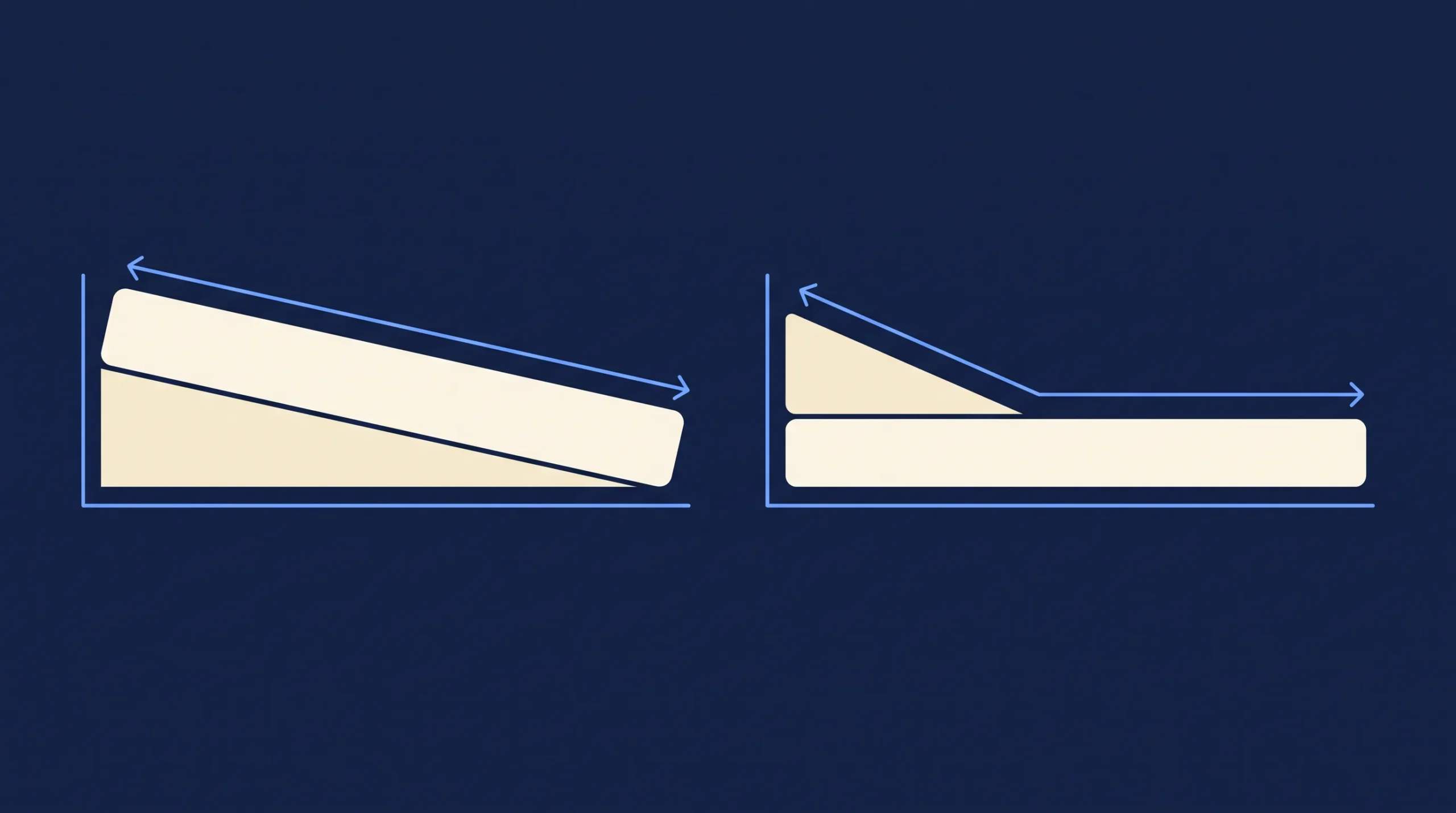
- A wedge under the mattress tilts the whole sleeping surface; a wedge pillow on top tilts only the part of you that lies on it.
- No trial has tested an under-mattress wedge directly. The closest tested stand-in is blocks under the bed legs, which tilt the whole surface the same way — every whole-bed number below is that stand-in, not the product.
- Measured head to head in one group, acid exposure was 15% of the night on a 25 cm foam wedge and 15% on 20 cm blocks, against 21% lying flat (BMC Fam Pract 2021) — roughly a quarter less time with acid in the oesophagus, and no difference between the two methods.
- Of those 15 patients, 9 preferred the blocks, 5 preferred the wedge and 1 preferred neither — a small sample, and the split was about comfort rather than physiology.
- The NHS suggests raising the head of the bed by 10-20 cm, and warns against stacking extra pillows to imitate it — a caution about loose pillows folding you at the belly, not about a graded wedge.
- The under-mattress route fails on storage beds, adjustable bases, and shared beds where only one person wants the tilt; the wedge pillow route fails on width, sliding, and the ridge under your lower back.
- The ACG rates head-of-bed elevation a conditional recommendation on low-quality evidence — a positioning aid to use alongside whatever else you are doing, not a treatment.
What is the difference between a wedge under the mattress and a wedge pillow?
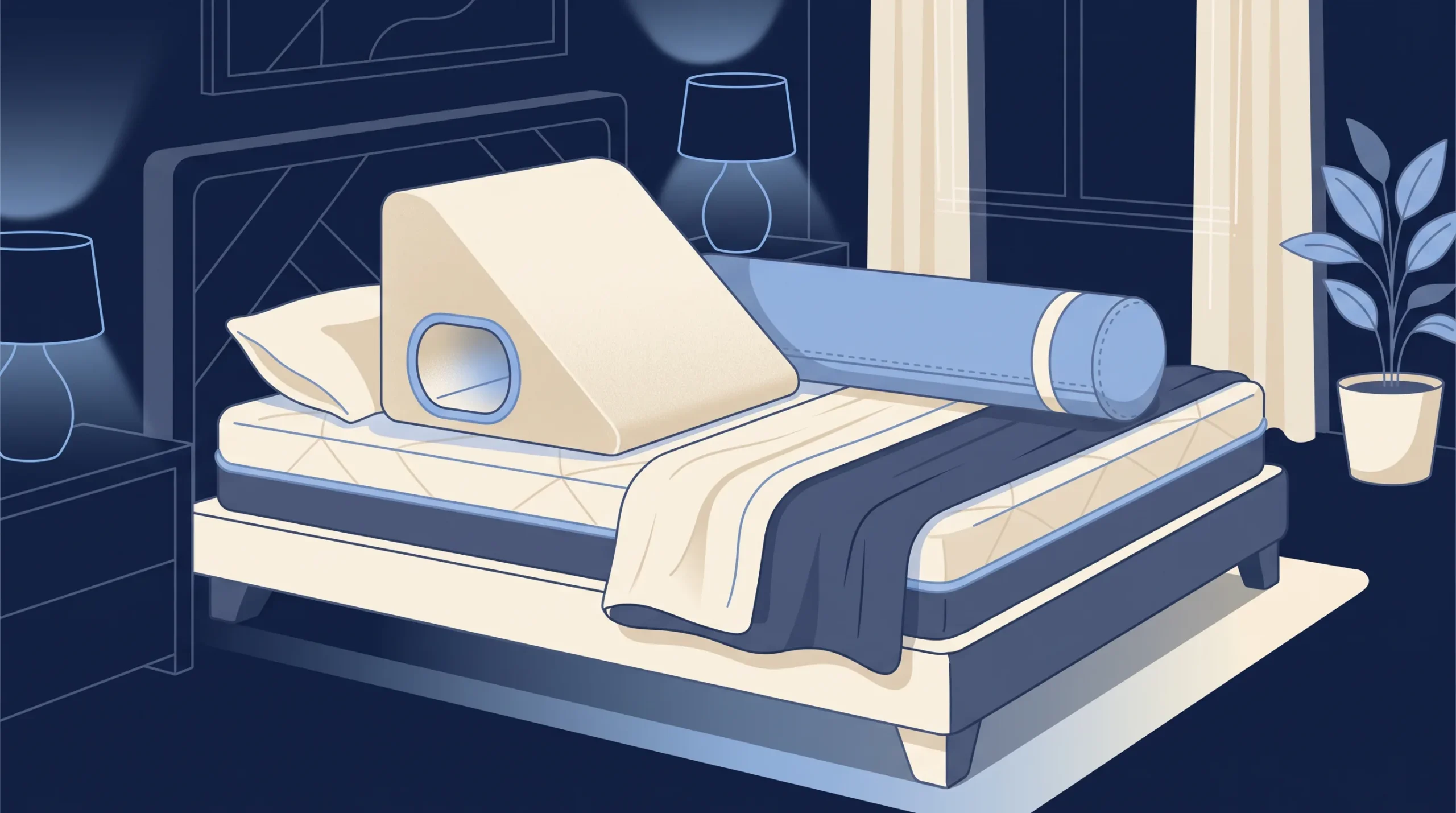
A wedge under the mattress is a long foam ramp that sits between the mattress and the bed base, so the mattress itself becomes the slope. A wedge pillow sits on top and raises your head, shoulders and part of your torso.
The practical difference is where the slope ends. An under-mattress wedge runs the length of the bed and tapers to nothing near your feet, so there is no ridge to lie across. A wedge pillow ends around your waist, and that end point is the source of most complaints — the ridge lands under your lower back, and you feel it.
Raising the bed legs with blocks or risers is a third route with the same geometry, compared separately in wedge pillow vs bed risers.
Does putting the wedge under the mattress work better for reflux?
The measured answer is no — not better, and not worse. One caveat first, because everything below rests on it: no published trial has tested a foam wedge under the mattress. What has been tested is blocks under the bed legs, which produce the same geometry — the whole surface tilts as one plane — so they are the closest stand-in the literature offers.
A cross-over trial by Hamilton and colleagues put the same 15 patients with erosive esophagitis through three conditions, measuring intra-oesophageal pH each time. It is the only study comparing a wedge on top with whole-bed elevation in one group.
| Condition | Time with pH ≤ 4 | 95% CI |
|---|---|---|
| 25 cm foam wedge at 22° | 15% of the night | 3 to 26 |
| 20 cm blocks under the bed legs | 15% of the night | 0 to 31 |
| Lying flat (control) | 21% of the night | 10 to 33 |
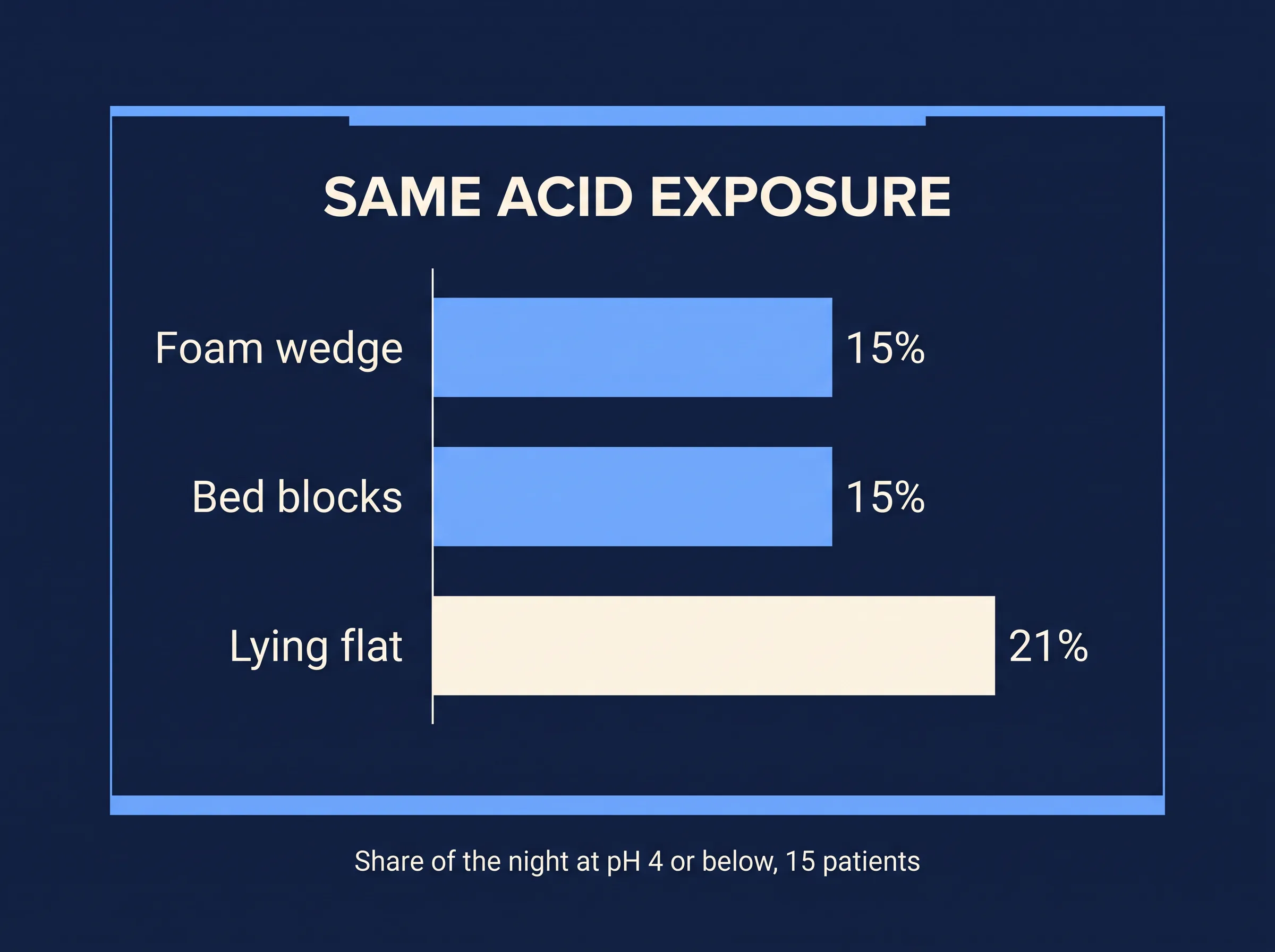
Both cut acid exposure against lying flat — about a quarter less time with acid in the oesophagus — and neither changed the number of reflux episodes or the acid clearance time. The confidence intervals are wide because the group was small. Asked which they preferred, 9 of the 15 chose the blocks, 5 chose the wedge and 1 chose neither.
Note the heights, too: the trials used 20 cm of block and a 25 cm wedge, while commercial under-mattress lifts run about 18 cm (7-inch) or 13 cm (5-inch) — below anything measured.
Separate work on whole-bed elevation points the same way. Khan and colleagues (2012) raised the head end of the bed by a 20 cm block for six nights in 20 patients: supine reflux time moved only from 15.0% to 13.7%, but long reflux episodes over five minutes fell from 3.3 to 1.0 per night and sleep disturbance improved in 13 of 20. The headline percentage barely moved; what changed was how long acid sat there.
So the choice is not which one works, but which one you will still be using in a month. Our page on wedge pillows for acid reflux and GERD covers the angle and anti-sliding side of that.
4 things that decide between an under-mattress wedge and a wedge pillow
1. Who else sleeps in the bed. An under-mattress wedge tilts the whole surface, so your partner gets the incline too. A wedge pillow is the only one of the two that can tilt one person, and this point alone settles many households.
2. What your bed is. A storage bed with drawers, a platform bed with a fixed deck, or an adjustable base all resist a wedge underneath, because it fights the mechanism or has nowhere to sit.
3. Whether you sleep on your side. The under-mattress route is generally kinder to side sleepers, because there is no ridge to lie across. Side sleeping on a wedge pillow is workable but needs setup, which we walk through in sleeping on your side on a wedge pillow.
4. Whether you want to reverse it. A wedge pillow comes off the bed in seconds and travels. Lifting a mattress to remove a full-length wedge is a two-person job.
Why do some people get neck and shoulder pain on a wedge pillow but not under the mattress?
Because the two put the bend in different places. On an under-mattress wedge the whole body tilts together, closer to standing on a gentle hill. On a wedge pillow the slope ends partway down your back, so your spine has a hinge in it, and your head sits at the top of the ramp where a normal-loft pillow can push your chin toward your chest.
That is usually a setup problem rather than a reason to abandon the wedge. A flatter pillow on the incline, or none at all, is the first thing to change — our page on what to put on top of a wedge pillow covers the loft question, and the wedge pillow height guide covers apex. If the discomfort is new, some of it is adaptation; if it is not settling, wedge pillow side effects sets out which complaints are worth taking to a clinician.
How high should the wedge be, and where is the height measured?
The NHS suggests raising the head of the bed by around 10 to 20 cm so your chest and head sit above your waist, and says not to get the same effect with extra pillows, because that can increase pressure on your belly and make symptoms worse (NHS).
Read that warning carefully: it is about stacking loose pillows, not about a purpose-made wedge. A stack collapses and folds you at the belly; a graded wedge holds one continuous slope from shoulder to hip. That is the difference, and it is the failure mode we describe in stacked pillows vs a wedge pillow.
The measurement point also differs. An under-mattress wedge is specified by its lift at the head end; a wedge pillow is specified by its apex, which is where your shoulders sit rather than where the bed ends, so the two numbers are not comparable. The Aeris Wedge Pillow has a 22 cm apex on a 65 × 65 cm base.
| Under-mattress wedge | Wedge pillow | |
|---|---|---|
| What tilts | The whole mattress | Head, shoulders, upper torso |
| Typical lift | 5 to 7 inches at the head end | 7.5 to 12 inches at the apex |
| Tilts one person only | No | Yes |
| Works on a storage bed | Often not | Yes |
| Works on an adjustable base | No | Usually |
| Removed in seconds | No | Yes |
| Travels | No | Yes |
| Ridge under the lower back | None | Yes, at the taper |
Can you side-sleep on an under-mattress wedge?
Usually more easily than on a wedge pillow, for a structural reason: the surface stays continuous, so there is nothing for your hip or ribs to bridge. Two things still go wrong — some people slide down a tilted mattress overnight, especially on slippery sheets, and some feel the tilt in the shoulder underneath.
If you sleep on your side and you have reflux, the ACG notes that lying right-side down increases nocturnal reflux compared with left-side down, and rates sleeping on the left side as the one lifestyle measure with unequivocal supporting evidence — stronger than the evidence for elevation itself (ACG 2022).
What does the evidence actually support?
A modest, real effect and not much more. A systematic review screened 1,206 records and found five controlled trials with 228 patients between them; two used blocks under the bed legs, one used a wedge pillow, and two used both. All five carried a high risk of performance bias, and the outcome measures varied too much to pool.
The strongest single signal was a symptom-score improvement at six weeks with a risk ratio of 2.1 (95% CI 1.2 to 3.6), and the authors’ conclusion was careful: worth considering as a cheap and relatively safe option, but the literature does not allow confident claims. A broader 2022 review reached the same place (Schuitenmaker 2022).
The ACG lands in the same register, marking the evidence for sleeping with the head elevated as equivocal while still marking it recommendable. Treat elevation as something to do alongside whatever else you are doing; persistent or worsening symptoms are a reason to see a clinician rather than to buy a taller wedge.
Frequently asked questions
Is a wedge under the mattress better than a wedge pillow for reflux?
Not by the measurements, though no trial has tested an under-mattress wedge itself. In the one cross-over trial on the same 15 patients, acid exposure was 15% of the night on a 25 cm foam wedge and 15% on 20 cm bed blocks, against 21% lying flat. Comfort and practicality decide.
Can I put a wedge under the mattress if my partner sleeps in the same bed?
Only if they are willing to sleep on the incline too, because the whole surface tilts. A wedge pillow is the only one of the two that raises one person. Split adjustable bases are the other way to get an independent tilt.
Will an under-mattress wedge work on a storage bed or an adjustable base?
Usually not. A storage bed has a fixed deck with drawers underneath, and on an adjustable base the wedge fights the mechanism when the head section lifts. In both cases a wedge pillow is the workable route.
How high should an under-mattress wedge be?
The NHS describes 10 to 20 cm at the head of the bed, and the trials used 20 cm blocks. Commercial lifts are sold as 5-inch (about 13 cm) or 7-inch (about 18 cm), so both sit below the tested height.
Do I still need a pillow on an under-mattress wedge?
Yes, but often a flatter one than you used on a level bed, because the mattress is already doing part of the lifting. Start with your normal pillow and go thinner if your chin tucks toward your chest.
Can I use both at once?
You can, but the angles add up quickly and most people find the combination too steep. Raising one and leaving the other flat is easier to live with.
Is a wedge pillow a treatment for GERD?
No. It is a positioning aid. The ACG rates head-of-bed elevation as a conditional suggestion on low-quality evidence, and reflux that persists, worsens, or comes with swallowing difficulty or weight loss is a reason to see a clinician.
Which route should you choose?
If you sleep alone on a conventional frame, and the ridge under your back or side sleeping is what bothers you, tilt the whole bed — that is the geometry the NHS describes, and 9 of the 15 patients asked preferred it, by blocks. If you share a bed, have a storage bed, or want to undo the whole thing tonight, the wedge pillow is the only one of the two that fits. If you already own an adjustable base, you have the feature and need neither purchase.
We sell wedge pillows, which is why the failure cases above are spelled out as plainly as the benefits. Methodology: height figures are based on the maker’s production specs, and the physiological numbers come from the research linked above. If you are unsure, the wedge pillow is the easier thing to return.
Advertisement
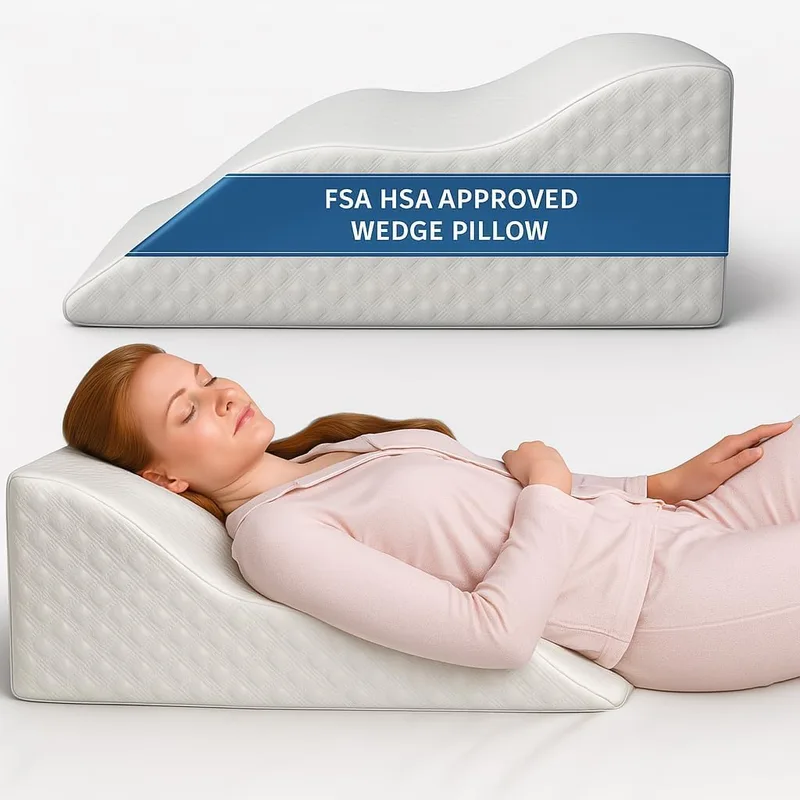
Aeris Wedge Pillow
65 × 65 cm base, 22 cm apex, 3.1 kg.
See the Aeris Wedge product details on AmazonProducts mentioned in this guide
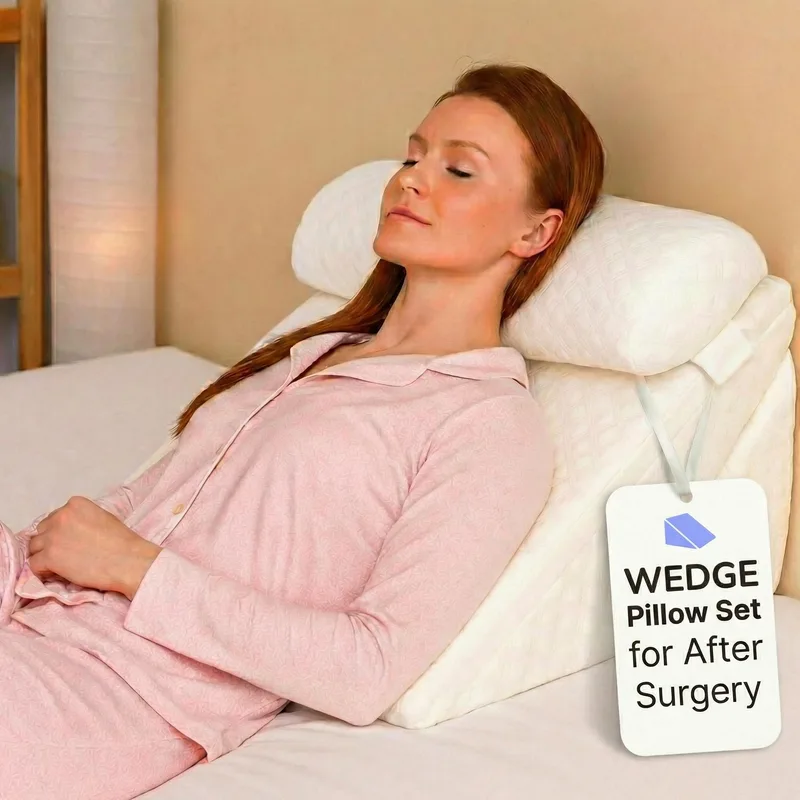 Flexicomfort Wedge Pillow — 60 × 56 cm base, 28 cm apex
- Avana Mattress Elevator, 7-inch — under-mattress foam lift, about 18 cm at the head end
- Avana Mattress Elevator, 5-inch — gentler under-mattress lift, about 13 cm at the head end