Last updated: September 2026
This guide is part of our full map of wedge pillows for acid reflux, GERD, and better sleep.
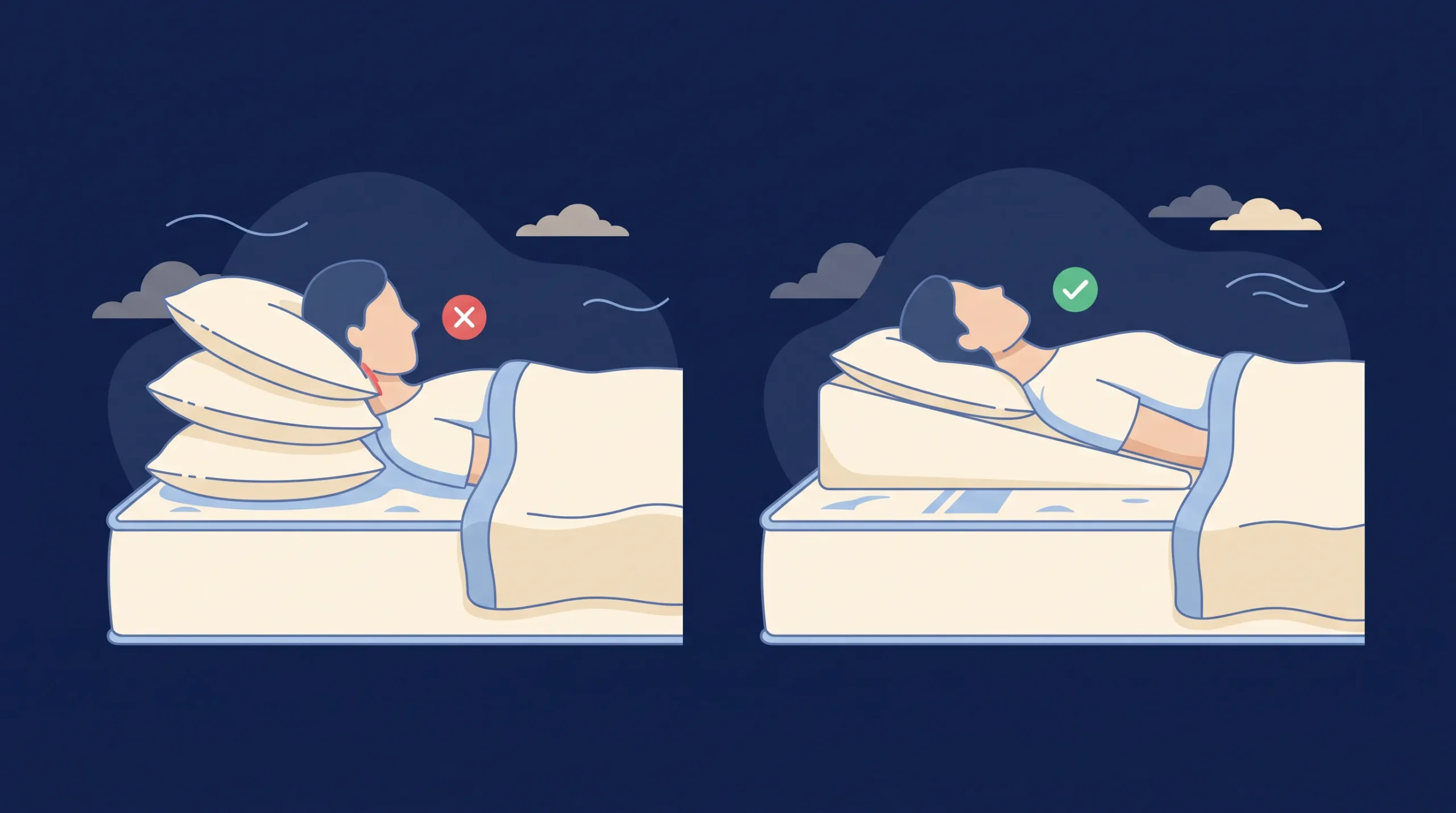
Stacked pillows vs a wedge pillow: a stack is a pile that raises your head; a wedge is one block that raises your torso. Only the second is what the reflux evidence describes, and stacks also flatten, slide and bend the neck by 2 a.m.
The stack is not useless. It is a free one-night test, and there is a right way to build it. This guide shows where it breaks, what the trials actually used, and when to switch.
Key takeaways
- “Regular pillows only elevate your head,” which gastroenterologist Scott Gabbard, MD, tells Cleveland Clinic “isn’t enough to prevent acid reflux”; a wedge elevates the whole torso.
- The trials behind head-of-bed elevation raised the body by about 20 cm (8 inches) with bed blocks or a wedge, not with pillows: five studies, 228 patients in the 2021 review.
- A stack of soft pillows loses height as the fill compresses and the pillows slide apart; a wedge is a single block that holds its shape until morning.
- Raising only the head bends the neck forward and, according to Mattress Clarity’s stacking guide, can add neck pain to the reflux you were trying to fix.
- If you do stack, stack firm: two or three firm pillows arranged as a slope that starts under the shoulder blades, never a single tall pile under the head.
- A stack is a reasonable one-night test of whether elevation helps you at all; a wedge is what you buy once the answer is yes.
- The Aeris Wedge Pillow is 8.7 inches over a 25.6 inch ramp, the geometry the trial wedges used; the FirmNest Extra Firm Pillow is the pillow to stack if you are still testing.
What is the difference between stacked pillows and a wedge pillow?
A stack of pillows lifts your head; a wedge lifts your head, neck, shoulders and upper back together on one continuous slope. That is the whole difference, and it explains every other one. Reflux and snoring respond to the position of the chest and throat relative to the stomach, not to how high the skull is, so a lift that starts at the neck does very little for either.
Talking to Cleveland Clinic, gastroenterologist Scott Gabbard, MD, puts it in one line: regular pillows only elevate your head, which is not enough, while wedge pillows work because they elevate the entire torso. The American College of Gastroenterology’s 2022 guideline suggests elevating the head of the bed for night-time symptoms as a conditional recommendation with low-level evidence, and the 2021 systematic review behind it pooled five trials in which the head end of the body was raised by about 20 cm with bed blocks or a wedge. None of those trials tested a pile of pillows. Our wedge pillow for acid reflux guide covers what the elevation is doing; elevation is a supporting measure alongside the plan you agree with your doctor, not a treatment.
Why do stacked pillows stop working during the night?
Because three things happen to a stack after you fall asleep, and none of them happens to a wedge. The stack compresses: pillow fill is designed to give under the weight of a head, so two pillows that measure 10 inches at bedtime are shorter by the small hours, and the softer the fill the faster it goes. The stack slides: each pillow is a separate object on a smooth sheet, and every turn you make pushes the top one toward the headboard or off to the side. And the stack folds you: since the lift is under the head, the neck flexes forward and the body slides down until only the head is on the pile.
The retail guides that teach stacking admit this. Mattress Clarity warns that a DIY stack “can be prone to shifting and unevenness, which may become uncomfortable as the night wears on,” and that raising only the head “may also cause undue stress on your neck.” Puffy’s guide tells readers to use two or three firm pillows and to avoid feather or down because they “compress unevenly and lose elevation quickly.” A wedge is a single block of foam cut to a slope: it has no joints to slide apart, its firm core does not pack down under the shoulders, and the lift starts under the ribcage, so the neck stays in line. Our wedge pillow height guide shows how far that lift should go.
The 2 a.m. test. Build your stack, note its height at the top edge before you lie down, and measure it again when you wake in the night. A stack that has lost a third of its height has also lost most of its effect. A foam wedge measured the same way is the same height at both times; that is the entire case for it.
Are stacked pillows bad for your neck?
They can be, because they bend it. When the lift is under the head alone, the chin drops toward the chest, the same fault a thick pillow on top of a wedge creates; our pillow on top of a wedge pillow article explains the neck geometry in detail. Stack guides try to fix this by telling you to start the slope under the shoulder blades and to angle the top pillow, which is the right instruction and also an admission: the closer the stack gets to working, the more it is trying to be a wedge.
The other neck problem is nightly variation. A wedge puts your neck in the same position every night, so the body adapts within a week. A stack is rebuilt every evening and collapses differently every night, which is why people report a good night followed by a stiff one. If you have an existing neck or back condition, ask a physical therapist before sleeping elevated at all; our wedge pillow side effects article lists who should be careful.
When are stacked pillows good enough?
For a one-night test, for travel, and for people who need an inch or two of head lift rather than torso elevation. The test is the most useful: if you are not sure whether elevation will help your reflux, snoring or congestion, a stack of firm pillows tonight costs nothing and tells you by morning whether it is worth buying foam. Travel is the second case, because a wedge does not fit in a carry-on and hotel pillows are free; our inflatable wedge review covers the packable middle ground. And some people only want a slightly higher head for a blocked nose, where a stack is fine because torso angle was never the point.
If you stack, stack well. Two or three firm pillows, the bottom one lowest under the shoulder blades and the next stepped up so the slope is gradual; a firm memory-foam pillow such as the FirmNest Extra Firm Pillow holds its 14 cm height far better than a soft down pillow and makes the stack behave more like a wedge, which is why it is the pillow we suggest for the trial night. Put a pillow under the knees to stop the slide. And read the height by measuring, not guessing: Mattress Clarity aims for 6 to 8 inches at the head with the torso off the mattress, which is hard to hold with pillows and is exactly what a wedge is cut to.
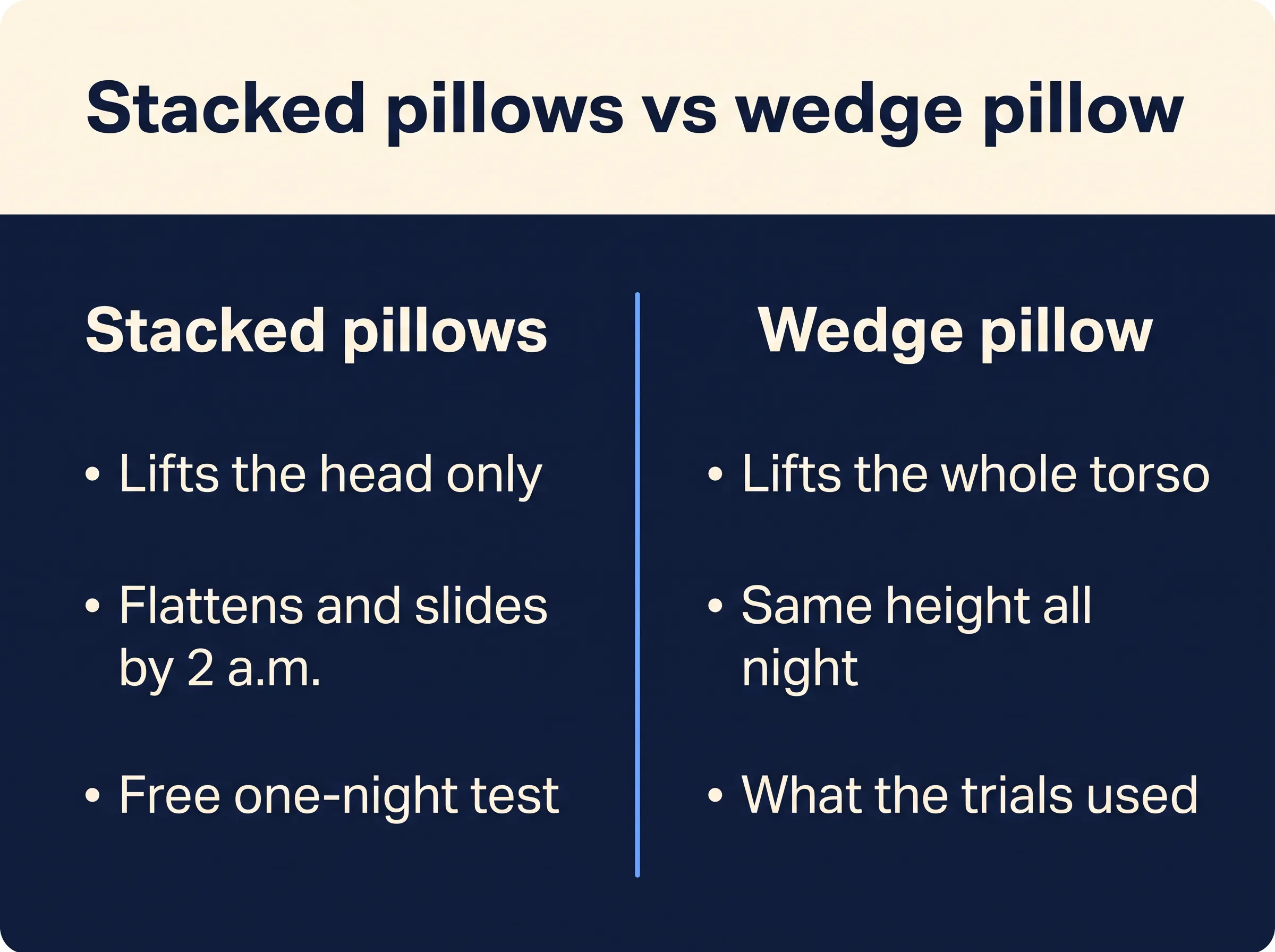
| Stacked pillows | Wedge pillow | |
|---|---|---|
| What it lifts | Head, sometimes upper back | Head, neck, shoulders and upper back on one slope |
| Height at 2 a.m. | Lower than at bedtime; fill compresses, pillows slide | Same as at bedtime |
| Neck position | Flexed forward unless carefully stepped | In line with the spine on a moderate wedge |
| Evidence base | None of the reviewed elevation trials used pillows | Trials used a wedge or bed blocks at about 20 cm |
| Cost | Free with pillows you own | Mid-range, one purchase |
| Best for | One-night test, travel, a blocked nose | Nightly reflux, snoring, post-op sleeping |
| Side sleeping | Unstable | Works with a wide wedge and a knee pillow |
4 signs it is time to switch from a stack to a wedge
Most people who write to us about stacks describe the same four things. Any one of them means the stack has done its job as a test and it is time for the real thing.
- The stack helped the first night and then stopped. That is compression and sliding, not the elevation failing; the height is no longer there at the hour reflux peaks.
- You wake up with a stiff neck or a sore upper back. The lift is under your head, not your torso; a wedge moves it down to where it belongs.
- You rebuild the pile more than once a night. Every rebuild is a wake-up; a single block needs none.
- Your partner is sleeping on your overflow pillows. A stack big enough to work takes three or four pillows and half the bed; a wedge takes one 65 cm square at your end.
The Aeris Wedge Pillow is the wedge we point stack refugees to: 65 by 65 cm, 22 cm at the apex, so 8.7 inches over a 25.6 inch ramp at about 19 degrees, which is the trial-height geometry in one firm block that measures the same at 2 a.m. as at 10 p.m. in our hands-on testing. People who want more lift for sitting up as well as sleeping go to the taller Flexicomfort Wedge Pillow Set, which ships with its own headrest so nothing has to be stacked on top of it either. The five-step guide to choosing a wedge pillow walks through height, width and firmness before you buy.
Stack or wedge tonight? Answer three questions.
Frequently asked questions
Can I use stacked pillows instead of a wedge pillow for acid reflux?
For a test night, yes; for nightly use, it rarely holds up. A stack lifts the head, compresses and slides, while the trials behind head-of-bed elevation raised the torso by about 20 cm with a wedge or bed blocks. If a stack helps you, that is the signal to switch to a wedge, and to discuss elevation with your doctor as part of your plan.
How many pillows equal a wedge pillow?
Three firm pillows stepped from under the shoulder blades come closest to a low wedge at bedtime, and none of them equals it by morning. Height is not the only measure; a wedge’s single firm block keeps the slope and the torso angle all night, which a pile of separate pillows cannot.
Why do stacked pillows make acid reflux worse for some people?
Because they lift the head without the torso and bend the body at the neck and waist. Stacking guides themselves warn that raising only the head can add neck strain, and a body folded at the middle is not the straight incline the elevation trials used. A slope that starts under the shoulder blades avoids most of it.
Is a wedge pillow better than pillows for snoring?
A wedge holds the head and chest at a steady angle all night, which is what the airway needs; a stack drops as it compresses. Our wedge pillow for snoring guide covers angle and side sleeping; sleep apnea needs a diagnosis and a treatment plan from a sleep physician, and a wedge supports that plan rather than replacing it.
What kind of pillows should I stack if I have no wedge?
Firm ones with a core that resists compression: memory foam or a dense fibre fill, never down or feather. Put the lowest pillow under the shoulder blades and step the next one up so the slope is gradual; a firm memory-foam pillow such as the FirmNest Extra Firm on top keeps the height longest. Add a pillow under the knees to stop sliding.
Can I put stacked pillows on top of a wedge for more height?
No. A wedge already raises the head; pillows on top raise it again and drop the chin to the chest. If you need more lift, choose a taller wedge or add a low bed riser under the head-end legs; our pillow on top of a wedge guide explains why stacking fails.
Do side sleepers do better with a stack or a wedge?
A wedge, provided it is wide enough for the shoulder to stay on the slope through a roll; a stack slides apart the first time you turn. Our guide to sleeping on your side on a wedge pillow gives the six-step setup, including the knee pillow that stops the slide.
Our recommendation
Use a stack for one purpose: to find out, tonight, whether elevation helps you. Build it from firm pillows stepped from the shoulder blades, measure the height before and after, and be honest about 2 a.m. If it helped and then flattened, you have your answer, and the Aeris Wedge Pillow is the same idea in one block that does not flatten. If nothing changed after a week of decent elevation, more pillows will not change it either; that is worth a conversation with your doctor, not another trip to the linen cupboard. The best wedge pillows by use guide picks a model for each of the rows in the table above.
Advertisement
Aeris Wedge Pillow
65 × 65 cm base, 22 cm apex, 3.1 kg — the wedge every measurement in this guide refers to.
See the Aeris Wedge product details on Amazon