Last updated: November 2026
This guide is part of our full map of wedge pillows for acid reflux, GERD, and better sleep.
Anti-snore pillow vs wedge pillow: it depends on what you need to move. An anti-snore pillow repositions your head and neck, while a wedge pillow raises your whole upper body on a foam ramp.
“Anti-snore pillow” is a label, not one design. This guide sorts the shapes sold under it, sets out what the trials measured, and explains how to test one against a wedge pillow.
Key takeaways
- “Anti-snore pillow” covers at least three shapes: contoured neck pillows, head-turning positional pillows, and powered pillows that move the head. A wedge pillow is a fourth approach that raises the torso.
- The NHS snoring page lists “a special pillow or bed wedge” as a way to sleep on your side, next to the tennis ball trick.
- Evidence for head-positioning pillows is limited and mixed. A 2004 randomised blinded trial of 40 snorers found no benefit over no aid; a 2017 crossover trial of 22 snorers found a lower snoring index.
- In a 2015 study of 25 adults, a head-positioning pillow cut the median snoring index from 218 to 115 events per hour, but not significantly in overweight participants.
- Incline studies show a modest change: a 12° home study of 25 snorers measured a 7% relative reduction in snoring duration, and a 30° airway study of 45 sleep apnoea patients found less soft-palate collapse but no difference at the tongue base.
- Side sleeping changes snoring mainly in people without sleep apnoea, according to a 2003 study of 72 habitual snorers.
- Gasping, choking or pauses in breathing call for a GP visit, not a new pillow.
What is an anti-snore pillow?
An anti-snore pillow is any pillow sold to change the head or neck position during sleep so the airway is less likely to vibrate. The label has no fixed definition, so products under it differ more from each other than from an ordinary pillow.
Most fall into three shapes. A contoured or cervical pillow has a raised neck roll that tips the chin slightly up; a head-positioning pillow has a firm, raised centre and lower sides that make the head roll onto one side; and a powered pillow uses a sensor and air chambers to nudge the head sideways when it detects snoring. A wedge pillow is usually sold separately, but the NHS lists it in the same breath as “a special pillow”.
That is why reviews of “anti-snore pillows” contradict each other. A review of a neck-roll pillow and a review of a head-turning pillow are describing two different products.
What does each pillow actually change?
Each design moves a different part of the body, and that sets who it suits.
| Pillow type | What it changes | Suits | Does not address | Main drawback |
|---|---|---|---|---|
| Contoured / cervical pillow | Tilts the chin up slightly by supporting the neck curve | Back sleepers whose snoring follows head position | Torso angle; a blocked nose | Firm neck roll can feel unnatural at first |
| Head-positioning pillow | Turns the head to one side with a high centre and low sides | Snoring that eases when the head is turned | Snoring that continues on the side | Less sleep time in one study |
| Powered (airbag) pillow | Inflates to nudge the head sideways when snoring is detected | People who want position changes only during snoring | Torso angle; nasal snoring | Cost, noise, power; little published data |
| Wedge pillow | Raises the head and upper body on a foam ramp | Snoring that is worse lying flat on the back | Snoring from the base of the tongue | Sliding down the slope during the night |
The split that matters is head versus torso. The first three change where your head points; a wedge pillow changes the angle of your whole upper airway, which is also why it is used for elevating the head of the bed when snoring is worse lying flat.
What did the studies find for anti-snore pillows?
Small groups and different pillows, so these results describe the products tested, not every pillow with the label.
| Pillow | Study | People | What was measured | Result |
|---|---|---|---|---|
| Head-positioning pillow | Michaelson & Mair 2004 | 40 snorers, randomised, blinded | Recorded snoring at home for a week vs no aid | No objective or subjective benefit |
| Pillow that changes head position | Cazan 2017 | 22 snorers without sleep apnoea | Snoring index, activated vs inactive pillow | Lower snoring index (p = 0.03); partners reported less snoring |
| Head-positioning pillow | 2015 Scientific Reports study | 25 adults with positional sleep apnoea | Snoring events per hour over 3 nights | 218 → 115 per hour; not significant in overweight participants |
| Cervical-extension pillow | Ahn 2022 | Small development test | Snoring at different neck angles | No snoring recorded at 20° or more of extension |
The two randomised trials point in opposite directions, and the positive one tested a pillow designed to change head position in people without apnoea. The 2015 study also found that normal-weight participants slept less on the positioning pillow, 6.3 hours against 7.5 hours on their own pillow.
What did the studies find for a wedge pillow?
Incline studies measure the torso angle, not the head, and they show a modest change in some people.
In a 2022 home study of 25 self-reported snorers, four weeks at a 12° incline gave a 7% relative reduction in snoring duration compared with four weeks flat. At 30°, the 2022 airway study of 45 patients found less collapse at the soft palate and throat walls, with no difference at the tongue base and epiglottis.
A typical sleeping wedge pillow sits between those two angles. The Aeris Wedge Pillow measures 22 cm at the apex over a 65 cm base, about 18.7°; our wedge pillow height guide explains how apex height and base length set the angle.
Does sleeping on your side matter more than the pillow?
For many snorers without sleep apnoea, position appears to matter more than the product. In the 2003 study of 72 habitual snorers, most of those without apnoea snored less on their side, both in time and loudness, while people with sleep apnoea “often fail to decrease snoring even in the lateral position”.
That gives a head-turning pillow and a wedge pillow a shared target: back-sleeping snoring. The head-turning pillow tries to move you off your back; a wedge pillow lets you stay on your back with the airway raised. The NHS also suggests a tennis ball sewn to the back of your sleepwear, though fewer than 10% of patients in one follow-up were still using it about 30 months later.
If you snore on your side as well as your back, neither pillow is likely to change much, and our comparison of a wedge pillow, nasal strips and mouth tape covers the nose and mouth side.
4 questions to choose between an anti-snore pillow and a wedge pillow
These are sorting questions to decide what to test first, not a diagnosis.
- Do you snore only on your back? If yes, both pillow types target your snoring. If you also snore on your side, a pillow is a weak first step.
- Can you sleep raised? Some people cannot settle on a slope. If you sleep flat by preference, a head-positioning or contoured pillow keeps you flat; if a slope feels fine, a wedge pillow changes more than the head alone.
- Do you also want reflux or congestion comfort? A wedge pillow is used for elevation in those situations too, which a flat contoured pillow does not provide; see our page on a wedge pillow for sleep apnoea for what elevation does and does not show.
- Do you share the bed? A head-positioning pillow takes no extra room; a full-width wedge pillow does, though our guide to using a wedge pillow in a shared bed covers raising one side only.
Then test one pillow for at least a week and keep the rest of the routine the same, as our two-week log for checking whether a wedge pillow is working sets out.
Can you use an anti-snore pillow on top of a wedge pillow?
You can, but it changes the angle at your neck. A thick or contoured pillow on top of the slope pushes the chin towards the chest, which works against the open neck position both designs aim for.
If you add a pillow on top, a thin, flat one keeps the neck in line with the slope. Stacking several ordinary pillows is a different thing again: the stack bends you at the neck and tends to flatten through the night, as our comparison of stacked pillows and a wedge pillow explains.
When is snoring a reason to see a doctor?
When it comes with signs of sleep apnoea. The NHS advises seeing a GP if you feel sleepy during the day, your breathing stops and starts while you sleep, or you make gasping or choking noises, and also if lifestyle changes are not helping.
Neither pillow type treats sleep apnoea. If you have been diagnosed and use CPAP, a wedge pillow can sit alongside it for comfort; our page on using a wedge pillow with CPAP covers mask and hose positioning.
Frequently asked questions
Is a wedge pillow an anti-snore pillow?
It is often sold next to them, and the NHS mentions a bed wedge alongside a special pillow for snoring. The difference is what moves: anti-snore pillows change the head and neck, while a wedge pillow raises the whole upper body on a foam ramp. Both mainly target snoring that is worse on your back.
Do anti-snore pillows actually work?
The evidence is mixed. A 2004 randomised blinded trial of 40 snorers found no benefit from a head-positioning pillow over no aid. A 2017 crossover trial of 22 snorers without sleep apnoea found a lower snoring index with a pillow that changes head position. Results depend on the design and on why you snore.
Which is better for back sleepers who snore?
Both target back sleeping in different ways. A head-positioning pillow tries to turn your head to the side, while a wedge pillow lets you stay on your back with the airway raised. If you find side sleeping uncomfortable, a wedge pillow keeps your usual position; if you cannot sleep on a slope, a flat positioning pillow may suit you better.
Can an anti-snore pillow cause neck pain?
Some people find them uncomfortable. In a 2015 study of a head-positioning pillow, 48% of participants reported no obvious discomfort and 32% mild discomfort, and normal-weight participants slept about an hour less on it than on their own pillow. Give any new pillow a week before judging it.
Are smart anti-snore pillows worth it?
Powered pillows that inflate to turn the head when they detect snoring follow the same side-position idea as a foam positioning pillow. Published, peer-reviewed data on them is thin, so judge them on a home trial and the return policy rather than on headline percentages.
What angle should a wedge pillow be for snoring?
Studies have used 12° to 30°. A 12° incline at home gave a 7% relative reduction in snoring duration, and 30° reduced soft-palate collapse in a clinic. A typical sleeping wedge pillow of about 22 cm over 65 cm sits near 19°, inside that range.
Choosing a wedge pillow if position is the trigger
If the four questions point to back-sleeping snoring and you can settle on a slope, a wedge pillow is the option that changes the torso angle as well as the head; if you sleep flat by preference, a head-positioning pillow is the more comfortable first test. On a wedge pillow, what matters is that it holds one angle all night, because foam that compresses or a body that slides down the slope changes the angle you are testing; our guide on how to choose a wedge pillow works through height, length and firmness, and the adjustment period guide covers the first week on a slope.
The three below cover a gentle slope on a square base, a firmer core at a similar angle, and a taller wedge pillow for more lift. Methodology note: dimensions come from the makers’ production specifications and the published research cited above, with angles calculated as the arctangent of apex over base.
Advertisement
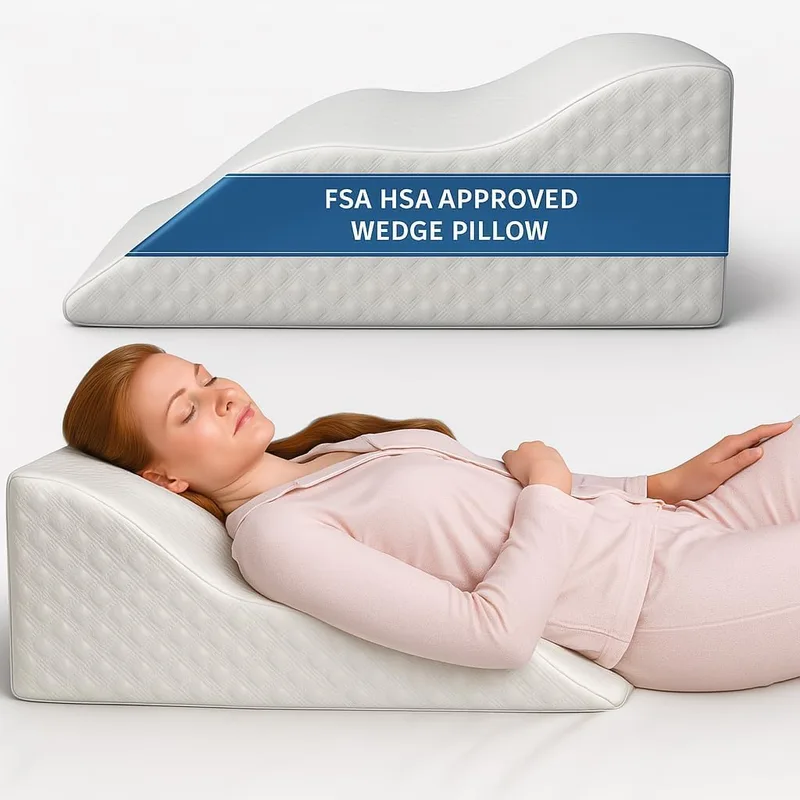
Aeris Wedge Pillow
65 × 65 cm base, 22 cm apex, 3.1 kg.
See the Aeris Wedge product details on AmazonProducts mentioned in this guide
- FirmNest Extra Firm Wedge Pillow — 61 × 61 cm base, 19 cm apex, about 17.3°
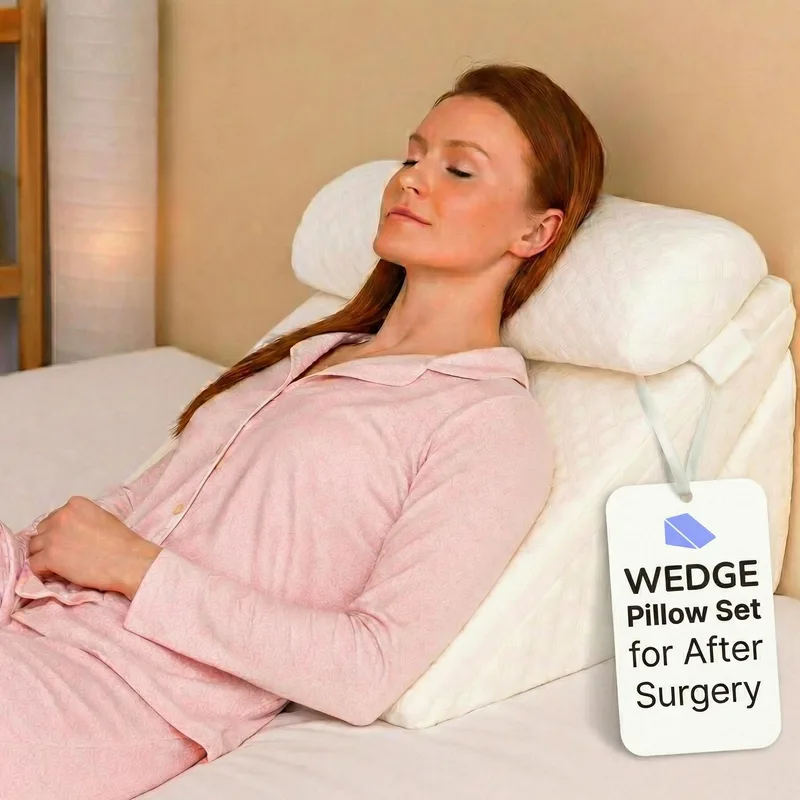 Flexicomfort Wedge Pillow — 60 × 56 × 28 cm