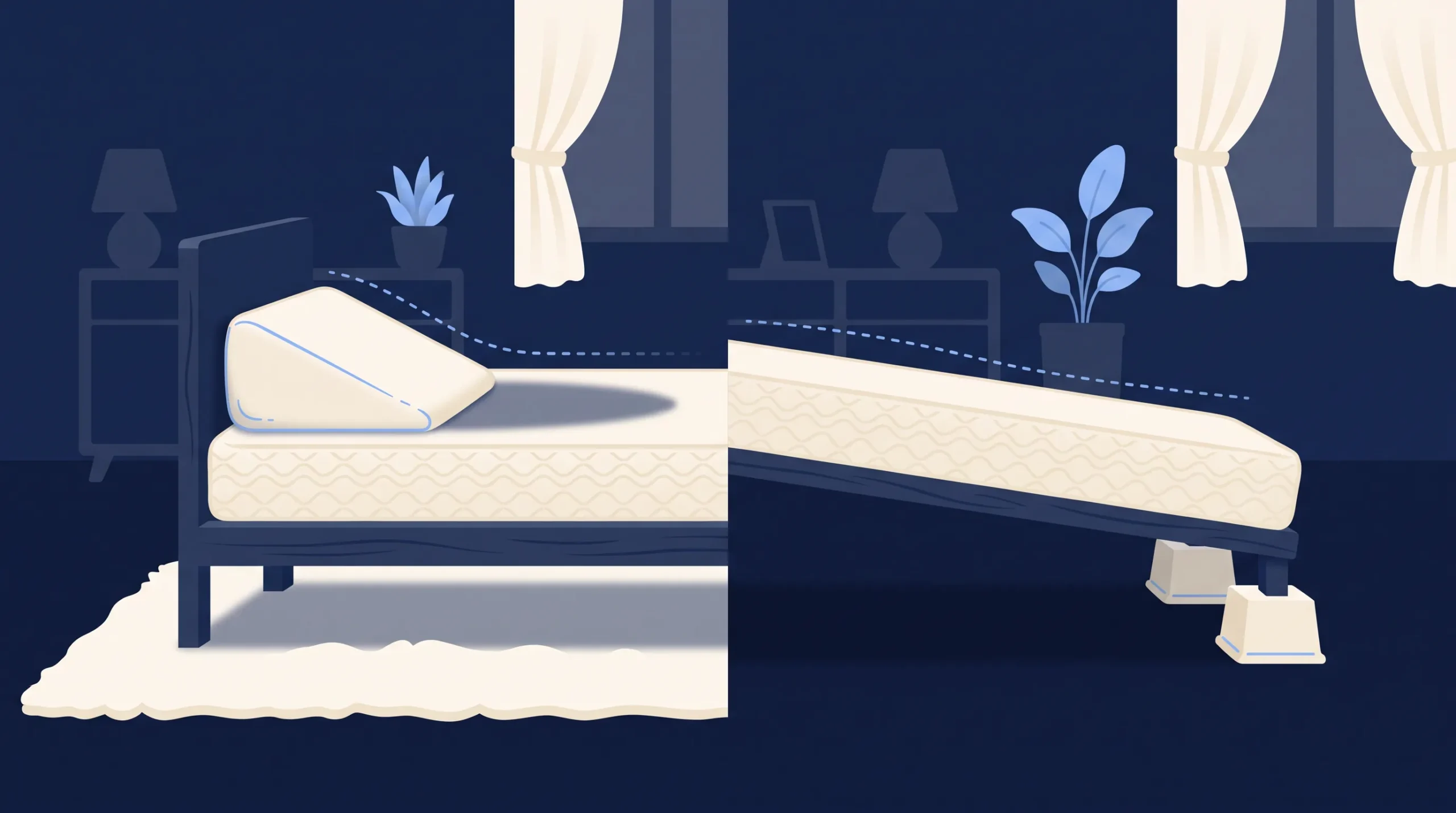
Last updated: September 2026
This guide is part of our full map of wedge pillows for acid reflux, GERD, and better sleep.
Can you sleep on your side on a wedge pillow? Yes. It works when three things line up: the wedge is wide enough for your shoulders, your shoulder rests on the slope, not off its edge, and a knee pillow keeps your hips level.
A wedge is built for back sleeping, so the setup carries the whole result. Get those three things wrong and your lower back pays for it by morning; get them right and the side position holds all night.
Key takeaways
- Side sleeping on a wedge is a positioning problem, not a yes-or-no question: width, shoulder placement and hip support decide whether it works.
- In a 2015 randomized crossover trial of 20 volunteers, lying left-side down on an inclined positioning device produced less esophageal acid exposure than a standard wedge in any position, a flat bed, or the same device right-side down.
- A 2023 systematic review found that left-side sleeping lowered acid exposure time by about 2 percentage points compared with the right side and about 2.7 points compared with lying flat on the back.
- The American College of Gastroenterology’s 2022 guideline lists head-of-bed elevation as a conditional suggestion for night-time symptoms and lists sleeping on the left side among lifestyle measures with evidence of improvement.
- A pillow between the knees helps keep the spine, hips and pelvis in a more neutral line for side sleepers, according to the Sleep Foundation.
- Side sleepers need more height under the head than back sleepers; a 2025 biomechanics study found shoulder width predicts the right pillow height for side lying.
- The Aeris Wedge Pillow is 65 cm wide, which is the measurement that matters most for a side sleeper on a wedge.
Can you sleep on your side on a wedge pillow without hurting your back?
Yes, and the back pain most people report comes from one of three setup mistakes rather than from the incline itself. A wedge lifts your torso along a slope; on your back the slope supports the whole spine evenly, but on your side your shoulder becomes a pivot point. If the shoulder hangs off the edge of a narrow wedge, or sits at the very top where the foam is thinnest, the spine bends sideways and the lower back twists to compensate.
The second mistake is sleeping with the hips unsupported. Side sleeping on any surface lets the upper leg drop forward and roll the pelvis; on a slope that roll is amplified, because gravity is also pulling you toward the foot of the bed. The third is using the same thick head pillow you use on a flat mattress, which pushes the head up and forward. Each has a simple fix, and the setup steps below go through them in order. If you already have a back condition, or pain that persists after two weeks of a corrected setup, talk to a doctor or physical therapist before continuing; a wedge is a comfort and positioning aid, not a treatment.
Which side should you sleep on with a wedge pillow?
The left side, if reflux is the reason you bought the wedge. In a randomized crossover trial published in the Journal of Clinical Gastroenterology in 2015, 20 healthy volunteers each completed four six-hour impedance-pH recordings after a standard meal, lying in four assigned setups: an inclined positioning device left-side down, the same device right-side down, a standard wedge in any position, and a flat bed. Esophageal acid exposure was lowest left-side down on the device; it was highest right-side down on the same device, which suggests that side matters as much as incline. Volunteers on the device stayed in the assigned position for most of the first two hours and more than half of the six hours, while those on a plain wedge or flat bed drifted onto their backs. The device maker was a co-author on that study, so the result deserves the usual caution.
The side effect is not specific to one device. A 2023 systematic review and meta-analysis in the World Journal of Clinical Cases pooled two non-randomized studies and found that left-side sleeping reduced acid exposure time by a mean of 2.03 percentage points compared with the right side and 2.71 points compared with lying on the back, with faster acid clearance in both comparisons; right side and back did not differ from each other. The authors describe the evidence base as small and call for more trials. The 2022 ACG guideline frames head-of-bed elevation as a conditional suggestion with low-level evidence, and its lifestyle table places sleeping on the left side among measures with evidence of improvement. For snoring or congestion rather than reflux, either side can work; our wedge pillow for snoring guide covers that case.
Why left and not right? The stomach sits to the left of the esophagus. Lying left-side down keeps the junction between the two above the pool of stomach contents; lying right-side down puts it below. That anatomy is the usual explanation for the trial results above, and it is why a wedge plus the left side is the combination most reflux guides describe.
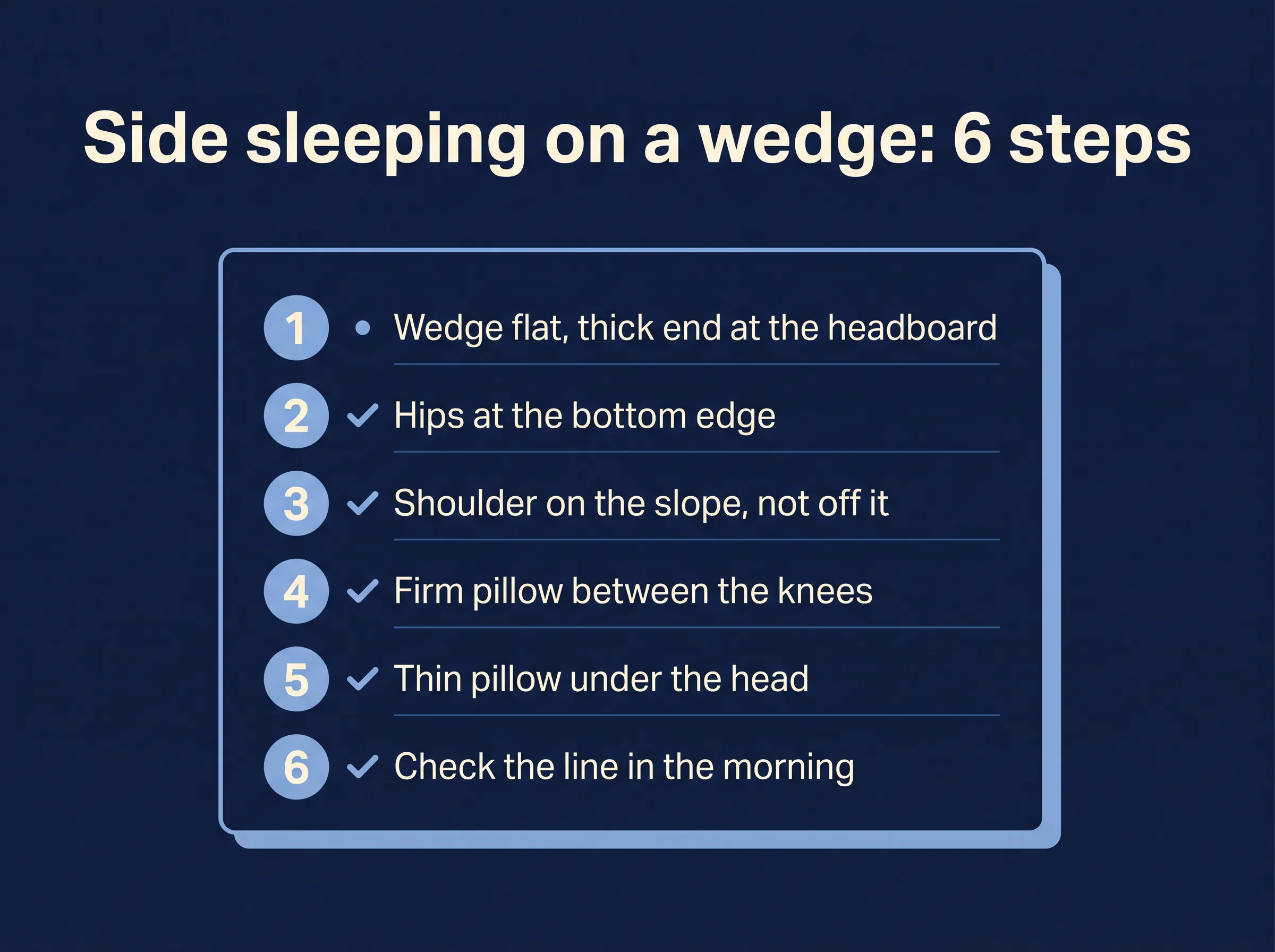
How do you set up a wedge pillow for side sleeping? 6 steps
Place the wedge, then build the position from the hips up. The order matters, because the head pillow is the last thing you choose, not the first.
- Position the wedge with the thick end at the headboard and the thin end pointing toward your feet, flat on the mattress. Do not prop it against the headboard at a steeper angle; that makes the shoulder pivot worse.
- Lie on your left side with your hips at the bottom edge of the wedge, so the slope begins under your waist, not under your armpit. On a 65 cm wedge the ramp then carries your ribcage and shoulder.
- Put your lower shoulder on the slope, not in front of it. The shoulder should sink into the foam a little, with your lower arm forward of your chest. A shoulder hanging off the side edge is the single biggest cause of morning back pain on a wedge.
- Add a pillow between your knees. Bend both knees slightly and place a firm knee pillow or a folded standard pillow between them so the upper knee sits level with the upper hip. This keeps the pelvis square and stops the slide-and-twist.
- Fill the gap under your neck with a thin pillow. Because the wedge already raises your head, you need less height than on a flat bed; start with a pillow half the thickness of your usual one and adjust. Our companion guide on putting a pillow on top of a wedge pillow goes into the numbers.
- Check the line in the morning. If you wake with one shoulder numb, move the wedge 5 cm lower under your body. If your lower back aches, the knee pillow is too thin or missing. Change one thing per night.
Where should your shoulder go on the wedge?
On the slope, roughly a third of the way up from the thin end, so the foam supports the shoulder from below rather than the shoulder supporting the body from the side. “If your neck is bent in any way for an extended period of time, you’ll get uncomfortable,” physical therapist Matthew O’Rourke of Spaulding Rehabilitation Hospital tells Harvard Health; the same article notes that side sleepers generally need firmer, taller support under the head than back sleepers because the shoulder holds the head further from the mattress.
On a wedge the shoulder sinks into the incline, which partly closes that gap, so the extra height you need is smaller than on a flat bed. That is why the order in the setup steps ends with the head pillow: fix the shoulder first, then measure what is left. A firm wedge helps here. Soft foam lets the shoulder sink unevenly and tilts the head; the firm core of the Aeris Wedge Pillow holds a consistent slope under the shoulder through the night, which is what we found in our hands-on testing over several weeks of side sleeping on it.
Do you need a pillow between your knees on a wedge?
Yes, more than on a flat bed. The Sleep Foundation explains that a pillow between the knees can improve spinal alignment, reduce pressure on the hips and knees and ease back pain, especially for side sleepers, by holding the body in a more neutral position. On a wedge you are also fighting a slow slide toward the foot of the bed, and an unsupported upper leg is what turns that slide into a pelvic twist.
A knee pillow also solves the sliding problem better than gripping the edge of the wedge. With the knees supported and bent, your lower body anchors on the flat part of the mattress and the wedge only has to hold your torso. We use the Flexicomfort Knee Pillow, a 30 by 22 by 20 cm contoured block firm enough not to flatten by morning, but a folded standard pillow works for a trial night. Pregnant side sleepers have their own set of angles, covered in our wedge pillow for pregnancy guide.
The slide test. Lie on your side on the wedge without a knee pillow and note where your hips are after ten minutes. Add the knee pillow and repeat. If the second position holds, you have found the fix for most wedge back pain; if you still slide, the wedge is too steep for side sleeping and a lower profile or a low bed riser plus a modest wedge is the next thing to try.
How wide does a wedge pillow need to be for a side sleeper?
Wider than your shoulders with room to roll, which in practice means 60 cm or more. A back sleeper can use a narrow wedge because the body stays centered; a side sleeper moves, turns over, and needs the slope to be there on both sides of the roll. Width is the first thing to read on a wedge spec sheet if you sleep on your side; height comes second, because a steep wedge is harder to hold a side position on.
| Spec | Aeris Wedge Pillow | Flexicomfort Wedge Pillow |
|---|---|---|
| Length (ramp) | 65 cm | 60 cm |
| Width | 65 cm | 56 cm |
| Height at the apex | 22 cm | 28 cm |
| Approximate incline from the spec | about 19 degrees | about 27 degrees |
| Weight | 3.1 kg | 3.5 kg |
| Side-sleeper fit | Wide and moderate: room for the shoulder roll | Taller and narrower: better on the back or for sitting up |
Both figures come from the makers’ production specifications, not from marketing copy. For side sleeping the Aeris Wedge Pillow is the one we recommend: its 65 cm width keeps a shoulder on foam through a full roll, and the 22 cm apex over a 65 cm ramp gives a moderate slope that is easier to hold on your side than a steep one. The Flexicomfort Wedge Pillow is taller and narrower, which suits back sleepers who want more lift and people who use the wedge to sit up and read. If neither shape fits, the positioning-wedge category is built specifically for side sleepers; our Fanwer positioning wedge review covers that style, and the five-step guide to choosing a wedge pillow compares the whole range.
Why does side sleeping on a wedge hurt your back, and how do you fix it?
Because something in the chain from shoulder to knee is out of line, and each symptom points to a different link. Use the table as a checklist before you give up on the wedge.
| What you wake up with | Likely cause | Fix to try tonight |
|---|---|---|
| Lower-back ache on one side | Upper leg dropped forward, pelvis twisted | Firmer or thicker knee pillow; knees bent |
| Numb or sore lower shoulder | Shoulder at the thin top edge or off the side | Move the wedge 5 cm lower under your body; centre yourself |
| Stiff neck | Head pillow too thick for the raised position | Halve the head-pillow height; see our pillow-on-top guide |
| Hips at the foot of the bed by 2 a.m. | Wedge too steep for side sleeping | Lower-profile wedge, or a low riser plus a modest wedge |
| Sore hip on the mattress side | Hips on the slope instead of the flat mattress | Slide your hips off the bottom edge so only the torso is inclined |
If a corrected setup still leaves you in pain after two weeks, stop and talk to a doctor or physical therapist. Our wedge pillow side effects article lists who should be careful with inclined sleeping, and wedge pillow for lower back pain covers the back-sleeping alternative with the wedge under the knees.
Frequently asked questions
Can you sleep on your side on a wedge pillow for acid reflux?
Yes, and the left side is the one the research supports. A 2015 crossover trial found the least acid exposure left-side down on an incline, and a 2023 review found left-side sleeping lowered acid exposure time compared with the right side or the back. Discuss the plan with your doctor; the evidence base is small.
Is it better to sleep on your left or right side on a wedge?
Left, for reflux. In the 2015 trial the same inclined device produced the most acid exposure right-side down and the least left-side down, so the side you choose can matter more than the incline. For snoring or congestion, either side is fine; pick whichever lets you stay asleep.
Do side sleepers need a wider wedge pillow?
Yes. A back sleeper stays centred, but a side sleeper rolls, and a narrow wedge leaves the shoulder hanging off the edge after a turn. Look for 60 cm or more of width; the Aeris wedge is 65 cm. Height matters less, and a very steep wedge is harder to hold on your side.
Should I use a knee pillow with a wedge pillow?
Yes. The Sleep Foundation notes that a pillow between the knees helps keep the spine, hips and pelvis aligned for side sleepers, and on a slope it also stops the slow slide toward the foot of the bed. A firm contoured knee pillow holds its shape; a folded standard pillow is fine for a test night.
Why do I slide down the wedge when I sleep on my side?
Because your lower body is on the slope. Move your hips off the bottom edge so only the torso is inclined, bend your knees with a pillow between them, and your legs anchor you on the flat mattress. If you still slide, the wedge is too steep for side sleeping and a lower profile is the answer.
Can I put my regular pillow on top of the wedge as a side sleeper?
A thin one, yes. Side sleepers need some height to fill the gap between shoulder and head, but the wedge already lifts the head, so a standard-thickness pillow usually pushes the head up and forward. Start with half your usual thickness and adjust; our pillow on top of a wedge pillow guide has the details.
Is a wedge pillow bad for your hips if you sleep on your side?
It can be uncomfortable if your hips rest on the slope, because the point of contact shifts to the bony side of the hip. Slide your hips onto the flat mattress below the wedge and support the knees. Stomach sleepers face a different problem, covered in our wedge pillow for stomach sleepers article.
Who should sleep on their back on a wedge instead?
Anyone who cannot hold a side position after two weeks of the setup above, and anyone whose shoulder pain is the main complaint. A wedge is at its best on the back, where the slope supports the spine evenly and there is no pivot point; the 2015 trial also showed how easily people on a plain wedge drift onto their backs during the night. If that is you, let it happen: a back-sleeping wedge with a pillow under the knees is a perfectly good reflux and snoring setup, and our best wedge pillows by use guide points to the right height for it.
If you are set on your side, the recipe is short: a wedge at least 60 cm wide, your shoulder on the slope, your hips on the flat mattress, a firm pillow between your knees and a thin pillow under your head. Left side if reflux is the reason. Give each change a night, and if anything hurts after two weeks, ask a professional before buying more foam.
Our pick for the wedge side
Aeris Wedge Pillow
65 × 65 cm base, 22 cm apex, 3.1 kg — the wedge every measurement in this guide refers to.
Check the Aeris Wedge price on Amazon