Last updated: November 2026
This guide is part of our full map of wedge pillows for acid reflux, GERD, and better sleep.
If you fly carry-on only, the easiest way to travel with a wedge pillow is an inflatable wedge. A foam wedge with a 65 × 65 cm base is longer and wider than the 56 × 35 cm a typical carry-on allows.
The other options are a folding foam wedge, packing your own wedge in a checked bag, or a no-wedge setup in the hotel room. If you drive or check a bag, the choice is wider. This guide compares all four on bag space, angle and comfort, so you can choose before you pack.
Key takeaways
- A typical US carry-on limit is 22 × 14 × 9 inches (56 × 35 × 23 cm) on Delta; the Aeris Wedge Pillow base alone is 65 × 65 cm, so a full foam wedge pillow will not fit in that bag.
- The TSA allows pillows in both carry-on and checked bags, with the final decision resting with the officer at the checkpoint.
- Inflatable wedges deflate and fold into a pouch; one travel model is listed at 32 × 30 × 8 inches inflated and 2.2 lb, with a mini USB pump.
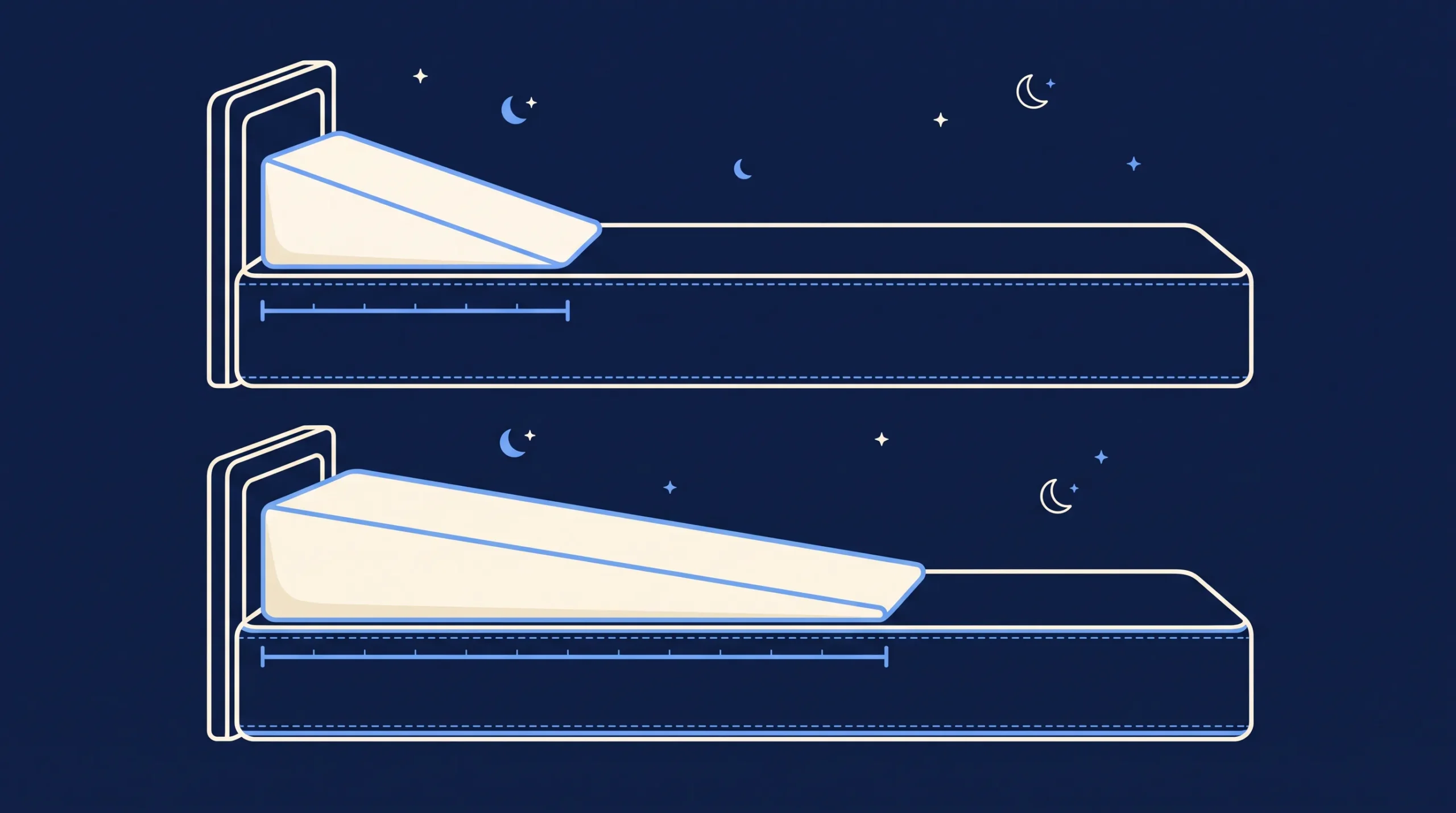
- An 8-inch (about 20 cm) inflatable gives about 14° on a 32-inch base and about 10° on a 45-inch base; a 22 cm foam wedge pillow on a 65 cm base gives about 18.7°.
- The NHS describes raising the head of the bed by around 10 to 20 cm so your chest and head are above your waist, and warns that extra pillows can increase pressure on your belly.
- A 2021 systematic review of five trials (228 patients) covered both bed blocks and wedge pillows; the four trials that reported reflux symptoms found an improvement with head-of-bed elevation, though all five were judged at high risk of bias.
Why is a wedge pillow hard to travel with?
Because foam takes up space in its full shape. A foam wedge pillow is a solid triangle, and it keeps that shape in your bag. The Aeris model is 65 cm long, 65 cm wide and 22 cm at the apex, which fills about 46 litres as a triangle and needs a box of about 93 litres to hold it.
A carry-on that meets the 56 × 35 × 23 cm limit holds about 45 litres in total. So even before you pack clothes, the wedge pillow is too long and too wide for the bag. That is why the question is not “how do I pack my wedge” for most trips, but “what do I use instead while I am away”.
What are the 4 ways to sleep elevated when you travel?
There are four practical options, and each one trades bag space against angle and comfort.
| Option | Bag space | Typical angle | Main trade-off |
|---|---|---|---|
| Inflatable wedge | Folds flat when deflated | About 10° to 16°, set by base and height | Air feel; valve and seams can leak |
| Folding foam wedge | Smaller than a solid wedge, still bulky | Close to a foam wedge of the same height | Still hard to fit in a carry-on |
| Your own foam wedge pillow | Large; checked bag or car only | The angle you already know | Space, and the risk of damage in transit |
| Hotel setup (no wedge) | None | Depends on what is under the mattress | Hard to measure and to keep stable |
The rest of this guide takes them one at a time, then covers what to check before you leave.
Is an inflatable wedge pillow good for travel?
For most trips, yes; it is the option that packs smallest. Deflated, an inflatable wedge folds into a pouch, and you fill it with a pump or by mouth when you arrive. One travel model on Amazon is listed at 32 × 30 × 8 inches and 2.2 lb with a mini USB pump; a longer model is 45 × 30 × 8 inches and 3 lb.
The angle comes from the ratio of height to base length. With the same 8-inch height, the 32-inch base works out to about 14° and the 45-inch base to about 10°. If you sleep at a steeper angle at home, an inflatable of the same height may feel flatter, and you can see how height and angle relate in our wedge pillow height guide.
The trade-offs are the feel and the air. An air chamber can feel bouncier than foam, and you adjust firmness by how much air you add. Valves and seams are the parts that can let air out, so a screw cap valve and a test night at home are worth checking. Our reviews of the Geetery inflatable wedge and the Inflatable Triangle wedge cover two more designs.
Should you pack your own foam wedge pillow?
Only if you are driving or checking a large bag. Your own wedge pillow gives you the angle and firmness you are used to, which matters if you have just settled into sleeping elevated; our adjustment period guide explains why consistency helps in the first weeks.
On a road trip, the wedge pillow goes on the back seat and the problem disappears. On a flight, it does not fit the carry-on size limit, so it has to go in checked baggage or a separate bag. A foam wedge pillow in a large plastic bag or a fabric bag keeps the cover clean; our guide to cleaning a wedge pillow covers the cover and foam if it does get dirty.
A folding foam wedge sits between the two: it folds into sections, so it is shorter in the bag than a solid wedge pillow, but it is still a bulky item and usually needs its own space.
How do you sleep elevated in a hotel without a wedge?
You raise the head end of the mattress or the bed, not just your head. The NHS describes raising the head of the bed by around 10 to 20 cm so your chest and head are above your waist, and it warns against using extra pillows for the same effect because they can increase pressure on your belly.
In a hotel room, that means putting something firm and stable under the head end of the mattress, such as a folded blanket or spare bedding, rather than stacking pillows under your head. The stacked pillows vs wedge pillow comparison explains why stacked pillows bend you at the neck instead of tilting the torso, and our wedge under the mattress guide explains how a whole-mattress tilt differs from a wedge on top.
This setup costs nothing in luggage but is hard to measure. Check that the mattress does not slide and that the rise is even across the bed. Raising the bed legs is the method our wedge pillow vs bed risers guide covers at home; in a hotel, it is worth asking the front desk before you move furniture.
What should you check before you leave?
Four checks cover most problems, and you can do all of them at home.
- Test the inflatable for a full night. Inflate it, sleep on it at home and check in the morning whether it still holds its height.
- Match the angle. Compare the height and base of the travel option with your home wedge pillow, so the angle is close to what you are used to.
- Check the bag rules. Measure the folded wedge against your airline’s carry-on size, and remember that the TSA leaves the final decision to the officer at the checkpoint.
- Pack the pump and a cover. A small pump saves time at night, and a removable cover makes the air chamber feel less like plastic.
If you share the bed on the trip, our guide to elevating just your side of a shared bed explains how a wedge pillow affects the other sleeper.
Frequently asked questions
Can I take a wedge pillow on a plane?
Yes, the TSA allows pillows in both carry-on and checked bags, and the final decision rests with the officer at the checkpoint. The practical limit is size: a full foam wedge pillow is usually longer than a 22 × 14 × 9 inch carry-on bag, so a foam wedge often has to be checked, while a deflated inflatable fits in a carry-on.
Do inflatable wedge pillows work as well as foam?
They can give a similar incline if the height and base are similar, but they feel different. Air is bouncier than foam, and the firmness depends on how much air you add. Valves and seams can let air out, so it is worth testing one for a full night at home before a trip.
What angle does a travel wedge pillow give?
It depends on the height and the base length. An 8-inch inflatable gives about 14° on a 32-inch base and about 10° on a 45-inch base. A foam wedge pillow with a 22 cm apex on a 65 cm base gives about 18.7°. Compare those numbers with your home wedge pillow.
Can I use hotel pillows instead of a wedge pillow?
Stacked pillows mainly raise your head and bend your neck. The NHS warns that extra pillows can increase pressure on your belly and suggests raising the head of the bed instead. In a hotel, firm bedding placed under the head end of the mattress tilts more of the torso.
Will a foam wedge pillow fit in a suitcase?
A full foam wedge pillow rarely fits a carry-on. The Aeris wedge pillow, for example, has a 65 × 65 cm base, while a common carry-on limit is 56 × 35 × 23 cm. A large checked suitcase may hold one, but it takes up most of the space.
How do I stop an inflatable wedge pillow from sliding?
Push it against the headboard so it has something to rest against, and put a non-slip mat between the wedge and the mattress. A cover with a textured fabric also grips the sheet better than bare vinyl. If it still slides, check whether the angle is steeper than you are used to.
Choosing your travel setup
If you fly and want to keep your carry-on, an inflatable wedge is the straightforward choice; check its height and base against your home wedge pillow so the angle is close. If no inflatable matches your usual angle, a shorter base gives a steeper slope at the same height, and a folding foam wedge in a checked bag is the next step. If you drive, or can check a bag, taking your own foam wedge pillow keeps everything the same as at home, and for a short stay the hotel setup costs nothing to try.
The module below lists the foam wedge pillow used for the size and angle comparisons in this guide and two inflatable travel wedges: the shorter one gives the steeper angle, the longer one supports more of the torso at a gentler slope. Methodology note: figures come from the makers’ production specifications and Amazon listings, and the published sources cited above.
Advertisement
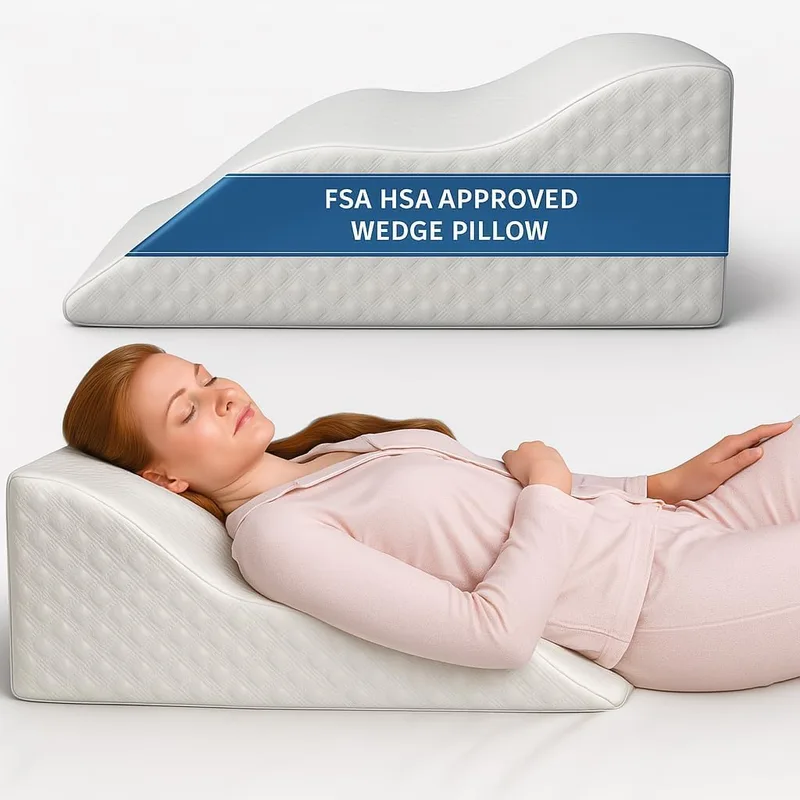
Aeris Wedge Pillow
65 × 65 cm base, 22 cm apex, 3.1 kg.
See the Aeris Wedge product details on AmazonProducts mentioned in this guide
- Travelwedge Small-Size Inflatable Bed Wedge — 32 × 30 × 8 inches, 2.2 lb, mini USB pump, about 14°, the steeper and lighter option
- Travelwedge Mid-Size Inflatable Bed Wedge — 45 × 30 × 8 inches, 3 lb, screw cap valve, about 10°, the longer slope