Last updated: October 2026
This guide is part of our full map of wedge pillows for acid reflux, GERD, and better sleep.
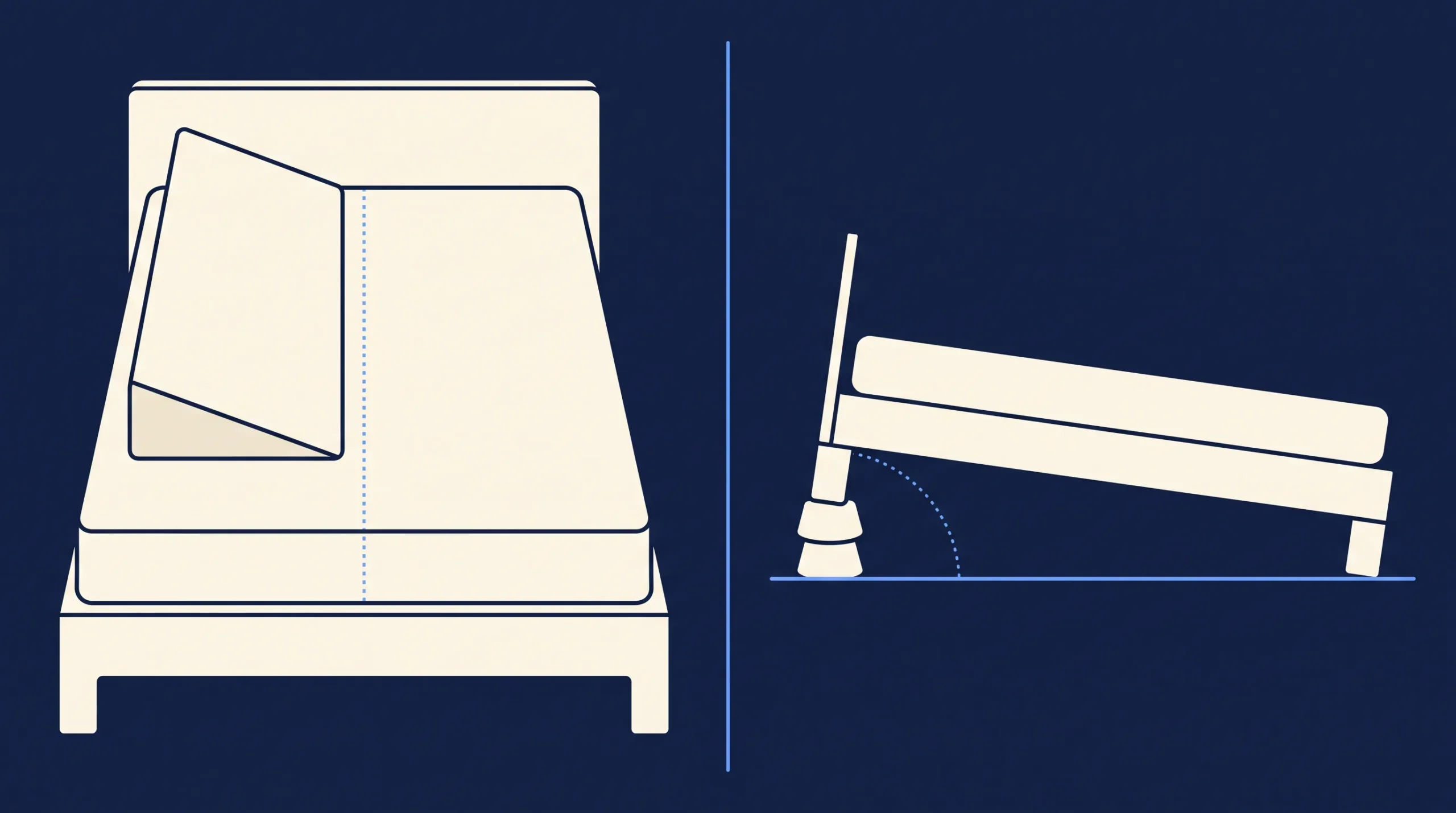
Yes. A wedge pillow sits on your side of the mattress, so your half tilts and your partner’s half stays flat. Bed risers and full-width under-mattress wedges raise the whole surface, which puts both of you on the same slope.
This guide covers how much of the bed a wedge takes, what the elevation trials actually tested, and four ways to raise one sleeper without raising the other.
Key takeaways
- The elevation evidence was collected on whole beds, not half beds: Khan 2012 used a 20 cm block under the head-end legs for six nights, and the IBELGA crossover trial used 20 × 20 × 20 cm wooden risers for six weeks. Both raise two occupants.
- Tilting a shared bed has measured costs. Over half of IBELGA’s participants reported some adverse reaction to 20 cm of tilt and about a quarter of those stopped; in its table of 63 people, one reported bed instability, three reported instability or breakage as a reason to stop, and one reported “sexual problems associated with the tilting of the bed”.
- A queen mattress is 60 inches wide, so each sleeper has about 30 inches. A 65 cm wedge pillow is 25.6 inches wide and leaves roughly 4 inches before it crosses the midline.
- The American College of Gastroenterology’s 2022 guideline suggests elevating the head of the bed for night-time GERD symptoms as a conditional recommendation on a low level of evidence, naming bed elevation and sleeping on a wedge in the same sentence.
- The same guideline rates sleeping on the left side as “unequivocal” in strength of evidence while head elevation is “equivocal” — and position costs your partner nothing.
- One option touches neither the bed nor the other sleeper: in a sham-controlled trial of 100 patients, a positional-therapy wearable hit its success threshold in 44% of the intervention group against 24% on sham.
What does a wedge pillow change that bed risers and under-mattress wedges don’t?
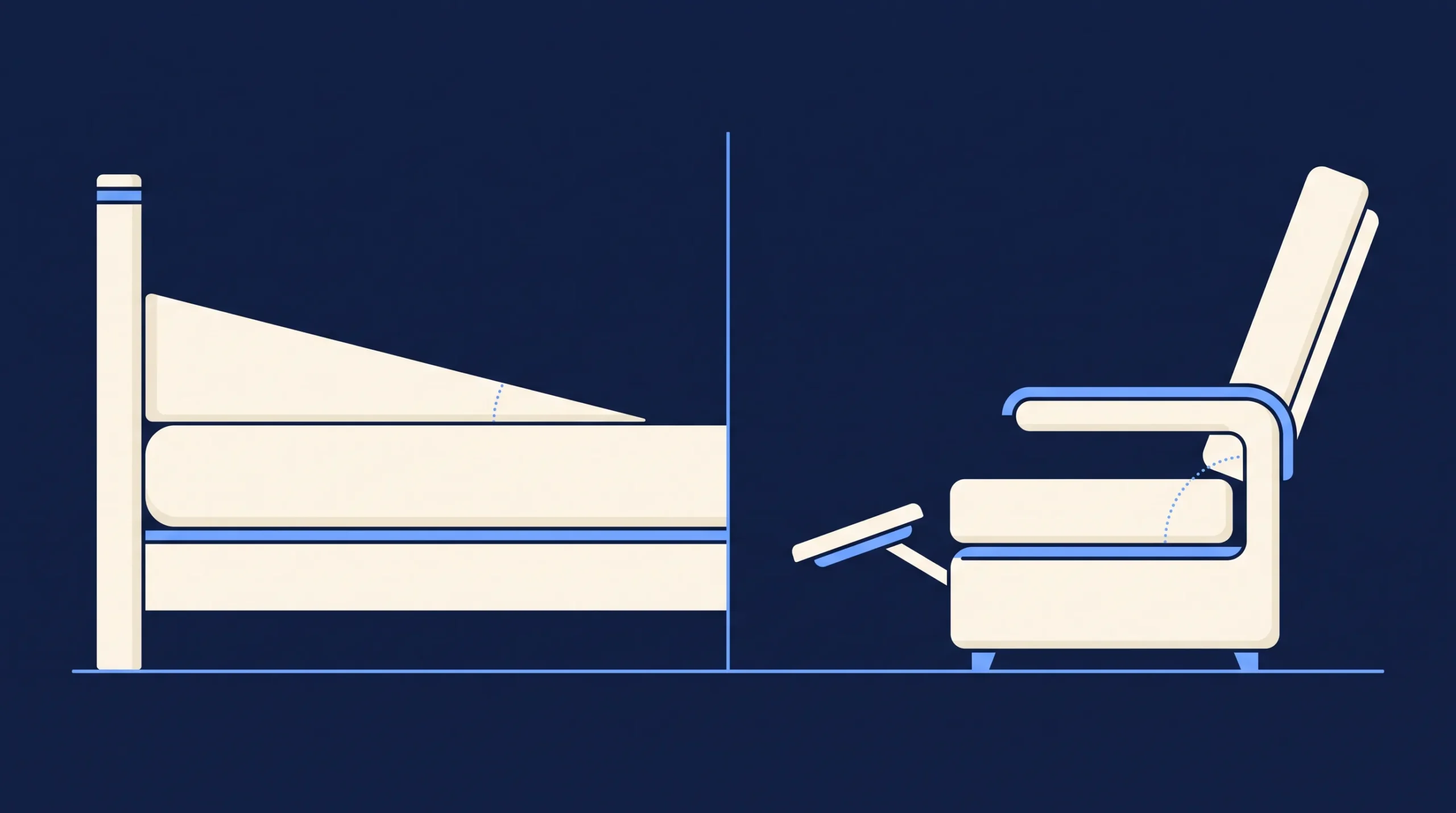
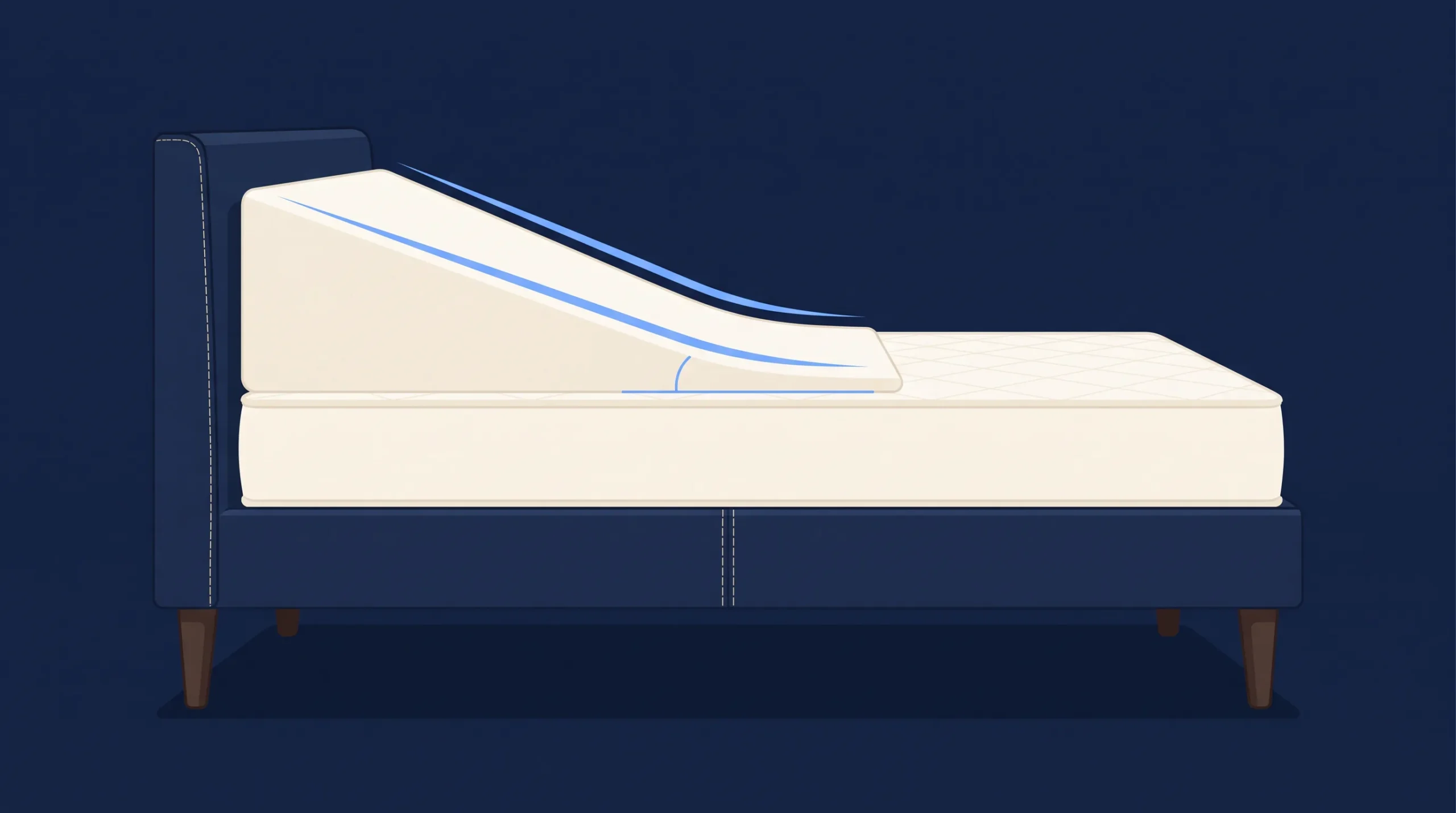
It changes the geometry of one sleeper instead of the geometry of the bed. A wedge pillow is a foam ramp resting on top of the mattress, so the mattress stays flat and only the person on the ramp is tilted. Every other common method modifies the bed itself.
Bed risers go under the two head-end legs and tilt the entire sleeping surface, as our comparison of raising the head of the bed on blocks against using a wedge pillow sets out. An under-mattress wedge does the same from inside the bed, the trade-off covered in wedge under the mattress or on top. An adjustable base lifts the whole head section unless it is a split model, the difference discussed in wedge pillow against adjustable bed.
That is why the question keeps appearing in reflux forums with a partner in the sentence: if the other person does not want to sleep on a slope, the wedge pillow is the only one of those three that does not ask them to.
How much of a shared bed does a wedge pillow actually take?
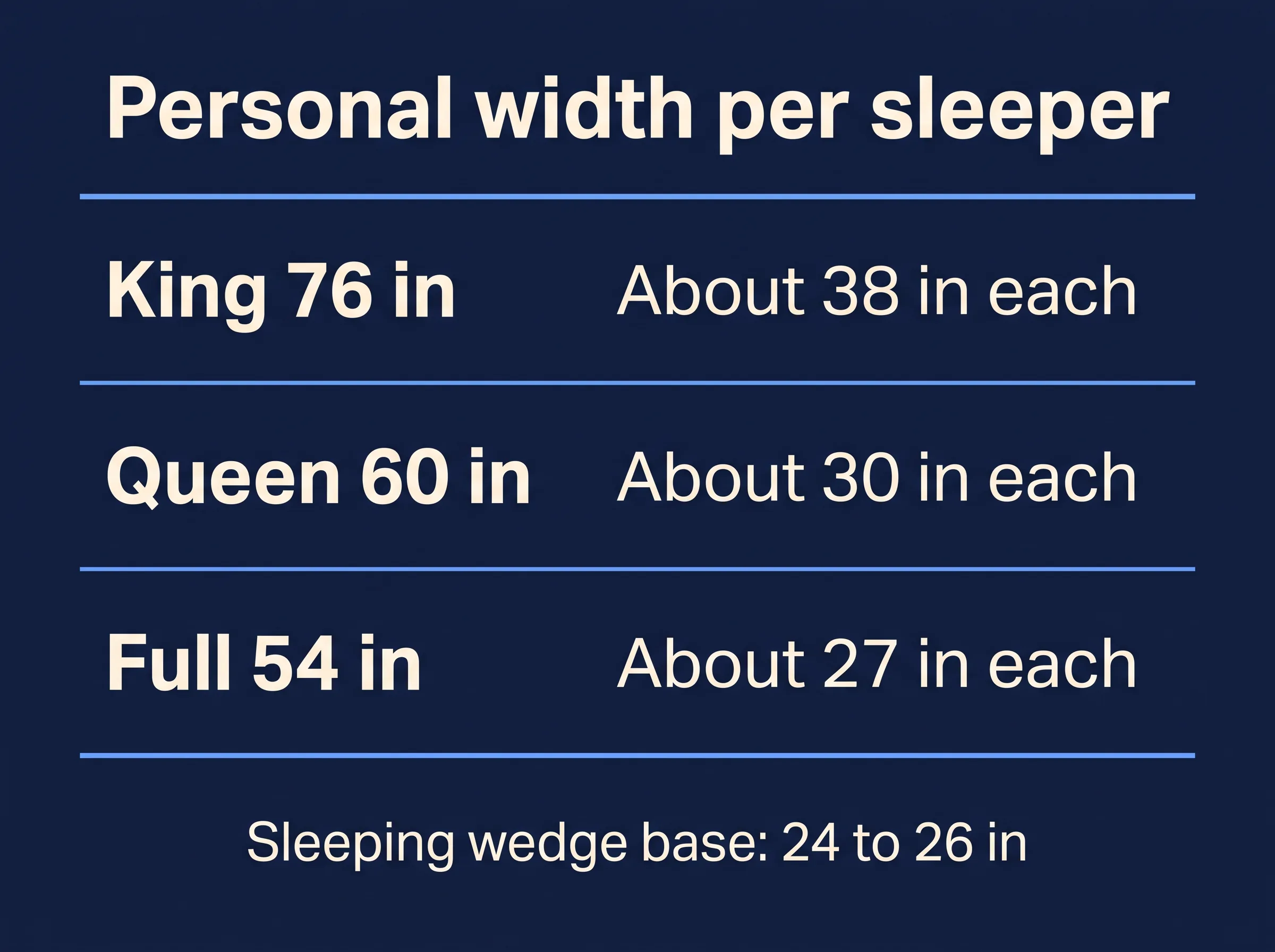
Less than most people expect, because sleeping wedges are built around one torso. US mattress widths are standardised, so the arithmetic is fixed: a queen is 60 inches wide and a king 76, which works out at about 30 and 38 inches of personal width per sleeper. A full is 54 inches, or about 27 inches each.
Set the wedges we make against those halves:
| Wedge | Base width | Apex | Clearance on a queen half (30 in) | Clearance on a king half (38 in) |
|---|---|---|---|---|
| Aeris Wedge Pillow | 65 cm (25.6 in) | 22 cm (8.7 in) | about 4.4 in | about 12.4 in |
| Flexicomfort Wedge Pillow | 60 cm (23.6 in) | 28 cm (11.0 in) | about 6.4 in | about 14.4 in |
| FirmNest Extra Firm Wedge | 61 cm (24.0 in) | 19 cm (7.5 in) | about 6.0 in | about 14.0 in |
The Aeris Wedge Pillow measures 65 × 65 cm with a 22 cm apex, so it occupies about one shoulder-width of a queen and stays inside the midline if you centre it on your own half. The number to watch is base width, not apex height: a wedge sold as queen-wide or king-wide is built to span the bed and will reach your partner’s shoulder.
A full-size bed is where this gets tight. At about 27 inches each, a 24 to 26 inch wedge leaves one to three inches of margin and ordinary movement will close it, so someone will feel the foam.
Does the elevation research cover sleeping on one side of the bed?
No, and that is worth saying plainly: the published trials raised the whole bed. In the 2012 study in the Journal of Gastroenterology and Hepatology, patients slept with the head end on a 20 cm block for six consecutive nights; among the 20 of 24 who completed it, supine reflux time fell from 15.0% to 13.7%, acid clearance time from 3.8 to 3.0, refluxes longer than five minutes from 3.3 to 1.0, and sleep disturbance improved in 13 patients, or 65%.
IBELGA, the larger randomized crossover trial, used purpose-cut 20 × 20 × 20 cm wooden risers for six weeks against six weeks flat. Of the 39 patients analysed, 27 — 69.2% — reached the primary outcome of at least a 10% drop in their reflux symptom score, a mean change of −1.24 against 0.09 flat. The acid-reflux and heartburn sub-scores alone did not reach significance, and quality of life did not move by the 10% the authors had set as meaningful. Participants still preferred sleeping elevated.
The 2022 systematic review of nocturnal reflux interventions found five elevation studies in total and put elevation first in a sequential strategy, alongside a longer gap between dinner and bed, a left-side position and acid-suppressive medication. No published comparison ranks a one-sided wedge against a tilted whole bed, so anyone calling the wedge the researched option is reading more into the literature than it holds. What the research does establish is that the useful angles are modest, the subject of our wedge pillow height guide. Methodology: dimensions come from the makers’ production spec sheets, every other figure from the studies linked above.
4 ways to raise one sleeper without raising the other
Each changes one person’s position while leaving the other side of the mattress alone. They differ in cost, in how well the slope holds, and in whether the bed itself changes.
- A wedge pillow on your half. A foam ramp roughly 24 to 26 inches wide, centred on your side. The bed is untouched and it comes off in seconds, making it the cheapest reversible test. Its weakness is anchoring: the slope is held by friction, so you can slide down it.
- A twin-width under-mattress wedge on a king. The GIVANLEE Mattress Wedge is sold at 76 × 26 × 6 inches and in twin and queen widths too, so on a 76-inch king a twin-width panel covers close to one sleeper’s half. It holds its angle better than a pillow because your body lies on the mattress, but fitting it means lifting the mattress.
- A split adjustable base. Two independently articulating halves under one bed: the best angle control and anchoring of the four, and by a wide margin the most expensive and least reversible.
- Positional therapy instead of elevation. A wearable that discourages right-side sleeping targets position rather than height. In the double-blind, sham-controlled trial of 100 patients, 44% of the intervention group reached at least a 50% drop in their nocturnal reflux score against 24% on sham, and time on the right side fell from 23.5% to 2.2%. Nothing about the bed changes.
The guideline’s evidence table rates “sleep on the left side” as unequivocal while head elevation is equivocal, so option 4 is not a consolation prize.
What should you do if both of you want to sleep elevated?
Then the objection disappears and the whole-bed methods become the better engineering. Blocks under the head-end legs or a full-width under-mattress wedge give both of you a slope your bodies rest on rather than a ramp you lie against.
IBELGA is still the caution to read first. Sliding down the bed led its adverse events at 16 of 63 as a mild event and 4 as a reason to quit, followed by venous-insufficiency symptoms in the lower limbs, neck or lower-back pain, and three reports of the bed becoming unstable or breaking. Anyone worrying about stacked blocks under a queen frame’s centre beam is worrying about a documented failure mode.
A reasonable sequence is to test the slope with two wedge pillows for a few weeks before touching the frame. If you both find it tolerable, convert to blocks or a panel; if one of you does not, you have learned that cheaply.
Why does a one-sided wedge pull the covers, and what helps?
Because a wedge raises your torso roughly 7 to 11 inches while your partner’s shoulders stay at mattress level, lifting the duvet into a ridge along the midline and opening a gap on the low side. It is the most common complaint about one-sided elevation that has nothing to do with reflux.
Three things reduce it. A longer, gentler wedge spreads the same rise over more length and creates a shallower ridge than a short, steep one — the geometry argument made in stacked pillows against a wedge pillow. Separate top covers remove the problem outright, which is why the two-duvet arrangement is standard in much of northern Europe. A wider bed helps for the obvious reason.
Sliding down the ramp is the other recurring complaint, and the person sliding tends to drift sideways as well as downward. Support under the knees and a wedge long enough to start below the shoulder blades both work on that. Our guide to sleeping on your side on a wedge pillow goes through the setup, and how long it takes to get used to a wedge pillow covers the first few weeks.
Frequently asked questions
Can you use a wedge pillow on just one side of a queen bed?
Yes. A queen is 60 inches wide, giving each sleeper about 30 inches, and a sleeping wedge is typically 24 to 26 inches at the base. A 65 cm wedge leaves roughly four inches before it reaches the midline. Centre it on your own half rather than on the headboard’s middle, and check base width rather than apex height when you buy.
Will a wedge pillow disturb my partner?
Less than tilting the bed, though not to zero. The mattress stays flat, so their surface is unchanged, but your raised torso lifts the shared duvet along the midline and can leave a gap on their side. Separate top covers resolve that. Whole-bed tilt, by contrast, produced reports of bed instability, breakage and tilt-related sexual problems in IBELGA.
Is it better to raise the head of the bed or use a wedge pillow?
No trial has compared them directly, so there is no evidence-based winner. The published studies all raised the whole bed, so that method has the data behind it; the wedge pillow is reversible, cheap and limited to one sleeper. If only one of you wants elevation, the wedge fits the constraint.
Can you raise only one side of a bed with risers?
Not safely on a shared frame. A bed frame is a rigid structure, so lifting the legs on one side tilts the whole platform sideways rather than raising half of it. IBELGA recorded three participants who stopped because of frame instability or breakage at 20 cm of straight head-end lift — the load case the frame was at least built for.
What is the least intrusive way to reduce night-time reflux in a shared bed?
Sleeping on your left side. It needs no equipment and nothing changes for the other person. The ACG’s 2022 guideline rates it unequivocal in strength of evidence, higher than head elevation, and notes that lying right-side down increases reflux because it places the junction of stomach and oesophagus below the pool of stomach contents. The two can be combined.
My partner snores and I have reflux. Can one wedge serve both of us?
Not one wedge, but the same approach can: elevation is used for both, which is why our pages on wedge pillows for snoring and wedge pillows for acid reflux and GERD overlap. Two single wedges keep each person’s height independent. Snoring with witnessed pauses in breathing should be assessed by a doctor rather than managed with a pillow.
Choosing the wedge that stays on your half
If one of you wants elevation and the other does not, the decision is mostly about base width: anything in the 60 to 65 cm range sits inside a queen half with room to spare, while anything sold as queen-wide or king-wide is built to span the bed. The rest of the trade-off is walked through in how to choose a wedge pillow.
As the maker of the Aeris wedge pillow we can state its geometry: 65 × 65 cm with a 22 cm apex, a single-sleeper footprint by design. If you both end up wanting the slope, the better long-run answer is the bed itself — blocks under the head-end legs or a full-width under-mattress panel — which is the setup the research above was collected on.
Advertisement
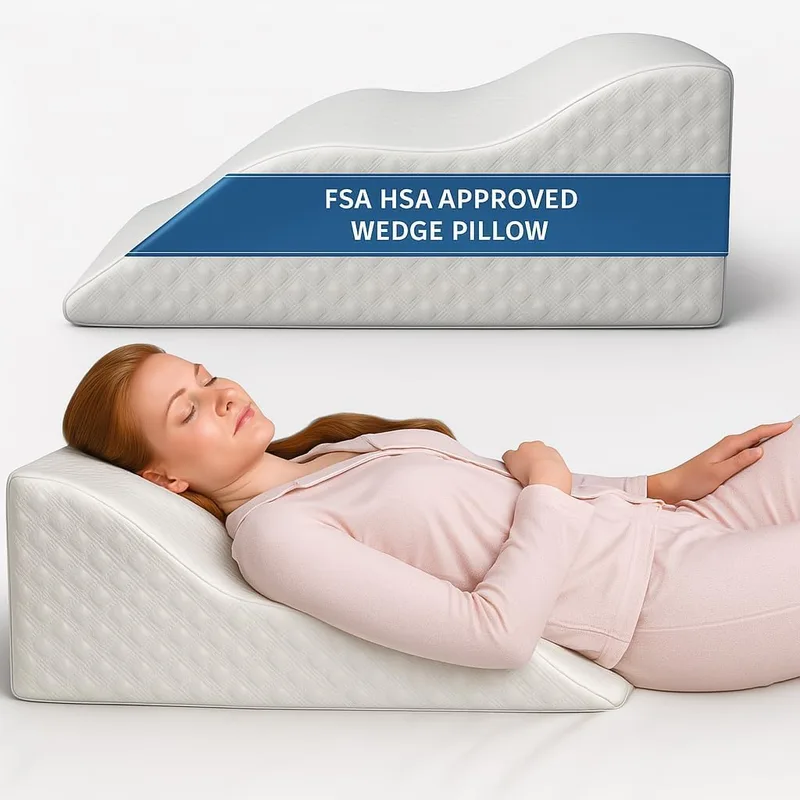
Aeris Wedge Pillow
65 × 65 cm base, 22 cm apex, 3.1 kg.
See the Aeris Wedge product details on AmazonProducts mentioned in this guide
- Home It adjustable bed risers — 3, 5 or 8 inch heights, set of 4
- GIVANLEE Mattress Wedge — 76 × 26 × 6 in, also sold in twin and queen widths