Last updated: September 2026
This guide is part of our full map of wedge pillows for acid reflux, GERD, and better sleep.
The best pillow for sleeping upright is a low, long foam wedge pillow for sleep and a backrest pillow with arms for sitting up awake. Sleeping wedges typically sit at 17 to 25 degrees, far from a vertical back.
This guide compares the common setups by angle and sliding, and shows what the elevation research actually used.
Key takeaways
- “Sleeping upright” in practice means sleeping inclined: the studies cited in this guide used between 7.5 and 30 degrees, not a seated 90.
- A wedge’s angle is set by its height divided by its length: 22 cm of lift over a 65 cm ramp is about 19 degrees; 28 cm over 60 cm is about 25 degrees.
- Head-of-bed elevation is a conditional, low-evidence recommendation for night-time GERD symptoms in the American College of Gastroenterology’s 2022 guideline.
- Mild elevation can matter for breathing too: in a 2017 study of 52 sleep-apnea patients, a 7.5 degree head-of-bed tilt lowered the apnea-hypopnea index from 15.7 to 10.7 events per hour.
- Sliding is the main complaint: in a 2020 trial summarised in a 2021 systematic review, 20 of 63 people sleeping with the head of the bed raised reported slipping in bed.
- Backrest (reading) pillows are built for sitting awake, not for lying on through the night; stacked bed pillows tend to collapse and let the head fall forward.
- An adjustable bed or bed risers raise the whole mattress, which avoids the “step” at the top of a wedge but costs more or tilts the whole bed.
What does “sleeping upright” actually mean?
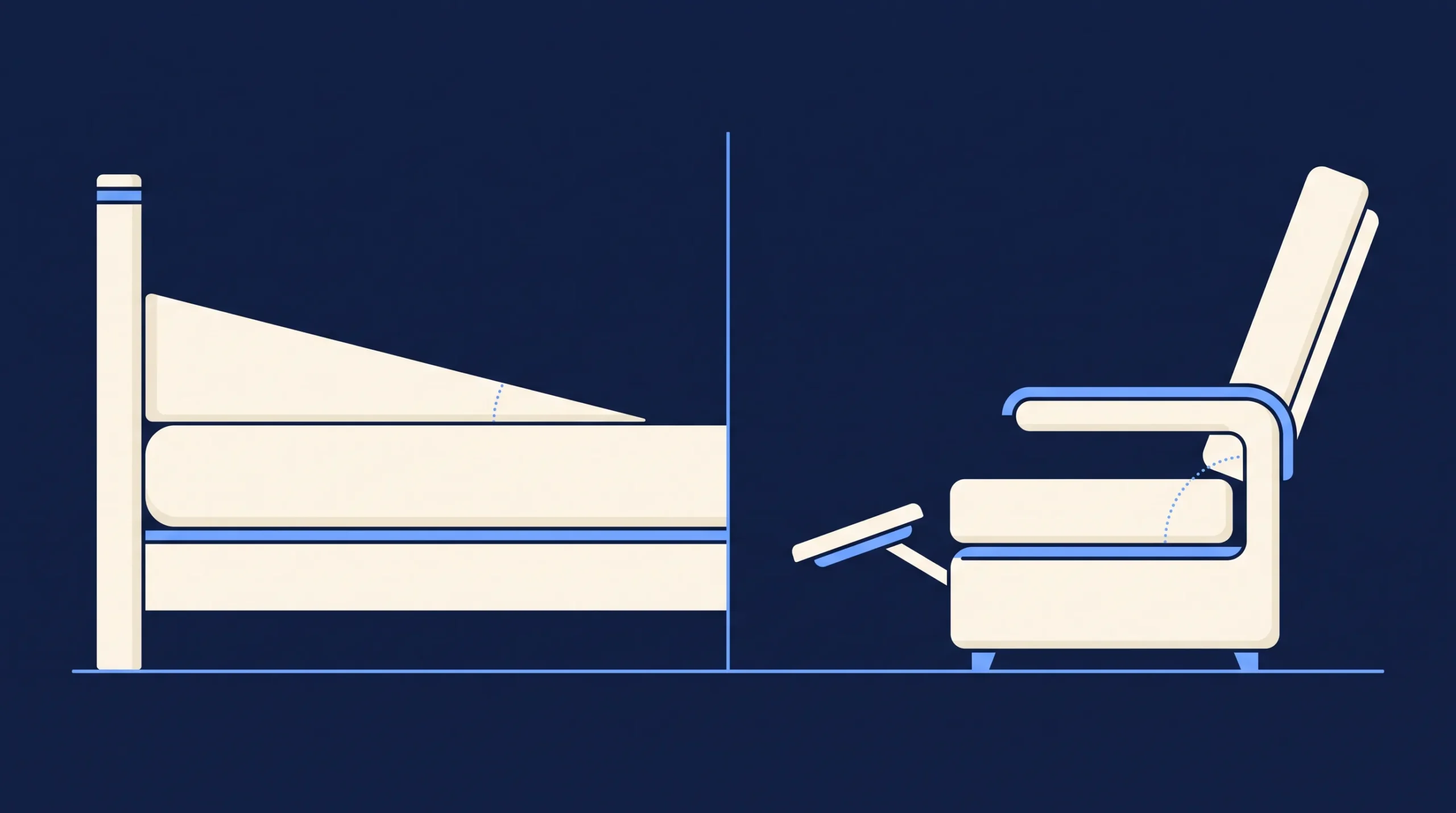
Sleeping upright almost always means sleeping with the upper body raised on a slope, not sitting vertically. A seated back is close to 90 degrees; the studies cited here for night-time reflux and sleep apnea used 7.5 to about 30 degrees. The steeper the slope, the more the body bends at the waist and the more it is pulled down the slope.
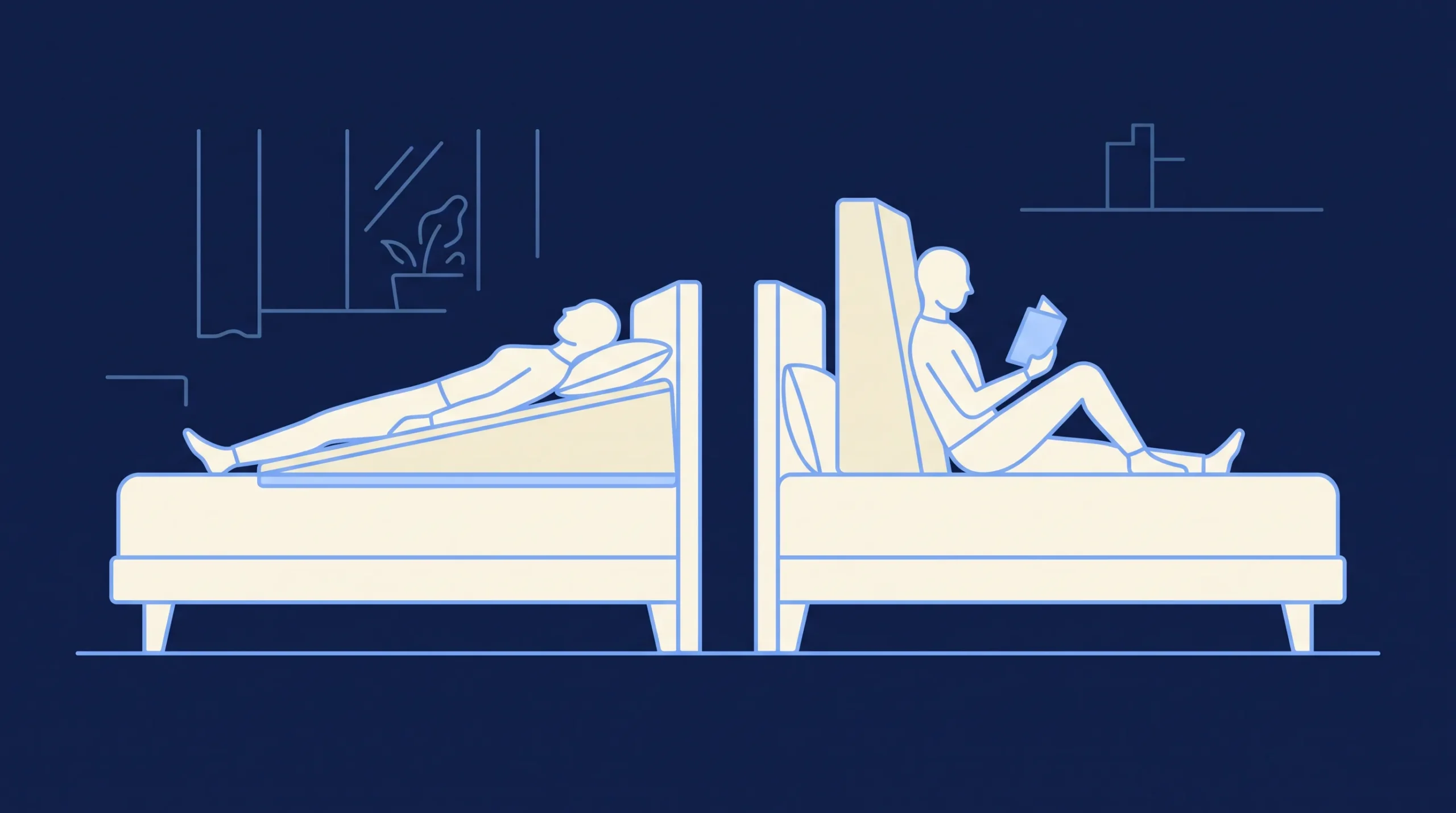
Two needs hide behind the same search: sleeping through the night raised, usually for night-time reflux, snoring or congestion, and sitting up in bed to read or watch TV, where the back is closer to vertical for an hour or two. The right pillow differs for each.
Which pillow is best for sleeping upright?
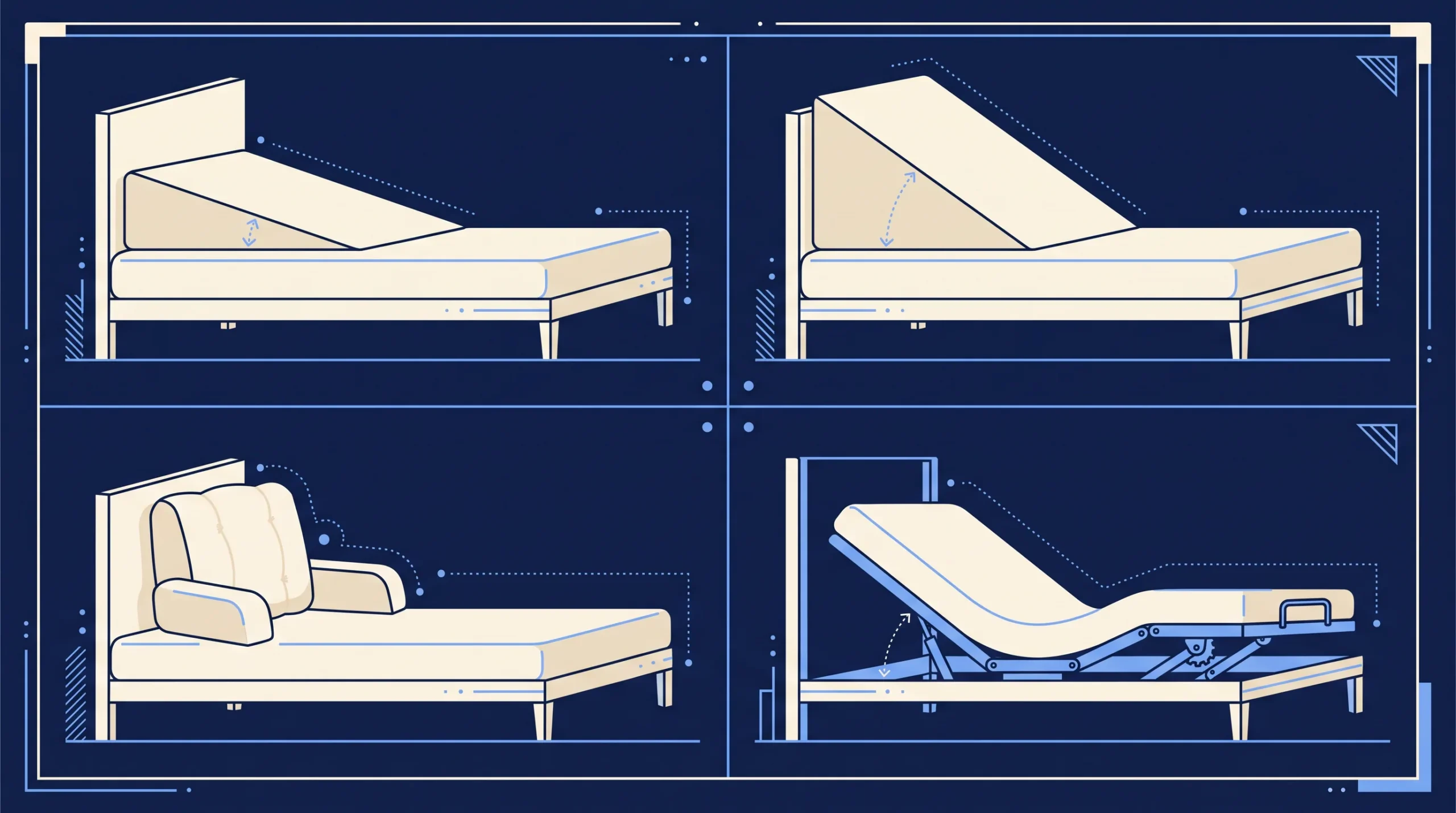
For sleeping through the night, a wedge pillow of 7.5 to 9 inches with a long ramp is the most stable choice; for sitting up awake, a backrest pillow with arms is. The table compares the five setups people usually try.
| Setup | Typical angle | Best for | Sliding | Main drawback |
|---|---|---|---|---|
| Low foam wedge (7.5–9 in, 24 in or longer) | about 17–21° | Sleeping all night raised: reflux, snoring, congestion | Some, reduced by a knee pillow | Too low for sitting up to read |
| Tall foam wedge (10–12 in) | about 23–27° on a 24 in ramp | Reading, TV, the first weeks of recovery | More | Hard to sleep on for eight hours |
| Wedge set with headrest | about 25° plus a head support | Half-sitting rest, recovery, reading | Moderate | Takes up more of the bed |
| Backrest (reading) pillow with arms | Close to a seated angle | Sitting awake in bed | Not built for lying down | Pushes the head forward if you fall asleep on it |
| Stacked bed pillows | Changes through the night | Short-term, no purchase | High; pillows shift and flatten | Head bends forward, lower back unsupported |
| Adjustable bed or bed risers | Set by the base or riser height | People who want the whole mattress raised | Low to moderate | Cost (adjustable base) or tilting the whole bed (risers) |
To sleep raised, choose the lowest angle that helps and a ramp long enough to start under the waist. To sit up, choose back and arm support, and move onto a flat bed or low wedge before you fall asleep. Our five-step guide to choosing a wedge pillow covers firmness and covers once the angle is picked.
How steep should a pillow for sleeping upright be?
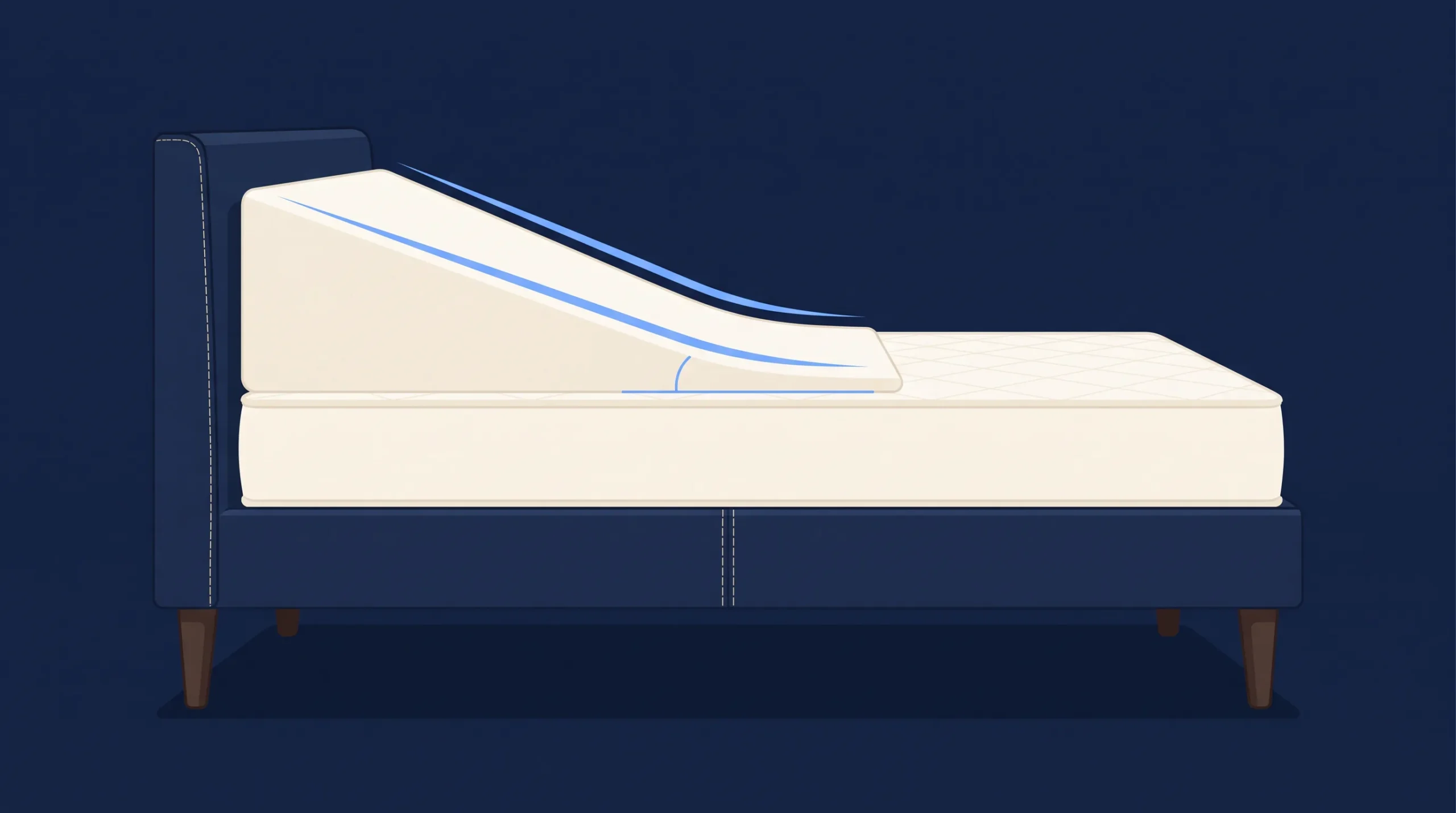
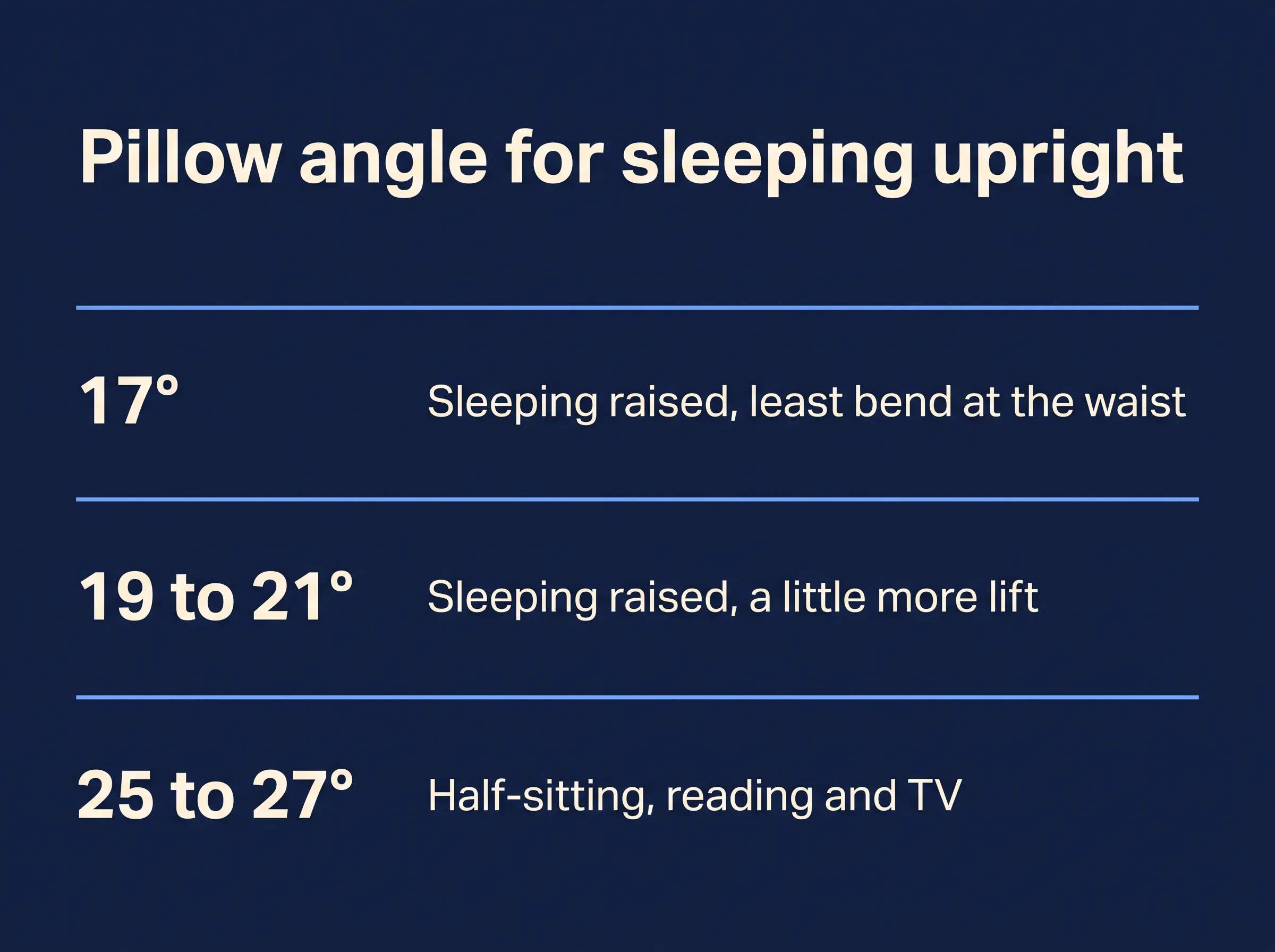
Steep enough to raise the head and chest, and gentle enough that you stay in place; sleeping wedges are typically built at 17 to 25 degrees. The angle is height divided by length, so two wedges of the same height can differ a lot.
| Height | Length | Angle | What it suits |
|---|---|---|---|
| 7.5 in (19 cm) | 24 in (61 cm) | about 17° | Sleeping raised with the least bend at the waist |
| 8.7 in (22 cm) | 25.6 in (65 cm) | about 19° | Sleeping raised; the Aeris Wedge Pillow’s geometry |
| 9 in (23 cm) | 24 in (61 cm) | about 21° | Sleeping raised, a little more lift |
| 11 in (28 cm) | 23.6 in (60 cm) | about 25° | Half-sitting; the Flexicomfort Wedge Pillow Set’s geometry |
| 12 in (30 cm) | 24 in (61 cm) | about 27° | Reading and TV, short rests |
The Aeris Wedge Pillow measures 65 cm long and 22 cm high, and the Flexicomfort Wedge Pillow Set 60 cm long and 28 cm high. A wedge only reaches 45 degrees when it is as tall as it is long, so check any angle claim against the measurements. The wedge pillow height guide explains the height and length trade-off with more examples.
Who sleeps upright, and what does the research say?
Night-time reflux and snoring or sleep apnea are the two reasons with published studies behind them, although the evidence is modest and none of it replaces a doctor’s diagnosis or treatment plan.
For reflux, the ACG’s 2022 guideline suggests elevating the head of the bed for night-time GERD symptoms, as a conditional recommendation with a low level of evidence. The 2021 systematic review behind that advice found five randomised trials, all small (14 to 71 participants) and short (six weeks at most), and concluded that elevation may have a beneficial effect but that methodological limits prevent confident conclusions. One of those trials described its wedge precisely: Huang and colleagues gave 14 patients with reflux after esophageal surgery a memory-foam wedge 20 cm high and 62 cm long, alongside medication, and reported that the combination “may be beneficial.” See our wedge pillow for acid reflux guide.
For breathing, a mild tilt was measurable. In Souza and colleagues’ 2017 study, 52 patients with obstructive sleep apnea slept once flat and once with the head of the bed raised 7.5 degrees; the apnea-hypopnea index fell from a median of 15.7 to 10.7 events per hour and minimum oxygen saturation rose from 83.5 to 87 percent, with sleep architecture similar. A 2026 study in The Laryngoscope tested 30 degrees and saw the index fall from 22.6 to 16.4, and lower again (11.7) when patients lay on their side; the authors call the findings hypothesis-generating. Our wedge pillow for snoring and wedge pillow for sleep apnea guides go further, and sleep apnea needs assessment by a sleep physician.
4 things that stop you sliding down a pillow for sleeping upright
Sliding is the most common reason people give up on sleeping raised, and it was the most reported side effect in the elevation trials: in the 2020 bed-block trial summarised in the 2021 review, 20 of 63 participants reported slipping in bed. Four adjustments can reduce it.
- Start the slope at the waist. Push the thick end against the headboard and lie so the ramp begins under the lower back, not the shoulder blades; a longer wedge makes this easier.
- Support the knees. A pillow or a second wedge under the knees gives the hips something to rest against, which can stop the gradual slide towards the foot of the bed. Our guide to wedge pillow positions shows the knee setup.
- Keep the head pillow thin, or leave it off. A full pillow on top of a wedge lifts the head a second time and bends the neck forward; the pillow on top of a wedge pillow guide explains how thin is thin enough.
- Choose the lowest angle that helps. Every extra degree adds pull down the slope, so a 19 degree wedge you stay on is more useful than a 27 degree wedge you slide off by morning.
Wedge pillow or backrest pillow for sitting up in bed?
For sitting up awake, a backrest pillow is usually more comfortable; for sleeping, a wedge pillow is the better base. A backrest pillow with arms, such as the Nestl Reading Pillow, is built around a short, near-vertical back and side supports, with a shredded memory-foam fill you can add or remove. That shape holds a seated posture well, but if you fall asleep against it the head tends to drop forward.
A foam wedge works the other way round: its long, gentle slope supports the whole torso lying back, which suits sleep more than typing or eating in bed. Many people use a backrest to read and a low wedge for the night; our wedge pillow for reading and TV guide compares heights for sitting up.
Recovering from surgery? Surgeons often give a specific position and angle for the first weeks, and it can differ by procedure. Follow that instruction first; our wedge pillow for post-surgery recovery guide explains why recovery setups often run taller for a short time.
When is a wedge pillow not enough for sleeping upright?
A wedge pillow may not be enough when you need the whole mattress raised or cannot stop sliding at any comfortable angle. Raising the bed tilts the mattress as one surface, so there is no step at the top of a wedge.
Bed risers under the head-end legs are the low-cost way to do this, and in one small 1988 crossover trial summarised in the 2021 review, 9 of 15 participants preferred 20 cm bed blocks and 5 preferred a 25 cm foam wedge. Risers tilt both sides of a shared bed; an adjustable base raises only the head section, at a much higher price. Our comparisons of wedge pillow vs bed risers and wedge pillow vs adjustable bed cover cost and setup in detail. If sleeping raised causes back, neck or hip discomfort, the wedge pillow side effects guide lists who should be careful, and a physical therapist can advise on your situation.
Angles in this guide are calculated from each maker’s production spec sheet; the research summaries link to the published papers.
Frequently asked questions
What is the best pillow for sleeping upright?
For sleeping through the night, a foam wedge pillow of about 7.5 to 9 inches on a ramp of 24 inches or longer is the most stable choice, giving roughly 17 to 21 degrees. For sitting up awake to read or watch TV, a backrest pillow with arms is more comfortable. Many people use both: the backrest in the evening, the wedge for sleep.
How do you sleep upright without sliding down?
Start the slope under your lower back rather than your shoulders, put a pillow or small wedge under your knees, keep the head pillow thin, and use the lowest angle that helps. Sliding was the most reported side effect in a 2020 elevation trial, where 20 of 63 participants noted slipping, so it is normal in the first nights.
Is a wedge pillow good for sleeping upright?
Yes, for sleeping raised rather than sitting vertically. A foam wedge holds one steady angle all night, unlike stacked pillows that flatten and shift, and its angle depends on its height and length. To sit close to vertical, a wedge alone is usually too gentle; a backrest pillow suits better.
How many degrees should I sleep upright?
The studies cited in this guide used between 7.5 and about 30 degrees, and sleeping wedges are typically built at 17 to 25 degrees. Steeper angles bend the body more at the waist and add pull down the slope. If a doctor has given you a specific angle after surgery or for a condition, follow that instruction.
Can I use regular pillows to sleep upright?
You can for a night or two, but stacked pillows tend to compress and slide apart, so the angle changes through the night and the head often ends up bent forward. A firm foam wedge keeps its shape, and the reflux trials used wedges or bed blocks rather than stacked pillows.
Is sleeping upright bad for your back?
It can be uncomfortable if the angle is too steep or the slope starts at the shoulder blades, because the lower back is left unsupported and the body bends at the waist. A lower angle, a longer ramp and knee support usually help. If you have an existing back or neck condition, ask a physical therapist before sleeping raised every night.
Choosing a pillow for sleeping upright
For sleeping raised, start with a low, long wedge and add knee support before going steeper; for sitting up in bed, a backrest pillow is the better tool, and a wedge set with a headrest sits between the two. As the maker of the Aeris wedge we can say it rises 22 cm over a 65 cm base, about 19 degrees, with a curved top that follows the line of the back.
Advertisement
Aeris Wedge Pillow
65 × 65 cm base, 22 cm apex, 3.1 kg.
See the Aeris Wedge product details on AmazonProducts mentioned in this guide
- Flexicomfort Wedge Pillow Set — 28 cm over a 60 cm ramp, about 25°, with adjustable headrest
- Nestl Reading Pillow — Standard 18 in backrest with arms, shredded memory foam, washable cover